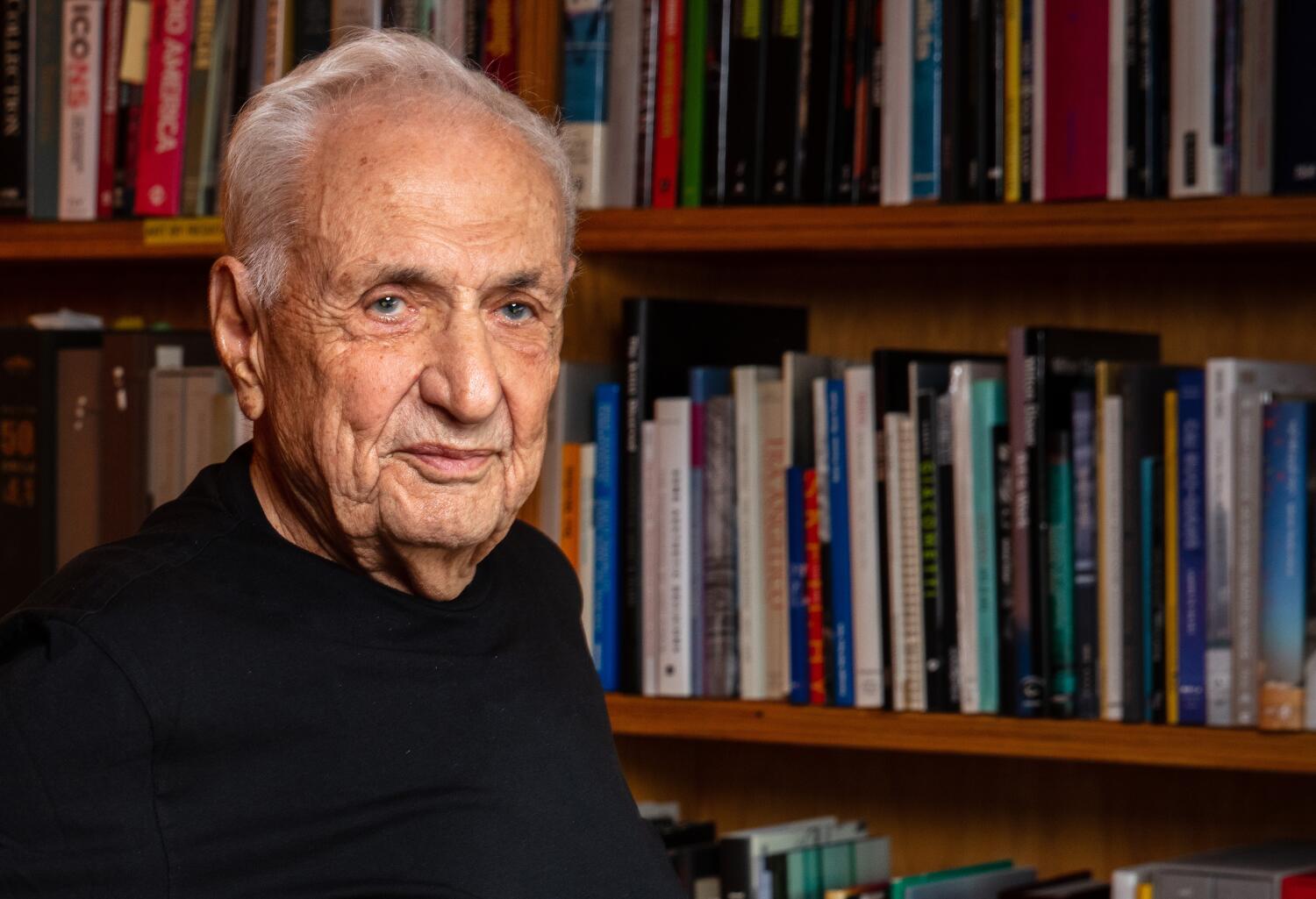
Frank Gehry, the man who forced titanium to behave like silk and transformed the skyline of Los Angeles from a sprawl of stucco boxes into a global center of high art, has died at 96. His passing marks the end of an era where architecture was treated as a tool for radical civic reinvention. While many will focus on the shimmering sails of the Walt Disney Concert Hall or the jagged edges of his early residential experiments, his true legacy lies in how he broke the bureaucratic stranglehold on urban design. He proved that a building could be both a functional piece of infrastructure and a defiant statement of human ego.
Gehry did not just build structures. He staged interventions. To understand his impact, one must look past the aesthetic "wow factor" and examine the industrial friction he created. He was a practitioner who thrived on the tension between the impossible shapes in his mind and the rigid limitations of construction software.
The Architecture of Controlled Chaos
Before Gehry, Los Angeles was a city defined by its anonymity. It was a place where "good enough" was the standard for commercial and residential development. Gehry saw this mediocrity as an invitation. His early work, specifically his own 1978 Santa Monica residence, was an act of architectural vandalism. By wrapping a traditional Dutch Colonial house in chain-link fence, corrugated metal, and plywood, he signaled a total rejection of the "clean" lines of Modernism.
It was ugly to some. It was a revelation to others. This wasn't just a design choice; it was a socio-economic critique. He used the "junk" materials of the industrial yard to build a sanctuary, challenging the notion that prestige required marble and glass. This period of his career was defined by a gritty, tactile reality that later evolved into the fluid, computer-aided designs that would make him a household name.
The transition from the raw materials of Santa Monica to the refined surfaces of the Guggenheim Museum Bilbao was facilitated by something most critics overlook: the aerospace industry. Gehry’s team pioneered the use of CATIA, a French software used to design fighter jets. Without this technology, the complex curves of his later work would have been structurally unsound or financially impossible to build. He didn't just change how buildings looked; he changed how they were engineered, shifting the entire industry toward digital fabrication.
The Guggenheim Effect and the Weight of Expectation
In 1997, the opening of the Guggenheim Museum Bilbao created a phenomenon that urban planners have spent decades trying to replicate. The "Bilbao Effect" describes the idea that a single, spectacular piece of architecture can revive the economy of a dying industrial city. It worked for Bilbao, turning a struggling port town into a tourist destination overnight.
However, this success created a trap for Gehry and the cities that hired him later. Every municipality wanted their own "Guggenheim." They wanted the titanium, the curves, and the instant prestige. This led to a period where Gehry’s style risked becoming a brand rather than a response to the site. We saw this with the Experience Music Project in Seattle, a building that even some of his most ardent fans found bloated and discordant with its surroundings.
The reality is that Gehry was at his best when he was fighting against something. When he was given an unlimited budget and a mandate to "be Gehry," the results could feel self-indulgent. But when he was navigating the tight constraints of a project like the Walt Disney Concert Hall, his genius was undeniable. That building sat in limbo for years, nearly killed by budget overruns and political infighting. When it finally opened in 2003, it didn't just provide Los Angeles with a world-class acoustic space; it gave the city a soul.
The Physics of the Fold
To achieve the "sailing" effect of his most famous buildings, Gehry relied on a specific understanding of geometric displacement.
- Non-Euclidean Surfaces: He moved away from the grid, favoring surfaces that curved in multiple directions simultaneously.
- Structural Redundancy: His buildings often feature a hidden internal skeleton of steel that bears the load, allowing the outer skin to hang like a curtain.
- Materiality: The choice of titanium for Bilbao wasn't just for show. The metal reacts to the specific gray light of the Basque Country, changing color based on the weather.
These weren't just decorative flourishes. They were calculated risks. Critics often complained that his buildings leaked or were difficult to maintain. While some of these criticisms were grounded in reality—most notably the glare issues with the Disney Hall’s polished steel—they missed the larger point. Innovation on this scale rarely comes without a period of adjustment. You cannot invent a new language of construction and expect it to be flawless on day one.
A Career Built on Refusal
One of the most defining moments of Gehry’s later life came during a 2014 press conference in Oviedo, Spain. When asked by a reporter if his architecture was "showy," Gehry famously gave the middle finger and stayed silent for a long moment. He later apologized, citing jet lag, but the gesture was authentic. He was tired of being treated as a decorator.
He viewed himself as an artist who happened to use buildings as his medium. He was deeply influenced by the Los Angeles art scene of the 1960s and 70s—figures like Ed Kienholz and Larry Bell. From them, he learned that art should be provocative and that materials should be pushed to their breaking point.
This pugnaciousness served him well in a profession that often rewards the polite and the predictable. He was a "starchitect" before the term existed, yet he frequently expressed disdain for the label. He understood that the cult of personality could overshadow the actual labor of the craft. Behind every one of his "scribbles" was a team of hundreds of architects and engineers working to solve the mathematical puzzles he set for them.
The Problem of the Monument
In the final decade of his life, Gehry turned his attention back to the infrastructure of Los Angeles, specifically the revitalization of the L.A. River. This was a departure from the "monument" architecture of his middle years. Instead of a single building, he was tasked with reimagining a concrete scar that runs through the heart of the city.
This project remains one of his most controversial. Critics argued that a high-design architect was the wrong person for an environmental and social justice issue. They feared "Gehry-fication"—the displacement of low-income residents in favor of high-priced parks and developments. Gehry’s response was characteristically blunt: he believed that beauty and high-quality design were not the exclusive domains of the wealthy. He wanted to bring the same level of architectural rigor to a public water project that he brought to a museum.
Whether he succeeded in that mission is still being debated, and the project will likely take decades to complete. But it shows a man who, even in his 90s, was unwilling to rest on his laurels or retreat into a comfortable retirement of designing luxury condos for billionaires.
The Shadow He Leaves Behind
What happens to the architectural landscape now that its most disruptive force is gone? We are currently seeing a shift away from the "extravagant" style that Gehry championed. The new generation of architects is focused on sustainability, carbon footprints, and adaptive reuse. To some of them, Gehry’s vast use of steel and titanium feels like a relic of a less environmentally conscious age.
But to dismiss him as a stylist is a mistake. Gehry’s real contribution was the democratization of the "strange." He made it acceptable for a public building to look like something other than a box. He broke the monopoly of the right angle. Every time you see a modern skyscraper with a slight twist, or a community center that uses unconventional materials, you are seeing a ripple of Gehry’s influence.
He was a man of contradictions: a populist who built elite institutions; a digital pioneer who started every design with a crumpled piece of paper; and a Canadian immigrant who became the definitive voice of Californian architecture. He didn't just change the skyline. He changed what we are willing to accept from our surroundings.
Gehry’s death leaves a void that won't be filled by another "starchitect." The era of the lone genius dictating the shape of a city is likely over, replaced by collaborative firms and algorithmic design. Yet, the physical evidence of his defiance remains. These buildings stand as monuments to the idea that the human spirit cannot be contained by four walls and a roof. They are loud, they are expensive, and they are occasionally inconvenient. But they are also vibrantly, undeniably alive.
The next time you stand beneath the towering, reflective curves of one of his creations, don't just look at the metal. Look at the way the building forces you to move, to crane your neck, and to wonder how it stays standing at all. That disorientation was his gift to us. He took the static world of architecture and made it move.