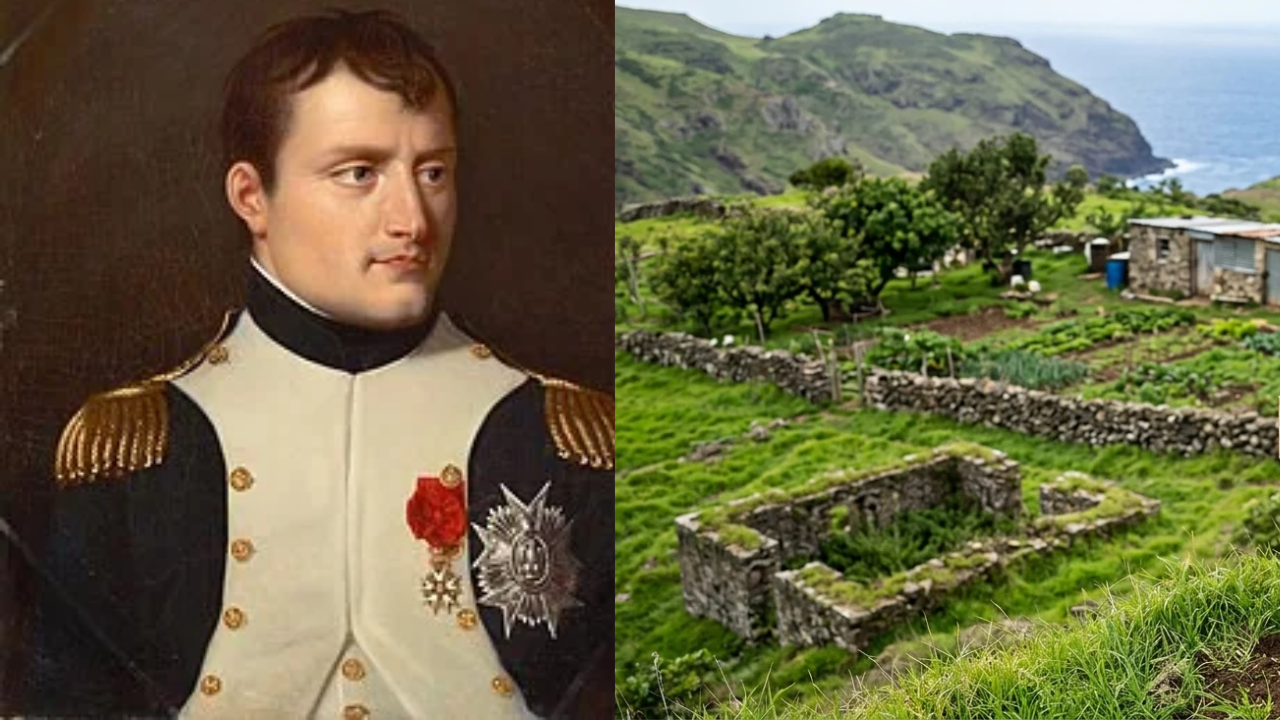
Fifteen years.
Think about how much dirt can settle into a threshold in fifteen years. Think about how a fence post leans, how salt wind erodes a stone lintel, how an empire that once drew borders from Moscow to Cadiz shrinks down to a damp pasture where cattle breathe steam into cold morning air.
When a story arrives with a headline as spare as a man claiming Crown land linked to Napoleon Bonaparte's former dairy after fifteen years, it is easy to treat it like a quirky legal footnote. A bit of empire dust. A bit of property law trivia.
Wait.
Look closer at what is actually colliding in that claim. You have a fallen emperor's vanished domestic orbit, a piece of Crown land held in public trust, and a neighbor or occupant who has spent fifteen years treating a piece of earth as their own through the old, stubborn doctrine of adverse possession.
I have walked enough old stone walls and disputed boundary lines to know that land disputes rarely start as grand philosophical battles. They start with a gate left unlatched. They start with a neighbor clearing brambles so the drainage does not flood a cellar, or mowing a strip of grass because nobody from the capital has come out to cut it since before the last prime minister took office.
Let us be completely clear about what we know and what is speculative here. The headline itself points to a real-world tension familiar across common-law jurisdictions: a long-term occupant asserting a claim over Crown land with historical ties to Napoleon's exile orbit—most famously Longwood on Saint Helena, where the deposed French emperor lived under British guard from 1815 until his death in 1821, and where outbuildings, gardens, and agricultural plots surrounded the estate. Because the competitor reference does not provide a full case dossier or named parties, any specific names, exact parcel dimensions, or court rulings would be guesswork. Where I introduce characters or walk through how a fifteen-year claim unfolds on the ground, I will tell you plainly that those are illustrative examples built to show how the law and the soil meet.
The Ghost of Longwood in a Patch of Grass
Napoleon loved order, maps, and scale. He had a habit of moving armies across continents with calipers and courier networks, yet at the end of his life on a windswept South Atlantic rock—or in the stories that radiate outward from the places where his household once provisioned itself—the grand architecture of power came down to mundane survival. Milk. Butter. Shelter from damp Atlantic mist. A roof that did not leak.
Historians know that during Napoleon's exile at Longwood House on Saint Helena, the surrounding grounds and outbuildings carried immense symbolic weight even when the physical structures were modest or decaying. A dairy sounds humdrum until you picture what it meant on an isolated island or in an imperial outpost: fresh food in a place where supplies arrived by ship when weather and politics allowed, a small pocket of domestic routine inside a gilded cage.
Now fast-forward across generations. Empires rise, fracture, get rebranded, and get filed away in registries. Crown land—land owned by the sovereign or the state on behalf of the public—is supposed to be permanent. That is the comforting story on paper, anyway. The Crown does not die. The Crown does not forget where its fences are.
Except offices turn over. Surveys get dusty. Budgets shrink. A parcel tied to an old dairy or an outbuilding sits quiet for a decade, then another, until the people who actually wake up beside it know every rut in the track better than any clerk in a distant ministry.
How Fifteen Years Turns Habit Into a Legal Sword
Why fifteen years? That number is not poetic coincidence. In many common-law systems—such as England and Wales for unregistered land, or certain jurisdictions where statutory limitation periods run for twelve to fifteen years—time is the quiet engine behind adverse possession, often called squatter's rights in plain speech.
Let me put it in plain terms, because legal jargon has a way of making simple human behavior sound like a heist.
Suppose I have a hypothetical neighbor, let us call him Arthur, living beside an overgrown strip of ground once attached to an old dairy. For fifteen years, Arthur mends the dry-stone wall when winter gales topple it. He keeps livestock off the rotten foundation stones so nobody breaks a leg. He plants hardy shrubs that hold the bank against erosion. Nobody stops him. Nobody posts a notice. Nobody shows up with a clipboard saying, Excuse me, that bramble belongs to the Crown.
Under classic adverse possession principles, a claimant generally has to show something close to continuous, open, and exclusive control—acting like the true owner rather than asking permission—for the statutory clock to run out. When private land is involved, the paper owner who sleeps on their rights for years can lose the ability to evict the occupant.
Here is the twist that makes a Crown land claim so sharp: Crown land is often protected by special rules. In many jurisdictions, adverse possession against the Crown requires a much longer period—sometimes thirty or sixty years—or is barred altogether for certain categories of public or royal land, depending on the statute and whether the land is registered. That asymmetry is where drama lives. A man who has poured fifteen years of sweat into a corner of historic ground may feel in his bones that the land is his, only to discover that the law measures time differently when the sovereign sits on the other side of the ledger.
You can see why people get tangled up in this. It is confusing. Even lawyers argue for months over whether an act counts as "taking possession" or merely "tidying up," whether a gate being shut was meant to keep intruders out or keep sheep in, and whether an old historical link to Napoleon's dairy changes how the public values the parcel today.
I will admit something honest here: watching someone fight for fifteen years over a piece of ground makes you feel two things at once. You feel the pull of human labor—the blisters, the winter mornings, the quiet pride of tending something nobody else bothered to touch. And you also feel the ache of losing a piece of shared history if a historic site slips into private hands without oversight.
Two Ways to Read the Same Stone Wall
When a story like this breaks, people pick sides fast. Usually too fast.
One side looks at the claimant and sees opportunism. Someone spotted an unguarded parcel with a neat historical hook—Napoleon! A dairy!—and decided to ride fifteen years of quiet occupancy all the way to a land title. Critics of loose adverse possession rules argue that letting time erase title rewards neglect by landholders and invites boundary gamesmanship.
The other side looks at the Crown—or whatever public authority let the land sit neglected—and asks a harder question. Where were you for fifteen years? If a patch of ground matters so much to the state or to historical heritage, why did nobody maintain the boundary, check the condition of the old dairy site, or notice that someone else was treating it as home?
Consider what happens next when a claim like this reaches a hearing or a registrar's desk:
- A surveyor pulls out old maps where lines were drawn with ink that has faded to brown.
- A historian points out what that old dairy once meant to the people who worked it or lived beside it.
- A legal official checks the exact statutory clock—fifteen years versus thirty or sixty, registered versus unregistered, private right versus Crown immunity.
Notice how the human story and the legal test do not always line up. In everyday life, ownership feels emotional and tactile. You know a place by the way rain smells on its stone and the way the wind comes off the ridge. In law, ownership is a bundle of rules, dates, notices, and exceptions.
If we use a metaphor here, think of a title deed as a ledger and fifteen years of care as a footpath worn into turf. A ledger can sit shut in a drawer for decades without losing a single word. A footpath only exists because someone walked it again and again until the grass gave way to earth. A dispute over a fifteen-year claim is really an argument over which one gets the final say when the ledger and the footpath cross.
Why an Old Dairy Still Matters Today
Why should anyone outside that parish or island care about a fifteen-year claim on land tied to Napoleon's former dairy?
Because we are living through a quiet reckoning with who owns the past and who maintains the present.
Across the world, public agencies and heritage estates are stretched thin. Historic outbuildings, old farmsteads, marginal pastures, and forgotten edge-land sit in a gray zone between "too historic to sell off casually" and "too expensive to actively patrol every week." When institutions pull back, ordinary people step into the vacuum—sometimes to care for the land, sometimes to farm it, sometimes to claim it.
And there is something magnetic about Napoleon attached to something so small. We remember him through grand canvases: horses rearing in mountain passes, eagles on standards, crowns placed on heads. A dairy pulls him down to earth. It reminds us that even the most famous man of his era depended on ordinary labor and fragile supply lines, and that two centuries later, his name can still show up in a modern argument over a fence line.
What makes a story like this linger is not a neat verdict. It is the image of a man standing at the edge of an old pasture after fifteen years, holding up the seasons he gave to the ground against a history older than his grandfather.
Rain on cold stone. A gate creaking in the wind. A boundary line that was never quite as straight as it looked on the map.


