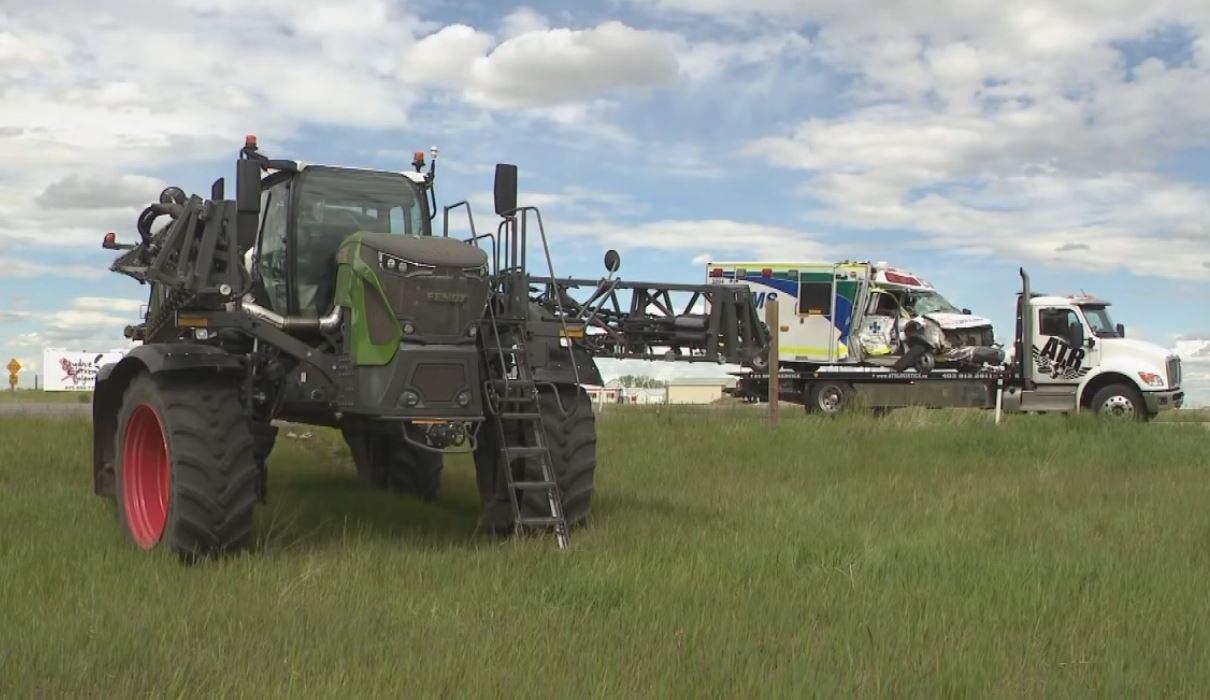
The media follows a predictable, lazy script every time a heavy farm vehicle collides with a commuter car or an emergency vehicle on a secondary highway. They report the location, tally the injuries, praise the helicopter crews who flew in to save the day, and treat the event like an unpredictable act of God.
They are looking at the wrong end of the problem.
When a STARS air ambulance lands north of Calgary to airlift a patient after a collision involving a tractor and an ambulance, the system has already experienced a catastrophic failure. The narrative focuses on the heroism of the medical airlift—the dramatic, high-tech response to rural trauma. We celebrate the speed of the helicopter, the skill of the flight paramedics, and the gold-standard care of trauma centers.
This hyper-fixation on the brilliance of our reactive emergency response blinds us to a brutal reality. We are treating a structural infrastructure disease with an incredibly expensive, microscopic band-aid. The real crisis isn't how fast we can fly someone to a Calgary trauma center; it is why our rural transportation networks routinely mix slow-moving heavy machinery with high-speed traffic on roads that were never designed to handle both safely.
The Rural Transport Paradox
We have built a lethal paradox into the heart of rural infrastructure. Rural roads serve two completely incompatible economic imperatives.
On one hand, these routes are high-speed logistical corridors for commuters, commercial trucking, and emergency services trying to shave minutes off a transit time. On the other hand, they are the primary moving lanes for industrial agricultural equipment.
Imagine a scenario where a modern tractor weighing 20 tons and moving at 30 kilometers per hour shares a two-lane undivided highway with an ambulance traveling at 110 kilometers per hour under emergency conditions. The differential in speed creates a massive, volatile closing velocity. This isn't an accidental collision; it is a mathematical certainty.
The standard industry response to this friction is to lecture farmers about visibility and warn drivers to be patient. That is a cheap cop-out. It shifts the blame from systemic design failures onto individual human behavior.
The underlying mechanics of rural road design—narrow shoulders, blind crests, and a lack of dedicated agricultural bypass lanes—actively create these points of impact. We are running industrial operations on asphalt networks designed for 1950s traffic volumes.
The Financial Illusion of Reactive Care
I have spent years analyzing capital allocation in public infrastructure and emergency networks. The money we pour into reactive, high-altitude trauma care is astronomical compared to the pennies we spend on proactive civil engineering for rural highways.
A single medical helicopter flight costs thousands of dollars per hour in fuel, maintenance, and elite staffing, not to mention the multi-million dollar acquisition cost of the aircraft itself. We fund these operations through a mix of government subsidies and emotional charity drives because the image of a helicopter landing on a closed highway stirs the soul.
It is an economic illusion.
- High Maintenance Costs: Air ambulances require continuous capital injection to maintain readiness, regardless of how many patients they transport.
- Marginal Outcomes: Airlifts only change the survival outcome in a narrow band of clinical scenarios where time is the absolute deciding factor.
- Zero Prevention: A helicopter flight does exactly nothing to prevent the next vehicle from tearing under the chassis of a combine harvester on the exact same stretch of road.
If we redirected a fraction of the capital used to maintain this reactive fleet toward widening key agricultural corridors, constructing paved shoulders, and mandating separate right-of-ways for heavy farm equipment, we wouldn't need to fly the helicopter nearly as often. But prevention is boring. Widening a shoulder doesn't make for a dramatic evening news segment.
Dismantling the Myth of Golden Hour Magic
For decades, the emergency medical community has operated under the dogma of the "Golden Hour"—the idea that a trauma patient needs to reach a definitive surgical suite within 60 minutes to survive. This concept has been used to justify the exponential expansion of expensive air ambulance networks worldwide.
Recent trauma registry data has begun to pull back the curtain on this myth. For many blunt-force trauma victims, particularly those involved in high-velocity impacts with industrial machinery, the survival curve is determined at the moment of impact, not during the flight.
The hard truth is that if the infrastructure causes a catastrophic deceleration injury, the patient often dies on the scene or suffers irreversible damage before the blades even start spinning. Air ambulances do not solve the problem of severe trauma; they merely shift the location where a patient passes away or enters long-term intensive care.
The downside to admitting this is obvious: it forces us to acknowledge that our current rural safety strategy is built on a foundation of false security. It means admitting that living or working in rural zones carries an inherent, unmitigated risk that no amount of high-tech flight gear can fully eliminate.
The Actionable Blueprint for Real Rural Safety
If we actually want to stop collecting bodies from agricultural corridors, we have to tear up the current playbook. We must stop treating rural roads as generic secondary highways and start treating them like the heavy industrial zones they are.
First, municipal and provincial transport authorities must mandate structural segregation. High-volume rural corridors require wide, gravel or paved field-access lanes running parallel to the main highway, specifically reserved for vehicles moving under 40 kilometers per hour.
Second, we need to completely overhaul how we route emergency vehicles through rural territory. Sending a lights-and-siren emergency vehicle down a narrow, two-lane undivided highway flanked by farms during seeding or harvest season is an unacceptable operational risk. Dispatch algorithms must account for seasonal agricultural density, favoring slightly longer but structurally separated dual-carriageway routes over dangerous shortcuts.
Stop looking at the helicopter in the sky. Look at the asphalt beneath the tires.


