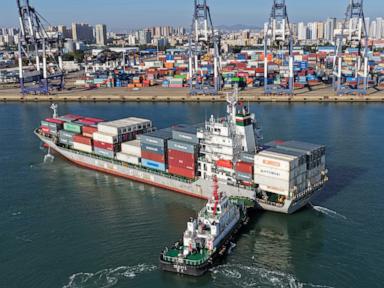
At three o'clock in the morning in a port city south of Shanghai, the cranes do not sleep. They swing over containers stacked like painted dominoes, hoisting electric vehicles, solar modules, and sleek consumer electronics onto vessels bound for Rotterdam, Los Angeles, and Jakarta. Floodlights hum against the coastal mist. Steel meets steel with a dull, practiced thud. From the ledger sheets of economists tracking headline growth, this rhythm looks like triumph. Ships leave full. Order books bulge. Growth ticks upward.
Then dawn breaks over a quiet apartment complex twenty miles inland. For a closer look into similar topics, we recommend: this related article.
A retired schoolteacher opens her refrigerator. Inside sit two cartons of milk, a bag of greens, and leftovers from a modest dinner. Her savings, once tied up in a neighborhood property project whose completion date keeps slipping further into the future, feel less like a cushion and more like frozen water. When her grandson asks for new sneakers for gym class, she pauses for three seconds longer than she used to. Not because she cannot afford them today, but because every yuan spent feels like one less shield against an uncertain tomorrow.
Two economies. One country. For further details on this issue, extensive analysis can be read at Financial Times.
That split—a roaring engine of outbound goods paired with a cautious, penny-pinching home front—sits at the center of China's economic story. Standard market dispatches call it an export-driven acceleration alongside persistent domestic weakness. Words like growth, trade surplus, and soft consumption get tossed across trading desks like poker chips. Yet numbers alone rarely tell you what it feels like to stand in a showroom with no buyers, or to watch a factory line run at full tilt while local shops sit half-empty on a Saturday night.
I have spent years watching supply chains bend, snap, and rebuild themselves across East Asia, and I will admit something candidly: even seasoned analysts get tripped up by this paradox. You look at export volumes surging and assume the whole machine is humming. Sometimes, though, a runner sprints with one strong leg and a bruised ankle. The pace looks fast from the bleachers. Up close, you see the wince.
A Tale of Two Rooms
To make sense of this tug-of-war, picture a large family house—a metaphor I am using intentionally to map macroeconomic forces onto everyday choices. In the front room, guests are arriving constantly. Orders pour in from overseas buyers hunting for competitive pricing, rapid delivery, and mature manufacturing ecosystems. That is the export engine. In the back room, the family sits around a table that feels slightly too large, hesitating before ordering extra dishes. That is domestic consumption.
Now let us introduce a hypothetical character to ground this in daily life—not a real person, just a composite sketch built from patterns repeated across countless industrial towns. Call her Lin Wei, a thirty-four-year-old logistics coordinator in Ningbo.
Lin Wei's days are ruled by shipping schedules and customs manifests. Her company moves precision components and finished goods to international ports with clockwork precision. Business is brisk. When foreign demand holds up—or surges ahead of tariff shifts and seasonal restocking—her phone lights up before sunrise. Overtime is available. Bonuses depend on volume. From her desk overlooking a busy freight corridor, the economy feels relentless, fast, and outward-looking.
Yet when Lin Wei leaves work and stops by a shopping mall on her way home, the mood shifts. Cafes offer two-for-one deals that barely draw a crowd. Apparel stores mark down spring inventory before the season even peaks. A friend of hers who bought a pre-sale apartment three years ago spends evenings checking construction updates on her phone, worrying less about appreciation and more about whether the keys will actually be handed over on time.
Why does someone working in a booming export hub still hold back at the checkout counter?
Fear. Plain and simple.
When households feel their primary store of wealth—often real estate—has lost its sheen, or when job security in certain white-collar and service sectors feels shaky, people save more. Precaution replaces impulse. Even if exports push headline gross domestic product higher in a given quarter, a household that feels financially squeezed does not suddenly start splurging on vacations, dining out, or big-ticket appliances because container ships are leaving the harbor.
Why Export Muscle Cannot Carry Everything Alone
Exports are a powerful fuel. Nobody in global commerce doubts the sheer scale and speed of Chinese manufacturing. When a factory can source raw materials down the road, reconfigure tooling in days rather than months, and ship at scale, foreign buyers notice. That competitiveness has kept trade surpluses elevated and helped cushion periods when domestic demand stumbled.
Still. Leaning too heavily on foreign buyers comes with strings attached.
First, external demand is outside Beijing's direct control. A shift in Western consumer spending, a tightening credit cycle abroad, or a sudden wave of tariffs and trade restrictions can cool overseas orders fast. When your growth engine relies heavily on what shoppers in Frankfurt, Chicago, or São Paulo decide to buy next quarter, you are riding waves generated far from your own shoreline.
Second, exports often come with razor-thin margins when price competition heats up. Selling more units abroad is not the same thing as lifting household incomes at home. If factories cut prices to win international orders, profits can get squeezed even as physical shipment volumes climb.
Third, there is a deeper structural question that economists debate endlessly: can an economy of more than 1.4 billion people rely indefinitely on the rest of the world to absorb its surplus production?
History offers a sobering mirror. Across decades, fast-growing Asian economies—from postwar Japan to South Korea and Taiwan—used export-led industrialization as a launchpad. Exports brought in foreign currency, technology, and industrial scale. Eventually, though, every one of those economies had to pivot toward stronger domestic consumption to sustain mature, balanced growth. Making that handoff smoothly is notoriously tricky. It requires households to trust the future enough to spend, and it requires income growth and social safety nets that make saving every extra coin less urgent.
When people ask how China can accelerate on exports while domestic weakness lingers, they are really asking two questions disguised as one. How does the country keep its factories competitive globally? And how does it convince its own citizens to open their wallets without feeling reckless?
The Shadow of Property and Caution
To understand the domestic drag, you have to look at balance sheets, not just paychecks.
For years, residential real estate was the centerpiece of household wealth across urban China. Buying an apartment was not merely finding a place to live; it was a rite of passage, a retirement plan, and a bet on steady appreciation. Developers borrowed heavily to build at breakneck speed, and families stretched to buy early.
When that property boom cooled and shifted into a prolonged adjustment, the shockwaves traveled far beyond brick and mortar. Local governments that relied heavily on land sales felt the pinch. Developers faced cash crunches and delayed projects. Homeowners saw paper gains stall or shrink.
Imagine building a sandcastle near the tide line—another metaphor, this one to illustrate how sentiment shifts. For twenty years, the tide stayed low, and the castle grew taller every summer. Then the water crept higher. Even after the waves receded, nobody built quite as close to the edge again.
That lingering caution shapes behavior everywhere. Families pay down mortgages early instead of investing in new ventures. Young graduates weigh stability over risk, favoring secure roles or sticking to modest budgets. Retailers notice the difference immediately: big-ticket items like cars and home renovations face stiff headwinds or depend heavily on trade-in subsidies and price cuts to move inventory.
Meanwhile, exports keep marching forward. Green tech, electric vehicles, batteries, machinery, and consumer goods find buyers across emerging markets as well as traditional ones. That contrast creates headlines that sound almost contradictory: strong trade numbers alongside sluggish retail sales and soft property indicators.
It is confusing. Even contradictory at first glance.
A country can simultaneously be the world's indispensable workshop and a place where shoppers walk past display windows with their hands in their pockets. In fact, that is precisely what happens when supply runs ahead of domestic confidence.
What Happens When Two Speeds Collide
Running at two speeds creates friction.
Consider another hypothetical scene—a small electrical parts supplier in Guangdong, run by a founder we can call Chen Ming. Ming has spent fifteen years building relationships with overseas distributors. Lately, foreign inquiries have picked up, giving his plant steady work. Yet domestically, orders from local builders and regional wholesalers remain patchy.
Chen Ming wants to expand, yet he hesitates before hiring dozens of new full-time staff or taking on heavy debt. Why? Because the signals around him are mixed. Global demand looks lively today, but trade friction can flare up overnight, and domestic buyers are still bargaining hard. Caution becomes a habit.
Multiply Chen Ming by millions of business owners and households, and you see why policy makers face a delicate balancing act. Support measures—whether interest rate adjustments, targeted credit, or consumer trade-in programs—can take time to thaw deep-seated caution. You can make borrowing cheaper or offer a discount on a new washing machine, yet a family still decides whether the timing feels safe for their own budget.
At the same time, leaning on exports to carry the weight has limits of its own. Trading partners push back when import surges threaten local industries. Supply chains diversify as companies adopt "China plus one" strategies, routing assembly or sourcing across Southeast Asia, Mexico, or Eastern Europe. Even when China remains central to global manufacturing—often supplying the core components even when final assembly happens elsewhere—the geopolitical weather stays choppy.
Let's pause and ask a question many readers quietly wonder about: does export strength fix domestic weakness automatically?
Not necessarily. Export growth can keep factories busy, support employment in trade-linked sectors, and generate trade surpluses. It does not automatically erase real estate anxiety or turn cautious savers into confident spenders overnight. Those two engines are connected through the broader economy, yet they respond to different pressures and move on different clocks.
Reading Between the Lines of Economic News
The next time a headline announces that exports beat expectations while domestic demand stays sluggish, resist the urge to see a simple win or a simple collapse. Reality is messier—and much more human—than a single data point.
Look beneath the surface. Ask who benefits from the export surge and who feels left behind by domestic softness. Notice the difference between factories shipping containers at full capacity and local shops discounting coffee to get people through the door. Pay attention to confidence, because confidence is the invisible currency that decides whether money circulates or sits still.
In the end, an economy is not a spreadsheet. It is millions of quiet decisions made at kitchen tables, loading docks, factory lines, and checkout counters.
Outside that coastal port in the early morning dark, another cargo ship slips away from the berth, lights reflecting off black water as it heads toward open sea, while miles away an alarm clock rings in a quiet apartment and another day of careful choices begins.