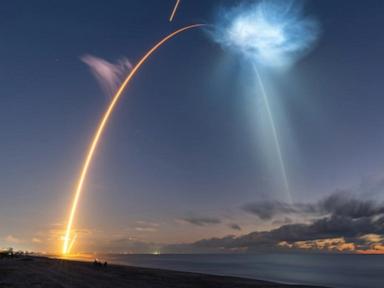
It isn't a cloud. It isn't a jellyfish. And it doesn't mean the rocket broke.
Every time a SpaceX Falcon 9 lifts off before sunrise or just after sunset, social feeds explode with the same breathless headline: a glowing "jellyfish" cloud floating over the coast. Clickbait outlets treat it like a freak weather event or a mysterious anomaly. People scroll past, snap a blurry phone picture, and walk away believing they just watched a rocket puff a giant translucent sea creature into the atmosphere.
Lazy reporting loves a neat visual metaphor. A bright point at the top, trailing tendrils below, glowing against a dark sky. Done. Ship the story.
That lazy consensus misses almost everything interesting happening up there. The "jellyfish cloud" is not a cloud in the meteorological sense. There are no liquid water droplets or ice crystals condensing around dust particles the way a cumulus cloud forms in the troposphere. What people call a cloud is actually an expanding exhaust plume from the rocket's engines. What they call tentacles are turbulent gas streams and shock structures spreading outward where atmospheric pressure drops off a cliff.
And the glowing effect? That comes from geometry and sunlight, not magic. At ground level, you are standing in shadow. Before sunrise or after sunset, the sun sits below your horizon, so your streetlamp, your car hood, and the launch pad itself are in darkness. A rocket climbing into the upper atmosphere reaches altitudes where the sun is already up—or still shining—even while the ground below stays dark. Sunlight hits that high-altitude exhaust plume and scatters toward observers on the ground, turning invisible-to-ordinary-eyes gases into a bright, ghostly beacon.
Watching a SpaceX launch spawn a jellyfish cloud in the sky before sunrise is one of the coolest sights in modern aerospace. Calling it a jellyfish cloud is still a terrible way to understand what you are actually looking at.
The Lazy Consensus Around Pre-Dawn Plumes
Competitor articles covering a SpaceX launch before sunrise almost always follow the same script. They embed a dramatic video clip. They quote a surprised bystander or a local news anchor. They call it a rare or eerie sight. Then they move on to the next viral clip.
Three sloppy assumptions sit inside that standard narrative.
First, readers get the impression that the shape is a solid or semi-solid structure hanging in the sky like a balloon. In reality, you are watching gas expand at blistering speed into near-vacuum conditions. A rocket exhaust plume is dynamic, thinning, and constantly changing density as the vehicle climbs and atmospheric pressure plummets.
Second, outlets treat pre-dawn and post-dusk launches as if the rocket somehow creates a special "jellyfish mode" at twilight. The rocket behaves the same way during a midday launch. You just cannot see the wide, faint outer expansion of the plume as clearly against a bright blue sky flooded with scattered sunlight from every angle.
Third, headlines make the phenomenon sound like a weird side effect rather than a direct consequence of orbital mechanics and fluid dynamics. If you want to get to orbit, you have to climb fast and high, pushing massive amounts of hot propellant mass out the back of nine Merlin engines (on a Falcon 9 first stage) and then a vacuum-optimized Merlin engine on the second stage. The glowing plume is simply what that thrust looks like when caught by angled sunlight against a dark backdrop.
I have spent years working around aerospace communications, launch coverage, and public science outreach, and I have watched media teams and startups blow real credibility—and serious money—trying to ride viral sky phenomena without bothering to get the physics right. When you hype a visual gimmick and get the underlying mechanics wrong, anyone who actually knows rocketry tunes you out immediately. Worse, when a real anomaly happens later—a weird venting pattern, a stage separation issue, an off-nominal burn—an audience trained on "spooky sky jellyfish" has no mental baseline for what normal looks like.
What Is Actually Happening in That Sky
To understand the twilight phenomenon, you have to separate what the rocket is doing from how light hits the exhaust and how your eyes perceive contrast.
1. Pressure Drops, and Gas Explodes Outward
Near sea level, surrounding air pressure squeezes a rocket's exhaust jet tightly after it leaves the engine nozzle. As the Falcon 9 climbs through the upper atmosphere, ambient air pressure drops dramatically. Without heavy surrounding air pressing inward on the plume, the hot exhaust gases expand rapidly outward and backward.
Instead of a narrow, tightly bundled flame streak, the plume fans out into a wide, bell-like or umbrella-like envelope. Turbulences, shear layers, and uneven expansion patterns create streaks and filaments that human pattern-recognition brains immediately map onto familiar shapes—like a jellyfish trailing tentacles behind a bell.
2. The Twilight Geometry Trick
Think about how a projector works in a brightly lit room versus a dark room. On a bright afternoon, sunlight scatters across the entire sky, washing out faint light coming from a high-altitude plume.
During nautical or astronomical twilight—before sunrise or after sunset—the lower atmosphere where you stand is in Earth's shadow. The sky overhead and near the horizon is dark or deep indigo. Meanwhile, a rocket climbing to tens or hundreds of kilometers in altitude crosses the shadow boundary into direct sunlight.
Sunlight illuminates the expanding exhaust gases and particles high above. Because the surrounding sky is dark, that scattered light pops with dramatic contrast. The plume looks huge and luminous not because it suddenly became denser, but because the background got dark while the light source stayed bright.
3. Why "Cloud" Is the Wrong Word
Meteorologists define clouds around condensation and precipitation processes in Earth's atmosphere. Rocket exhaust is a combustion and expansion product—hot gases, unburned or partially burned hydrocarbons, water vapor from combustion, and fine particulates depending on propellant and engine conditions—moving at high velocities and rapidly dispersing.
Calling every glowing plume a cloud blurs the line between atmospheric weather and aerospace propulsion. When a real weather cloud forms, air cools to saturation and condenses around condensation nuclei. When a Falcon 9 climbs before dawn, you are watching high-speed exhaust expand into thin air while catching grazing sunlight. Those are two completely different physical regimes.
Why People Ask the Wrong Questions About These Launches
Whenever a SpaceX launch spawns a jellyfish cloud in the sky before sunrise, search bars fill up with predictable questions. Most of them start from a shaky premise.
"Is the jellyfish cloud dangerous or toxic?"
Wrong question to start with. The better question is: How much material is in that plume at high altitude, how fast does it disperse, and how does it compare to what's happening near the ground?
By the time a launch vehicle creates a wide, dramatic twilight plume high up, it is already high in the atmosphere over the ocean or well downrange along its flight path, and the gas is expanding over a massive volume. Ground-level air quality impacts around a launch are governed by local boundary-layer dispersion, wind conditions, and pad/low-altitude emissions—not a glowing high-altitude expansion structure miles up and spreading thin. Worrying about a "toxic jellyfish cloud" floating down on your neighborhood confuses a visual light-and-gas effect high above with a ground-level smog plume.
"Why does SpaceX's jellyfish cloud look bigger than other rockets?"
Cadence and visibility skew perception. SpaceX launches frequently—often multiple times a week across different corridors—so audiences see these plumes repeatedly and associate the visual closely with Falcon 9. Any large orbital rocket climbing into sunlight during twilight can produce a dramatic expanding plume effect under the right trajectory and lighting geometry. The physics belongs to high-altitude gas expansion and solar illumination, not a proprietary "SpaceX jellyfish" feature.
"Does a bigger jellyfish cloud mean a more powerful rocket?"
Not necessarily. A massive-looking plume at twilight depends heavily on altitude, sun angle, viewer location, and atmospheric/lighting contrast—not just raw thrust. A rocket with modest thrust at the right altitude and sun angle can look visually sweeping from hundreds of miles away, while a powerful launch in midday sun or poor viewing geometry can look like a routine streak or barely show a wide plume at all.
Imagine a scenario where two identical rockets launch along similar trajectories: Rocket A lifts off 45 minutes before local sunrise under clear skies for an observer 250 miles downrange; Rocket B lifts off at noon under partly cloudy skies for the same observer. Rocket A's exhaust plume catches direct high-altitude sunlight against a dark sky and looks like a sprawling celestial jellyfish. Rocket B is doing essentially the same propulsion job, yet looks ordinary to the naked eye. Treating visual drama as a direct meter of engine power is a classic observer trap.
What Heavy Hitters and Real Physics Tell Us
Anyone serious about aerospace and atmospheric optics looks at trajectory geometry, propellant chemistry, plume expansion, and solar illumination angles rather than viral nicknames.
In rocket propulsion and flight mechanics—the territory of engineers and orbital analysts like Elon Musk and SpaceX's propulsion teams, alongside spaceflight historians and aerospace educators such as Scott Manley and Tim Dodd—a launch is evaluated by impulse, staging, payload mass to orbit, and flight profile, not how photogenic the exhaust looks against a twilight sky. On the atmospheric and optical side, solar elevation angle, shadow height in the atmosphere, and light scattering govern why objects high up glow while the ground remains dark.
Even my contrarian pushback comes with trade-offs. Being pedantic about "plume vs. cloud" or "twilight geometry vs. jellyfish" can kill the sense of wonder if you over-lecture people who just looked up and saw something unforgettable. Nobody wants a physics pop quiz when they are standing in their driveway watching a glowing shape bloom across the predawn sky.
There is also a real risk of over-correcting into dry jargon. If you replace a fun nickname with stiff engineering talk and lose the reader, you haven't helped them understand anything—you just bored them. The sweet spot is keeping the awe while fixing the mental model.
How to Actually Watch and Read a Pre-Dawn Launch
If you want to stop falling for shallow coverage and get real value out of watching a SpaceX launch spawn a jellyfish cloud in the sky before sunrise, change how you prepare and what you look for.
- Check the solar timing, not just the launch time. Look up sunrise time at the launch site and at your own viewing location. The most dramatic illuminated plumes happen when the rocket climbs into sunlight while the lower sky and ground remain dark.
- Watch the transition, not just the peak shape. Pay attention to how the exhaust shifts as altitude increases and ambient pressure drops. You can literally see the plume open up as the vehicle climbs into thinner air.
- Track stage events. Watch for main engine cutoff (MECO), first- and second-stage separation, and second-stage ignition. Changes in thrust and plume geometry around staging tell you far more about the mission than a catchy nickname ever will.
- Ignore breathless "mystery" headlines. When a post calls a twilight plume a strange cloud or an unexplained phenomenon without mentioning altitude, sunlight angle, or exhaust expansion, treat it as entertainment rather than science reporting.
- Compare notes from multiple angles. A plume that looks like a neat jellyfish from one vantage point can look stretched, lopsided, or wispy from another depending on line of sight and distance.
Next time a pre-dawn launch lights up the sky, enjoy the view—and know the difference between a cloud and a rocket burning its way to space.


