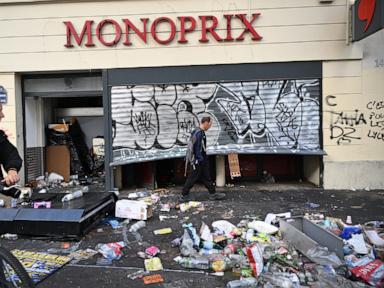
The standard wire-service playbook on French unrest writes itself. Count the arrests. Tally the burned cars and damaged city halls. Quote the interior ministry promising an "uncompromising" response, balance it with a line from opposition politicians blaming social inequality, and slap a headline on it about France's worst rioting in years.
That framing is lazy. Worse, it gets the mechanics backward.
When people look at scenes of street clashes, looted storefronts, curfews, and tens of thousands of officers deployed across major cities, they assume they are watching a single uprising spiral out of control. Look closer at recent waves of unrest—from the gilets jaunes peak to the urban explosions of 2023 and the street clashes and strikes of autumn 2026—and a very different picture emerges. You are not looking at one unified movement. You are watching distinct groups with incompatible motives collide inside a brittle institutional machine.
The Lazy Consensus Around Street Chaos
Conventional reporting treats a riot like a single wave: grievance builds, a spark hits, the crowd boils over, and the state pushes back. Neat. Dramatic. Mostly wrong.
Policing researcher Sebastian Roché of Sciences Po Grenoble has pointed out a critical distinction that wire summaries routinely blur: ideological street fighters and opportunistic looters do not act from the same script or aim at the same targets. Small, militant factions—estimated by French intelligence services at roughly 3,000 people across loose networks—go after political and commercial symbols such as banks, government offices, and multinational chains. Meanwhile, predatory crews and street looters go after portable goods—electronics, sportswear, cash—where the motive is acquisitive rather than ideological.
Lumping peaceful students marching over cramped classrooms, union members striking over wages and pensions, militant agitators throwing projectiles, and smash-and-grab crews into one bucket makes great television. It also guarantees terrible policy. When the state treats every crowd as an existential insurrection, it uses blunt instruments that radicalize the middle while failing to deter the opportunists.
Stop Asking Why France Riots So Often
Search engines fill up with the same tired questions whenever smoke rises over Paris, Lyon, or Marseille: Why does France have so many riots? Why can't the police keep order? Is the French social model failing?
Those questions are built on a flawed premise. France does not have a monopoly on economic pain, housing strain, or youth frustration. What makes French flashpoints so volatile is the collision between hyper-centralized state control and fragmented urban and political realities.
Think about how France governs. Power is heavily concentrated at the top in Paris, yet local friction plays out in specific neighborhoods, school districts, and municipal streets. When tension builds over living costs, school conditions, or policing tactics, grievances quickly nationalize into a direct showdown with the presidency and the interior ministry. Every local spark becomes a referendum on the regime.
That centralization cuts both ways. Over the years, I have watched security agencies and public institutions pour massive resources into reactive containment—more patrols, sharper rhetoric, emergency decrees, and tighter protest restrictions—while leaving underlying coordination gaps intact. Heavy-handed crowd-control munitions carry a steep political and human cost, including severe injuries to bystanders and young demonstrators that turn tactical policing into a grievance of its own.
The Institutional Traps Hiding Behind the Headlines
To understand why these episodes keep recurring, you have to look past the nightly arrest tallies and examine the structural traps documented by urban sociologists and policing scholars like Loïc Wacquant and Roché.
1. Housing and Urban Lock-In
Many outer-ring housing estates (grands ensembles) were built during post-war expansion with massive scale and limited everyday integration with surrounding neighborhoods. As urban researchers studying municipalities like Aubervilliers and Saint-Ouen have shown, tearing down and rebuilding large estates is extraordinarily expensive, while managing them piecemeal often locks in social isolation and administrative friction between housing bodies, town halls, and national authorities.
2. The Policing Paradox
French riot policing is famous for mass deployment and force projection, yet officers on the ground frequently face a brutal contradiction: they are asked to project overwhelming state authority in volatile spaces where local trust is near zero. When less-lethal kinetic weapons cause permanent injuries—eyes lost, hands shattered—the state hands agitators a moral weapon that outlasts any curfew. Conversely, when forces pull back or get bogged down in dense street fighting, critics cry that the state has abdicated.
3. Political Polarization as Oxygen
Every major wave of unrest becomes raw material for rival political camps. Hardliners demand blanket bans, curfews, and zero tolerance. Opponents accuse the government of authoritarian overreach or ignoring working-class strain. Both sides get what they need for their next campaign clip, while practical fixes—better de-escalation, targeted criminal enforcement against looters, and genuine local accountability—get drowned out by slogans.
A Thought Experiment: What If Paris De-Escalated the Theater?
Imagine a scenario where the interior ministry stopped treating every nationwide day of action as an all-or-nothing test of state virility. Instead of blanket bans that sweep up peaceful marchers alongside troublemakers, authorities protect marching routes for unions and students while running focused, intelligence-led operations specifically against arsonists, weapon carriers, and commercial looters.
What happens? First, peaceful protesters aren't herded into the same tear-gas clouds as violent fringe actors. Second, public sympathy stops bleeding toward the streets when a teenager gets maimed by a riot munition. Third, prosecutors and specialized units can focus on actual property crimes and violence rather than processing thousands of sweeping detention sweeps that clog courts without solving root disorders.
Where This Contrarian Take Can Backfire
Let's be honest about the downside of splitting the riot narrative into neat categories. If you over-index on separating peaceful protesters from violent agitators and looters, you risk underestimating how fast crowds mix in chaotic urban streets. In real time, a peaceful march can be hijacked within minutes by fast-moving black-bloc or street crews, putting ordinary marchers and shopkeepers in harm's way.
There is also a real risk in dismissing every hardline security measure as pure theater. When public buildings are torched, police are attacked with fireworks and petrol bombs, and entire commercial strips are ransacked, citizens expect immediate physical protection—not a seminar on urban sociology. A smart strategy pairs disciplined, non-maiming crowd control with swift, surgical law enforcement against violent offenders.
What Actually Works Instead
If you want fewer fires in French streets rather than louder press conferences, start with three unglamorous moves:
- Separate crowd management from criminal hunting. Stop using blunt perimeter bans that turn ordinary citizens into collateral damage. Keep peaceful assembly predictable, and deploy specialized units strictly against arson, assault, and organized looting.
- Audit use-of-force tools ruthlessly. Any policing tactic that routinely inflicts life-altering injuries during civil unrest destroys legitimacy faster than it restores order. Discipline and precision beat spectacle every time.
- Fix local bottlenecks before they nationalize. Address school overcrowding, transit bottlenecks, housing maintenance, and neighborhood policing friction at the local level before a single spark turns into a national crisis.
When the smoke clears, the real story in France isn't a mysterious national addiction to chaos. It's a high-pressure system whose safety valves keep sticking.



