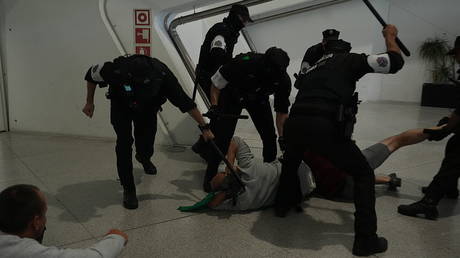
A chaotic scene just exploded at Bilbao Airport. Basque regional police, known as the Ertzaintza, ended up swinging batons, pinning people to the ground, and arresting four individuals. The internet is already flooded with short, context-free clips of the violence. Predictably, partisan commentators are using the footage to fuel their own pre-existing narratives.
If you look past the immediate shock value of the video, you'll find a massive diplomatic headache that connects Madrid, Jerusalem, and a highly controversial humanitarian mission. This isn't just a local policing issue. It's a geopolitical mess that caught the Spanish government completely off guard.
What Actually Happened at Bilbao Airport
Let's strip away the spin and look at the timeline. Six activists from the Global Sumud Flotilla had just landed in northern Spain on a flight from Turkey. These individuals were part of a larger international effort involving around 400 activists trying to break Israel's naval blockade of Gaza. Their ships were intercepted in international waters by Israeli forces, and the participants were subsequently deported.
When the Basque delegation walked into the arrivals hall around 2 PM on Saturday, a crowd of supporters and journalists was waiting for them. The atmosphere was already charged. The activists had delayed their return by a day because two team members required hospitalization for injuries allegedly sustained while in Israeli custody.
The spark that lit the fuse was remarkably mundane. As the activists posed for cameras, a relative or supporter tried to cross a security cordon to embrace one of the returning campaigners. A police officer forcefully blocked him. Within seconds, a scuffle broke out, tension boiled over, and the arrivals terminal turned into a battleground.
Videos show officers using batons against the crowd and dragging people across the terminal floor. According to activist Diana Zomeno, the police response was brutal. She publicly claimed that officers pinned down a campaigner who was already suffering from a broken shoulder blade. The Ertzaintza released a statement confirming that four people were arrested for serious disobedience, resisting arrest, and assaulting law enforcement officers.
The Hypocrisy of the Diplomatic Fallout
The real story isn't just the scuffle itself. It's the swift, almost cynical way international governments weaponized the footage.
Just days before this airport brawl, Spain and Israel were locked in a fierce diplomatic argument. Israel's National Security Minister, Itamar Ben-Gvir, had released a highly controversial video showing detained flotilla activists forced to kneel on the floor with their hands bound. Spanish Foreign Minister Jose Manuel Albares rightly condemned that footage, calling the treatment of the volunteers monstrous and inhumane. Spain even summoned Israel’s chargé d'affaires to lodge a formal protest.
Then Bilbao happened.
Israel's Foreign Ministry didn't waste a second. They immediately shared the video of Spanish police striking the pro-Palestinian activists, accompanied by a pointed caption: "We demand an explanation from the Spanish government regarding its treatment of the flotilla anarchists." In subsequent posts, Israeli officials claimed these activists bring provocation and chaos everywhere they go, essentially telling Spain, see, they are your problem now.
This rapid-fire blame game highlights a deeper truth about modern political conflicts. Nobody actually cares about airport security procedures or the nuances of crowd control. Both sides simply grabbed the nearest piece of video evidence to score points in an ongoing diplomatic feud.
A Deep Political Rift Inside Spain
The violence at Bilbao Airport also exposed massive fractures within Spain’s own political landscape. Prime Minister Pedro Sanchez has been one of Europe's most vocal critics of Israel's military campaign in Gaza, even using the term genocide to describe the situation. But while the national government talks a big game on international solidarity, domestic reality is much messier.
Look at how differently two Spanish airports handled the arriving activists on the exact same day:
- Bilbao Airport: The Basque regional police intervened heavily, leading to a riotous brawl, four arrests, and an immediate internal affairs investigation into whether officers broke operational protocols. Left-wing parties like EH Bildu and Podemos immediately slammed the police behavior as intolerable and unjustified.
- Barcelona-El Prat Airport: Around 20 other flotilla activists landed to a completely different reception. A crowd of 200 supporters waved Palestinian flags without incident. More importantly, Spanish Culture Minister Ernest Urtasun and European Parliament member Jaume Asens were right there on the tarmac to welcome them home and express explicit solidarity.
This contrast is glaring. You have a national cabinet minister welcoming activists as heroes in Barcelona, while regional police are beating those same activists' teammates with batons a few hundred miles away in Bilbao. It shows a complete lack of state coordination and proves that the Gaza issue is a domestic political landmine for Spain.
The Basque Security Department has opened an internal investigation to determine if its officers used excessive force. Meanwhile, left-wing politicians are demanding that Basque Security Minister Bingen Zupiria appear before parliament to answer for the crackdown.
The Reality of the Global Sumud Flotilla
To understand why the emotions are running so high, you have to look at what happened at sea. The Global Sumud Flotilla wasn't a minor protest; it was a coordinated convoy of 50 vessels carrying 428 people from 44 different countries, including 44 Spanish nationals. They set sail from Marmaris, Turkey, with the explicit goal of delivering humanitarian aid to Gaza and challenging a blockade that has been in place since 2007.
When Israel intercepted the convoy in international waters, the situation became tense. While Turkey managed to safely evacuate over 420 volunteers, many activists spent days in Israeli custody enduring what they described as harsh, violent detentions. By the time these people landed in Bilbao, they weren't just tired travelers—they were traumatized, angry, and highly defensive.
When you mix highly stressed activists with an anxious crowd, a delicate political environment, and rigid airport security protocols, a spark is almost guaranteed to cause an explosion.
Moving Beyond the Video Clips
If you want to understand these events, stop looking at isolated social media clips. The Bilbao airport clash wasn't an isolated incident of police brutality, nor was it a case of lawless anarchists looking for a fight. It was the predictable collision of international trauma and domestic political dysfunction.
For ordinary citizens and observers trying to make sense of this mess, the next steps don't involve picking a side on a ten-second video clip. Instead, keep a close eye on these three developing areas:
- Monitor the Ertzaintza internal investigation: Watch whether the Basque regional government actually holds its officers accountable for the use of batons inside a crowded terminal, or if the inquiry is quietly swept under the rug.
- Watch the parliamentary fallout: Follow the upcoming legislative sessions in the Basque parliament. The tension between the mainstream regional authorities and left-wing parties like EH Bildu over this incident will likely alter local political alliances.
- Track the diplomatic theater: See if Madrid offers a formal response to Israel's demands for an explanation, or if Prime Minister Sanchez chooses to ignore the jab to avoid highlighting his government's internal contradictions.