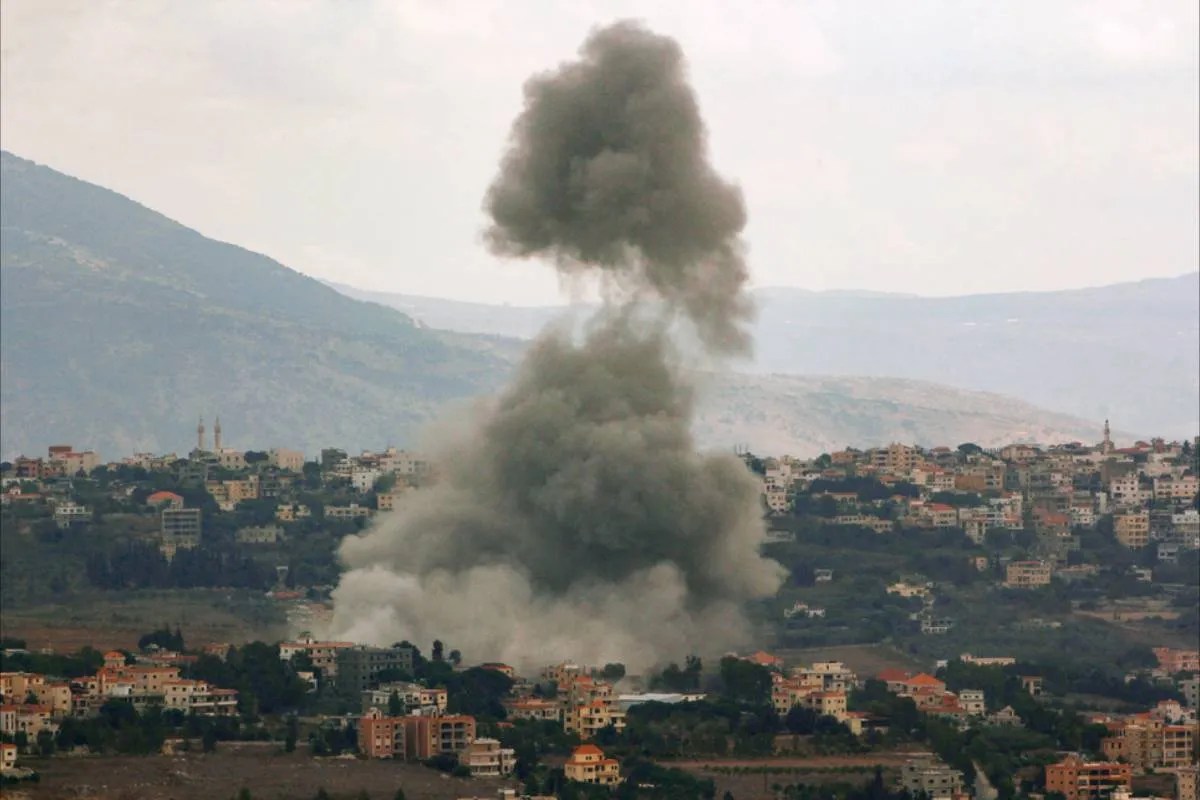
The Israeli Air Force recently intensified its campaign against Hezbollah targets in Lebanon, striking over 40 sites within a single 24-hour window. This surge in kinetic activity signals a shift from targeted containment to a broader strategy of systematic degradation. While headlines focus on the sheer volume of missiles launched, the real story lies in the calculated selection of targets and the message being sent to Beirut and Tehran. This is not just a reactive strike. It is an attempt to rewrite the rules of engagement on the northern border.
By hitting dozens of command centers and weapons caches in such a short burst, Israel is testing the threshold of regional conflict. The primary objective is to force a withdrawal of Hezbollah's elite forces from the border region, but the tactical reality on the ground suggests a more complex endgame. Every strike serves a dual purpose. First, it physically removes immediate threats like anti-tank missile squads. Second, it serves as a psychological lever designed to fracture the political resolve of the Lebanese government.
Precision over volume in the northern theater
The military logic behind hitting 40 targets in a day is grounded in the concept of "operational tempo." When a military increases the frequency of its strikes, it seeks to overwhelm the enemy's ability to repair, regroup, or respond. If you hit one site, the enemy learns. If you hit forty, they scramble.
These strikes were not random. Intelligence suggests the targets included specialized storage units for long-range projectiles and underground infrastructure that has been under construction for years. Military analysts observe that Israel is focusing on the "nerve endings" of the organization—the small, decentralized units that make the border area a permanent friction zone.
However, the cost of this precision is high. Each missile represents a massive financial investment and a diplomatic risk. As the strikes move deeper into Lebanese territory, the distinction between military infrastructure and civilian life becomes increasingly blurred. This is the friction point where tactical success can easily lead to strategic failure.
The intelligence gap and the drone war
Effective air campaigns rely on high-fidelity intelligence. In this specific surge, the role of unmanned aerial vehicles (UAVs) cannot be overstated. Israel has deployed a constant "eye in the sky" over southern Lebanon, using thermal imaging and signals intelligence to map out movements in real-time.
This surveillance creates a lethal feedback loop. A Hezbollah team moves a launcher; a drone spots it; a missile arrives minutes later. This cycle has forced Hezbollah to move further underground, literally and figuratively. They are now relying on hardened bunkers and courier-based communication to avoid the digital footprint that the Israeli Air Force tracks with predatory efficiency.
Yet, despite this technological edge, the "tunnel problem" remains unsolved. No amount of aerial bombardment can fully neutralize a subterranean network that spans kilometers. The 40 strikes may have leveled buildings and destroyed warehouses, but the core of the insurgency remains entrenched in the bedrock of the Lebanese hills.
The failure of traditional deterrence
For decades, the doctrine of "mutual assured destruction" kept the Israel-Lebanon border relatively quiet. Both sides knew that a full-scale war would be catastrophic. That equilibrium has shattered. We are now in a period of "competitive escalation" where each side feels compelled to match or exceed the other's violence to avoid looking weak.
Israel’s latest bombardment is a rejection of the old status quo. By hitting 40 targets in 24 hours, they are signaling that the old "red lines" no longer exist. They are willing to risk a wider war to ensure that the northern communities can return to their homes. This is a massive gamble.
Economic fallout for a fractured state
Lebanon is already a nation on the brink of total economic collapse. Its currency is nearly worthless, its central bank is paralyzed, and its infrastructure is crumbling. An intense air campaign, even one focused on military targets, acts as a hammer blow to what remains of the national psyche.
When missiles fall near major transit routes or power grids, the "collateral" is the economy itself. Investors flee, shipping insurance rates skyrocket, and the local population is pushed further into the arms of the very groups Israel is trying to weaken. This is the paradox of counter-terrorism. The more pressure you apply from the air, the more you risk creating a vacuum that only extremists can fill.
- Supply chain disruptions: Strikes near the southern ports slow the delivery of essential goods.
- Displacement costs: Each wave of bombing sends thousands of civilians fleeing north, straining the resources of a government that cannot even pay its own soldiers.
- Infrastructure decay: Vibrations and stray debris from nearby strikes accelerate the ruin of Lebanon’s aging electrical grid.
The Iranian shadow and the proxy calculation
It is impossible to analyze the 40 strikes without looking toward Tehran. Hezbollah is the crown jewel of Iran’s "Axis of Resistance." Every missile Israel fires is also a message to the Iranian Revolutionary Guard Corps. The message is simple: your forward operating base in Lebanon is no longer a safe haven.
Iran faces a difficult choice. If they allow Hezbollah to be degraded too far, they lose their primary deterrent against a direct strike on their nuclear facilities. If they encourage Hezbollah to retaliate with their full arsenal of 150,000 rockets, they risk a total war that could end in the destruction of their most valuable asset.
This is a high-stakes game of poker played with lives and regional stability. The Israeli strategy seems to be "boiling the frog"—increasing the heat slowly enough that Iran doesn't feel a sudden need to go all-in, but fast enough to fundamentally weaken Hezbollah’s capabilities.
The internal Israeli pressure cooker
Prime Minister Netanyahu’s government is under immense domestic pressure. Tens of thousands of Israelis are displaced from their northern homes, living in hotels and temporary housing for months. They are demanding a solution, and "targeted strikes" are the most visible way to show the public that the military is taking action.
Political survival often dictates military strategy. If the government cannot secure the north, it will collapse. This internal pressure creates an incentive for more aggressive, headline-grabbing operations like the 24-hour surge. The risk is that political necessity might override military caution, leading to a miscalculation that drags the entire region into the fire.
The limits of air power
History shows that air power alone rarely wins a war against a determined, decentralized insurgency. From Vietnam to Afghanistan, the ability to destroy targets from the sky has not always translated into political control on the ground. You can destroy 40 targets today, 40 tomorrow, and 40 the day after. But unless there is a diplomatic framework or a ground reality that changes the fundamental motivation of the enemy, the missiles are just a temporary fix.
The current strategy assumes that Hezbollah will eventually cry "enough." But what if they don't? What if the destruction only fuels their recruitment and hardens their resolve? This is the question that the military briefings often skip.
The humanitarian toll and the international response
As the footage of smoke rising from Lebanese villages spreads across social media, international pressure on Israel is mounting. Even its closest allies are beginning to question the long-term viability of this campaign. There is a growing gap between the military necessity of the strikes and the humanitarian standards the world expects.
The use of high-yield explosives in or near residential areas is a legal and ethical minefield. While Israel maintains that Hezbollah uses civilians as human shields—a claim backed by numerous intelligence reports—the burden of proof in the court of global public opinion often falls on the one pulling the trigger.
- Legal scrutiny: Human rights organizations are documenting every strike for potential war crimes investigations.
- Diplomatic isolation: Continued escalation risks alienating regional partners like Jordan and Egypt who are essential for any future peace.
- Public perception: The "David vs. Goliath" narrative is shifting, with Israel increasingly portrayed as the latter in the digital sphere.
The technical evolution of the battlefield
The missiles fired in these strikes are a far cry from the "dumb bombs" of previous generations. We are seeing the deployment of autonomous loitering munitions and "bunker-buster" variants specifically designed for the Lebanese terrain. These weapons use a combination of GPS, laser guidance, and AI-driven image recognition to hit targets with surgical accuracy.
This technological sophistication is intended to minimize collateral damage, but it also lowers the "cost of entry" for military action. When a strike is seen as "clean" and "precise," it becomes easier for leaders to authorize it. This leads to a higher frequency of strikes, which in turn increases the overall risk of a catastrophic mistake.
Furthermore, Hezbollah has developed its own countermeasures. They have deployed electronic warfare suites designed to jam GPS signals and confuse the guidance systems of incoming missiles. This invisible war in the electromagnetic spectrum is just as intense as the physical bombing. A missile that misses its target by even 50 meters because of jamming can mean the difference between a successful strike and a civilian tragedy.
The inevitable move toward the ground
Many analysts believe that the surge in air strikes is merely a "shaping operation" for an eventual ground incursion. You soften the defenses, destroy the communications, and clear the path before sending in the tanks and infantry. If this is the case, the 40 strikes are just the opening act.
A ground war in Lebanon would be a nightmare for both sides. The terrain is a maze of valleys and ridges that favors the defender. Hezbollah has spent nearly two decades preparing for this exact scenario, planting IEDs, digging tunnels, and training for close-quarters combat. Israel knows this, which is why they are trying so hard to achieve their goals through air power alone.
The 40 missiles launched in 24 hours represent a desperate hope that a full-scale ground invasion can be avoided through overwhelming aerial force. It is a gamble that assumes the enemy is rational and can be deterred by loss. But in the Middle East, the logic of "honor" and "resistance" often overrides the logic of "loss" and "survival."
The smoke clearing over southern Lebanon provides no answers, only more questions about what happens when the targets run out but the war remains. The infrastructure of a militant group can be rebuilt; the trust of a displaced population and the stability of a region are much harder to restore. Israel has demonstrated it has the power to destroy. It has yet to demonstrate it has a plan for the day the bombing stops.