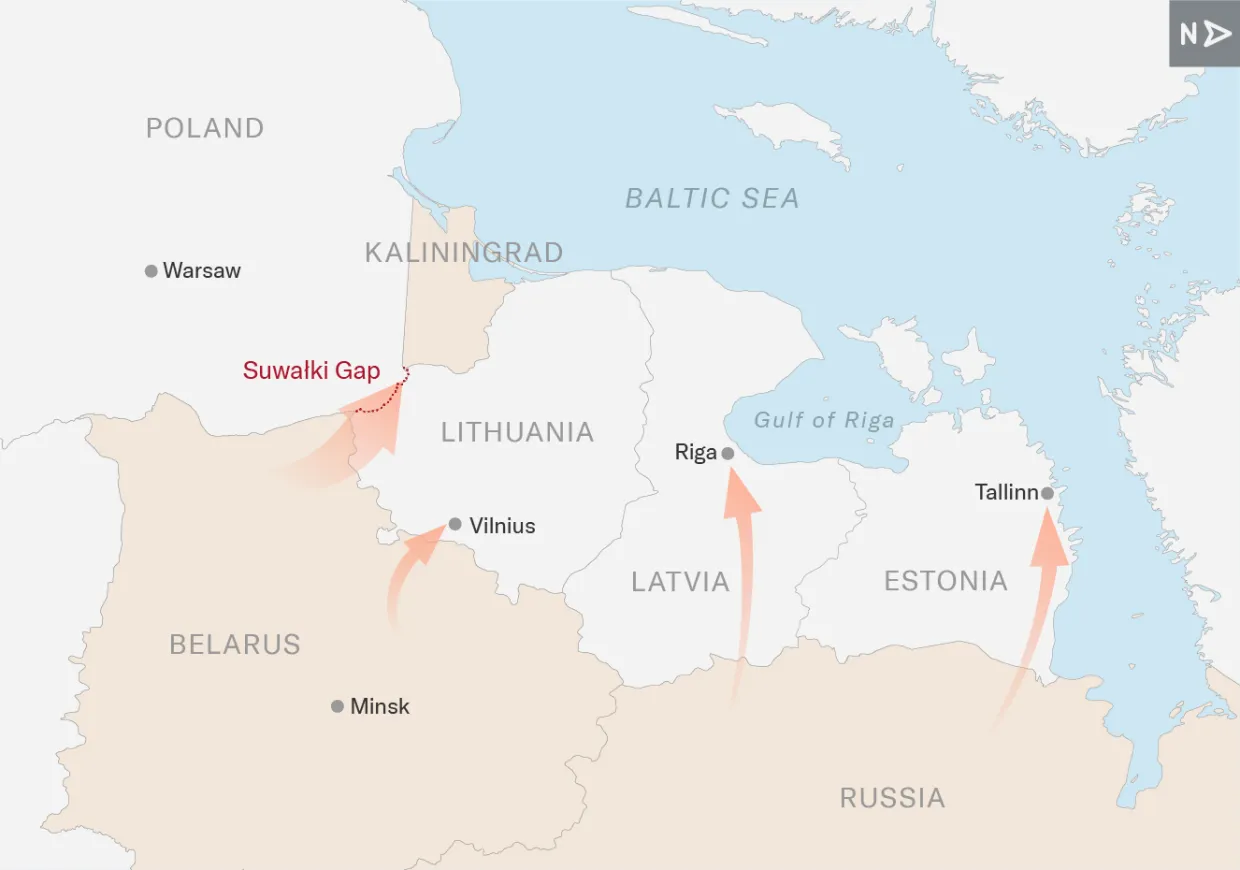
The interception and shootdown of an unidentified aerial vehicle entering Lithuanian airspace from Belarusian territory is not an isolated border violation. It represents a stress test of regional air defense architecture along the eastern flank of the Alliance. When NATO assets engage airborne targets crossing from a Russian-allied staging ground, the event exposes the operational friction between rapid defensive reaction and strategic deterrence escalation. Analyzing this incident requires stripping away the immediate operational panic to examine the mechanics of airspace sovereignty enforcement, vector analysis of low-altitude incursions, and the structural vulnerabilities inherent in defending narrow geographic bottlenecks.
The Mechanics of Cross-Border Airspace Violations
Airspace defense relies on continuous radar vectoring, identification friend or foe protocols, and rigid rules of engagement. When an unannounced vector crosses an international boundary, defense command structures must calculate three critical variables within seconds: kinetic threat potential, trajectory projection, and the geopolitical cost of kinetic interception versus diplomatic signaling. Discover more on a similar issue: this related article.
[Border Entry Point] --> [Radar Tracking & Vector Analysis]
                                  |
            +---------------------+---------------------+
            |                                           |
[Low-Threat Trajectory]                      [High-Threat / Intercept]
            |                                           |
[Diplomatic Protest / Scramble]             [Kinetic Engagement & Debris Vector]
The operational complexity multiplies exponentially when dealing with unmanned systems. Unlike crewed military aircraft, which transmit transponder data and adhere to predictable flight profiles, small drones exhibit high radar cross-section variability, erratic low-altitude flight paths, and ambiguous launch provenance. Whether the platform was a reconnaissance asset testing reaction times, a loitering munition off-course, or a deliberate probe to map radar illumination frequencies, the defensive response must treat the worst-case payload scenario as a baseline.
Strategic Geography of the Baltic Approaches
The geography of the Baltic theater imposes severe structural disadvantages on air defense commanders. The airspace is compressed, leaving minimal reaction time between border penetration and critical infrastructure or population centers. Additional journalism by NPR explores similar perspectives on the subject.
The Perimeter Defense Paradox
Defending a linear frontier requires persistent radar coverage at lower altitudes where terrain masking and ground clutter degrade sensor performance. Belarusian airspace acts as an operational sanctuary for launch platforms, creating an asymmetric defensive posture. While NATO interceptors must operate under strict legal and political constraints regarding cross-border tracking or retaliatory positioning, external actors can probe the periphery with low-cost assets to map reaction intervals.
- Sensor Horizon Limitations: Earth curvature and surface clutter reduce early warning times for low-flying, slow-speed aerial vehicles.
- Decision Latency: The time required to authorize kinetic engagement under multinational command structures often exceeds the flight duration of a tactical drone crossing a narrow national sector.
- Collateral Risk: Intercepting aerial targets over densely populated European borderlands introduces severe liability regarding falling debris and ground safety.
The Economics of Asymmetric Air Defense
A fundamental asymmetry governs modern border skirmishing: the cost curve of defense versus offense. Deploying fourth or fifth-generation fighter jets—such as Eurofighters or F-35s operating under Baltic Air Policing missions—to neutralize low-cost reconnaissance or decoy drones creates an unsustainable economic mismatch.
The marginal cost of a surface-to-air missile or an air-to-air missile is orders of magnitude higher than the manufacturing cost of a small tactical drone. When repeated across multiple incursions, this dynamic strains ordnance inventories and operational airframes. Consequently, military planners are forced to accelerate the integration of directed-energy weapons, mobile electronic warfare suites, and layered short-range air defense systems that match the cost profile of the threat vector.
Operational Friction in Multinational Command Structures
Integrating national air defense systems with integrated NATO command structures introduces operational latency. National sovereignty dictates that individual member states retain ultimate authority over their sovereign airspace, yet collective defense requires real-time data sharing and delegated authorities for time-critical intercepts.
When an object breaches a national boundary adjacent to a non-member state or an active adversary staging area, the chain of command must reconcile differing national risk tolerances. One nation may prioritize immediate kinetic neutralization to establish a deterrent baseline, while another may advocate for electronic jamming or shadowing to avoid accidental escalation. This divergence in tactical doctrine creates exploitable windows for external observers monitoring reaction functions.
Intelligence Implications of the Interception
Every engagement generates telemetry, electronic intelligence, and debris fields that offer high-value forensic insights. Analyzing the wreckage of an intercepted drone reveals microchip provenance, communication link frequencies, and navigation redundancy systems.
- Guidance Resilience: Determining whether the platform relied on standard commercial GPS or military-grade inertial navigation resistant to jamming.
- Payload Architecture: Identifying sensor suites, optical transmission equipment, or explosive configurations.
- Launch Signature: Correlating radar tracks with known ground-station positions inside neighboring territory to map mobile deployment nodes.
The successful neutralization of the drone denies the originating actor tactical intelligence while providing NATO analysts with empirical data regarding adversary capability thresholds. However, it also signals the precise engagement parameters of deployed air defense batteries, allowing opposing planners to refine future penetration profiles.
Force Posture Optimization and Threshold Management
To mitigate future incursions without triggering unwanted escalation spirals, defensive posture adjustments must focus on three operational shifts:
- Decentralized Authorization: Delegating tactical engagement authority to local air defense commanders to eliminate the latency of multinational political clearance loops.
- Sensor Density Enhancement: Deploying persistent aerostats and distributed passive radar networks to close low-altitude detection gaps along the frontier.
- Non-Kinetic Integration: Expanding the deployment of tactical electronic warfare systems capable of disrupting control links without expending high-value interceptor missiles.
The intersection of electronic reconnaissance, border sovereignty enforcement, and asymmetric cost structures dictates that low-altitude incursions will remain a persistent friction point. Establishing a predictable, automated, and economically sustainable response mechanism is the only viable method to neutralize the utility of aerial probes along the eastern frontier.


