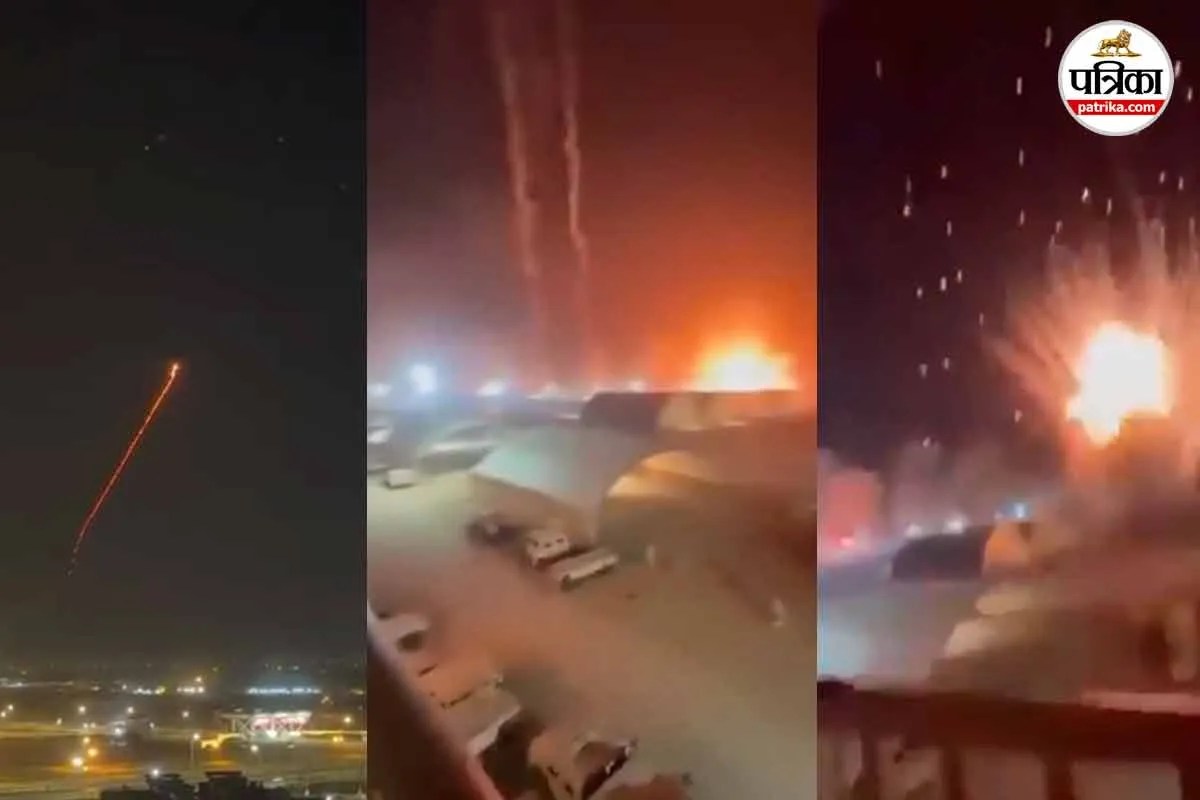
The Middle East security map just fractured. Tehran’s recent drone strikes targeting US military installations in Kuwait mark a dangerous shift in regional warfare, moving from localized proxy fights to direct state-backed confrontation. For years, Kuwait remained a relatively quiet logistics hub for American forces, insulated from the direct crossfire seen in Iraq or Syria. That insulation is gone. Iran's latest gamble proves that no Western military footprint in the Gulf is safe from its expanding drone arsenal, signaling a desperate move by Tehran to redraw the rules of engagement.
This is not a random act of aggression. It is a calculated message wrapped in explosive fiberglass.
The Myth of the Kuwaiti Safe Haven
For two decades, Kuwait served as the dependable backbone for US operations in the region. Bases like Camp Arifjan and Ali Al Salem Air Base were viewed as rear-guard sanctuaries. They handled logistics, troop rotations, and intelligence support away from the immediate danger zones of Baghdad or Damascus.
Iran just shattered that illusion. By deploying long-range one-way attack drones against these specific nodes, Tehran demonstrated that distance no longer guarantees security. The strikes target the very nervous system of US power projection in the Gulf. If Kuwait becomes a hot zone, the American logistical pipeline in the Middle East begins to choke.
Military planners have long warned about this vulnerability. While heavy air defense systems like the Patriot missile batteries protect high-value assets, they are frequently bypassed by low-flying, slow-moving drone swarms. These unmanned aerial vehicles operate in the radar blind spots, exploiting gaps in traditional air defense frameworks designed for ballistic missiles.
The Hardware of Proximity Warfare
The attacks rely heavily on Iran's Shahed-series loitering munitions. These are cheap assets. They use commercial-grade GPS components, lawnmower engines, and carbon-fiber bodies that mimic the radar cross-section of a large bird.
Building one costs Iran roughly twenty thousand dollars. Intercepting it requires a missile that costs up to three million dollars. The math is simple, brutal, and entirely in Tehran’s favor.
Iran Drone Cost: ~$20,000
US Interceptor Cost: ~$3,000,000+
This economic asymmetry is the driving force behind Iran's strategy. They do not need to win a conventional dogfight against Western aviation. They simply need to exhaust the supply lines of advanced air defense interceptors. By forcing the US and its allies to fire multimillion-dollar missiles at cheap plastic drones, Iran inflicts financial and material attrition without ever risking a pilot or a conventional warship.
Inside the Domestic Pressures Driving Tehran
To understand why Iran chose this moment to strike Kuwait, you have to look inside the regime's walls. The leadership in Tehran faces severe economic stagnation, currency devaluation, and persistent internal dissent. Historically, when the Iranian state feels threatened at home, it projects power abroad to unify its domestic base and project strength to its regional proxies.
The proxy network—stretching through Yemen, Iraq, Syria, and Lebanon—requires constant proof of Iranian capability. If Tehran appears weak or hesitant to strike back against Western pressure, its influence over these groups degrades. Targeting a US base in Kuwait is a high-profile demonstration of reach intended to reassure allies that Iran remains the dominant anti-Western force in the region.
The Intelligence Failure and Air Defense Gaps
Western intelligence clearly misjudged Iran's risk tolerance. The prevailing assumption was that Tehran would keep its operations confined to the Levant and the Red Sea shipping lanes. By expanding the target envelope to Kuwait, Iran caught regional defense networks off-guard.
Early warning radar systems in the Gulf are heavily oriented toward the north and east, anticipating threats directly across the waters of the Persian Gulf. Drones can be launched from southern Iraq or even from maritime platforms, taking circuitous routes that approach bases from unexpected vectors. This fluid geometry of drone warfare renders fixed defensive lines obsolete.
Furthermore, integrating electronic warfare countermeasures remains a chaotic process. Jamming a drone's GPS signal sounds simple in a briefing room. In reality, heavy jamming can disrupt local civilian communication infrastructure, commercial aviation, and friendly military networks. It is a double-edged sword that commanders are hesitant to wield without absolute certainty.
Regional Shockwaves and the Kuwaiti Dilemma
Kuwait now finds itself trapped in a geopolitical vice. The nation has traditionally maintained a delicate diplomatic balance, hosting thousands of American troops while keeping channels open with Iran to avoid conflict. These drone strikes effectively destroy that neutrality.
The Kuwaiti government faces intense pressure from two opposing sides. Washington demands greater freedom of action, better intelligence sharing, and the deployment of more aggressive defensive systems on Kuwaiti soil. Meanwhile, Tehran issues quiet warnings that further integration into Western military frameworks will only bring more strikes.
Other Gulf states are watching this play out with growing alarm. If Kuwait's defenses can be penetrated, then facilities in the UAE, Qatar, and Saudi Arabia are equally vulnerable. The collective security architecture of the Gulf Cooperation Council is built on the assumption of American protection, but that protection is looking increasingly expensive and technically strained.
The United States cannot easily walk away from these bases without conceding the region to Iranian influence. Yet staying requires a massive re-allocation of short-range air defense systems, electronic warfare units, and counter-drone technology that are currently needed in other global theaters. Washington must now decide whether to absorb these periodic asymmetric punches or launch a direct retaliatory strike on Iranian soil, an option that risks triggering the wider regional war everyone claims they want to avoid.