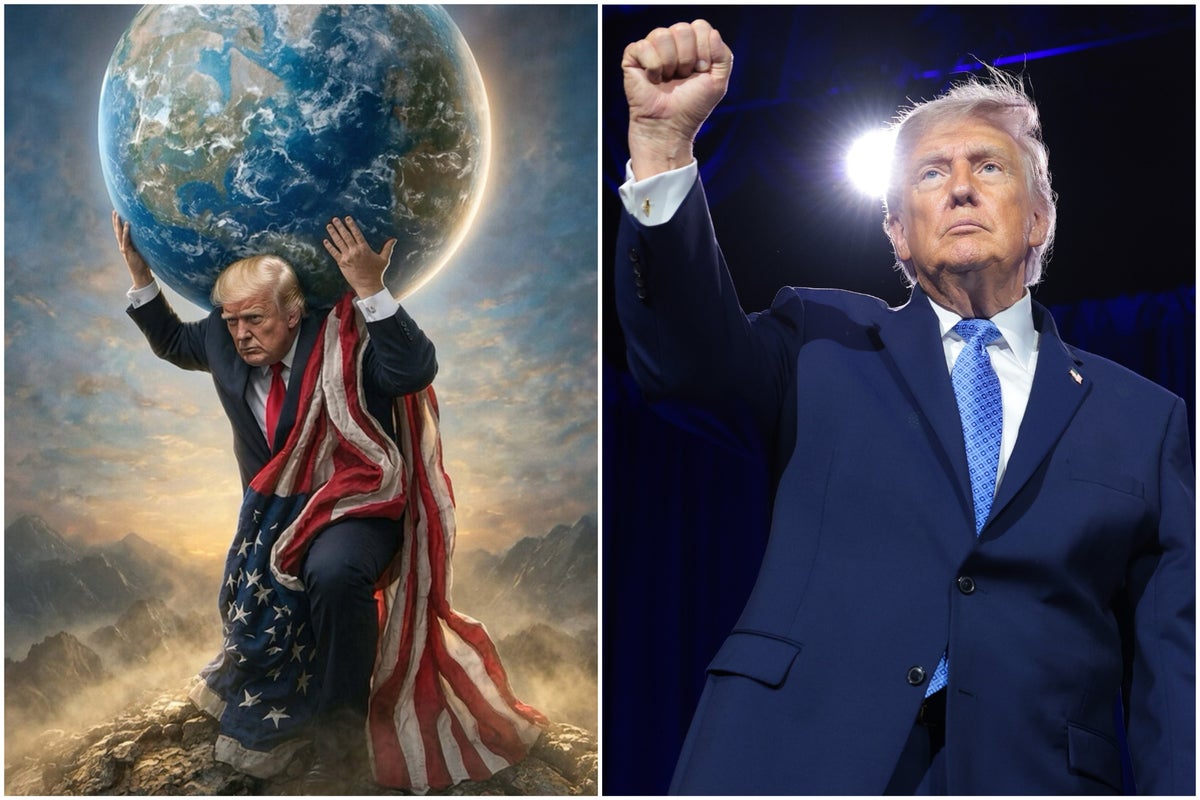
On a quiet Saturday morning, Donald Trump broadcasted a stark message to his followers on Truth Social without typing a single word. He uploaded a single, high-fidelity, synthetically generated image showing himself on one knee, draped in the American flag, hoisting the entire weight of the planet Earth upon his back. The iconography deliberately channeled the classical myth of Atlas, the titan condemned to carry the celestial weight for eternity. Coming less than twenty-four hours after American forces executed retaliatory airstrikes on drone infrastructure inside Iran following maritime aggression in the Strait of Hormuz, the message was unmistakable. The executive office was no longer just an administrative position. It was being framed as a cosmic, singular burden.
This development goes far beyond typical internet posturing. It offers a window into how geopolitical messaging, statecraft, and artificial intelligence have merged to reshape public perception. While mainstream commentators quickly dismissed the graphic as mere vanity, a closer examination reveals a calculated effort to institutionalize a new form of personalist authority. The imagery signals a shift from the traditional constitutional framework of a president operating as the head of a co-equal branch of government to a system where the leader is viewed as an indispensable, solitary axis around which global stability revolves.
The Subversion of Classical Mythology
To fully understand the weight of this digital campaign, one must examine the myth being co-opted. In the classical tradition, Atlas was not an idealized savior. He was a defeated rebel. His eternal labor was a punitive sentence handed down by Zeus after the Titans failed to overthrow the Olympian order. By casting himself in this specific mold, Trump implicitly turns the original myth on its head, converting an ancient symbol of divine punishment into an emblem of voluntary, heroic martyrdom.
The political utility of this symbol is obvious. It demands total fealty from supporters while disarming institutional critics. If a single leader is carrying the entire globe on his shoulders, any domestic political opposition, legislative gridlock, or judicial oversight can be framed as an active attempt to destabilize the world itself. The message creates a closed loop of logic. Policy failures are no longer structural shortcomings. They are merely proof that the burden is too heavy for anyone else to bear.
This is not the first time this strategy has appeared on Truth Social. Earlier, an image surfaced showing Trump in white clerical garments, with light radiating from his hands as he stood over a hospital bed to heal a patient. That particular imagery drew sharp criticism from orthodox religious groups who labeled it sacrilegious. The pivot to secular, classical mythology avoids the direct trap of religious heresy while retaining the exact same psychological appeal. It replaces theological divinity with historical and mythological inevitability.
Digital Combat and the Juxtaposition of Legitimacy
Minutes after uploading the Atlas graphic, the account published a second visual contrast. This was a side-by-side comparison featuring a pristine, black-and-white historical photograph of Trump at age twenty in his New York Military Academy uniform alongside a teenage Barack Obama holding a joint. The juxtaposition highlights the core mechanics of modern populist communication. It is a dual-track strategy based on absolute self-aggrandizement on one side and the aggressive degradation of institutional predecessors on the other.
Visual Chronology of Executive Self-Framing
-----------------------------------------------------------
Phase 1: The Clerical Healer  -> Claims divine benevolence
Phase 2: The Military Youth   -> Claims foundational discipline
Phase 3: The Sovereign Atlas  -> Claims ultimate global utility
-----------------------------------------------------------
By placing his military school background directly next to a youthful indiscretion of his predecessor, Trump establishes an explicit hierarchy of legitimacy. The uniform represents order, national sacrifice, and structural preparation. The cigarette represents counter-cultural drift, detachment, and weakness. This narrative bypasses decades of complex political history, reducing the vast ideological differences of the American presidency down to a simple battle of personal discipline and visual aesthetic.
Geopolitical Realism Through an Artificial Lens
The timing of these posts adds an entirely different layer of gravity to the situation. When American jets struck drone storage operations in Iran, the administration faced immediate, intense scrutiny from both international allies and domestic lawmakers. In previous eras, a president would address the nation from the Oval Office, surrounded by the physical symbols of constitutional office, reading a meticulously drafted script designed to project stability and international law.
Today, that traditional choreography has been replaced by synthetic media. The AI-generated Atlas does not answer questions about rules of engagement, long-term strategic goals, or potential civilian casualties. It provides something far more effective for the modern media eco-system. It provides an emotional shortcut.
By consuming the image of the president carrying the globe, the viewer is insulated from the messy, volatile realities of modern asymmetric warfare. The strike in Iran is no longer understood as a complex chess move within a fractured multilateral framework. Instead, it is digested as a necessary action by a solitary guardian protecting the planet from chaos.
The Rise of Post-Industrial Populism
This visual pivot reflects a deep transformation within conservative political theory. For decades, American conservatism was anchored by an intellectual movement that valued institutional checks, decentralized power, and a skepticism of imperial executives. The introduction of populist nationalism has fundamentally rewritten that script.
The modern political project relies heavily on the idea that the existing global order has completely failed the working class. It argues that globalist networks, free-trade agreements, and international bodies have hollowed out domestic industries while forcing ordinary citizens to finance endless foreign engagements. Within this framework, traditional institutions are no longer seen as protectors of liberty. They are viewed as corrupt mechanisms of a entrenched managerial class.
The Conceptual Shift in Executive Identity
+------------------------------------+------------------------------------+
| Traditional Constitutional Model    | Modern Personalist Model           |
+------------------------------------+------------------------------------+
| Power is leased by the office      | Power is inherent to the person    |
| Bound by institutional boundaries  | Boundless global responsibility    |
| Accountable to co-equal branches   | Accountable to the historical myth |
+------------------------------------+------------------------------------+
When the state is viewed as fundamentally broken, the only logical solution is the introduction of a singular, extraordinary figure who can bypass the bureaucracy entirely. The Atlas image is the perfect visual manifestation of this philosophy. It does not depict a functional government working to solve complex economic problems. It depicts a single individual bypassing the machinery of state to solve the problems through sheer force of will.
The Permanent Campaign in the Synthetic Era
The reliance on artificial intelligence to manufacture these images points to a structural shift in political communication. In past election cycles, political campaigns spent millions of dollars on photographers, lighting crews, and graphic designers to capture the perfect, authentic moment of leadership. Those days are gone.
Generative AI allows political actors to completely bypass the limitations of physical reality. If a leader wants to project an image of himself standing on a rocky peak amidst an atmospheric storm while balancing a planet, he no longer needs a physical stage or a real-world scenario. He needs an engineer and a prompt.
This creates an environment where political communication is completely untethered from observable facts. The danger here is not simply that the images are false. The danger is that they redefine the terms of political accountability. When reality can be generated on demand to match any preferred narrative, the ability of the public to evaluate a leader based on empirical performance begins to erode entirely.
The Loneliness of the Absolute Sovereign
There is an unintended consequence buried deep within the choice of the Atlas metaphor. In the original mythology, Atlas is completely alone. He has no allies, no advisors, and no community. His existence is defined entirely by isolation and unending, uncompensated labor.
By adopting this specific framing, the executive office is depicted as a place of profound, almost tragic isolation. This serves a dual political purpose. It explains away the frequent turnover of staff and the public breaks with former cabinet members. If the leader is the only one capable of holding up the world, then advisors, generals, and diplomats are inherently secondary, disposable figures who lack the capacity to share the burden.
Ultimately, this synthetic mythology creates a political reality where compromise becomes impossible. You cannot negotiate from the back of a titan. You cannot compromise when you believe you are preventing the entire sky from falling. The imagery warns the world that if this single figure steps aside, or if he is forced out of power by democratic or legal mechanisms, the entire global structure will come crashing down. The political stakes are deliberately elevated from an ordinary legislative debate to a continuous, existential crisis that can only be solved by permanent, uninterrupted authority.