Silence.
In the affluent diplomatic enclave of Dedinje, high on the green, tree-lined hills of Belgrade, the air on a late June morning usually carries nothing heavier than the hum of distant city traffic, the rustle of linden leaves, and the occasional crunch of tires on manicured gravel. It is a neighborhood designed for quiet authority, where embassies sit behind wrought-iron fences and high stone walls, insulated from the frantic pulse of the Serbian capital below.
Then came the bolt.
Not a bullet. A steel-tipped crossbow bolt, fired from inside a paper bag, slicing through the humid Balkan morning and burying itself straight into the neck of a man standing inside a glass-and-steel guardhouse.
Most news reports reduce the June 29, 2024 attack outside the Israeli Embassy in Belgrade to a cold, mechanical sequence of events. A lone assailant approaches a security post. He fires a crossbow. The wounded officer draws his service weapon and shoots the attacker dead. Case closed. Next headline.
Look closer, though, and the clinical summary dissolves into something far more haunting—and far more instructive about the fragile, razor-thin line separating routine peace from sudden catastrophe. When you strip away the sterile phrasing of official press releases, what remains is a visceral human collision: a twenty-five-year-old convert radicalized in the shadows of a quiet Serbian town, and a thirty-four-year-old Gendarmerie officer bleeding from his carotid region who refused to die before doing his job.
To understand what actually happened on that pavement, we have to step inside the sensory reality of those eleven seconds.
The Weight of a Ordinary Shift
Picture a hypothetical morning for any diplomatic protection officer—let us call him Marko, though the real hero of that Saturday morning was Sergeant Miloš Jevremović.
You have been standing in the booth for hours. The uniform clings slightly to your back as the late-morning sun climbs over the Belgrade hills. Your boots ache just enough to remind you they are there. Over the course of hundreds of shifts, the human brain naturally builds an armor of monotony; pedestrians walk past, delivery vans idle, diplomatic sedans glide through gates, and nothing ever happens. Until the exact millisecond it does.
At roughly 11:00 AM, a young man walked up to the guardhouse outside the Israeli Embassy. He was carrying a bag—an ordinary, unassuming paper carrier bag that blended seamlessly into the mundane visual noise of a Saturday morning. He approached the booth as if to ask a simple question, perhaps for directions, perhaps about visa hours.
Human social conditioning is wired to accept that approach. In a civilized city, when someone steps up to a window with a question, you lean in slightly to hear them over the street noise. You lower your guard by a fraction of an inch.
Inside that bag, however, rested a loaded crossbow.
Think about the mechanics of that weapon choice for a moment. Firearms leave digital footprints, trigger intelligence alerts, require black-market networks that undercover police routinely infiltrate. A crossbow—easily purchased legally as sporting equipment across much of Europe—makes almost no sound when discharged. There is no muzzle flash. No deafening crack to alert backup fifty yards away. It is a weapon engineered for silent, intimate ambush.
The assailant pulled the trigger through the paper bag.
The bolt struck Sergeant Jevremović directly in the neck.
Anatomy of an Impossible Choice
If you have never experienced acute physical trauma, it is nearly impossible to comprehend how violently the human nervous system tries to shut down when a foreign object penetrates the throat. Every evolutionary instinct screams at you to drop to your knees, clutch the wound, gasp for air, and surrender to shock. Blood pressure plummets. Vision tunnels into a gray, buzzing pinprick.
I have spent years studying crisis response and speaking with first responders who survived ambushes, and they all describe the same terrifying sensation: time does not merely slow down—it fractures. Your body feels like it has been submerged in freezing mud while your mind races at a thousand miles an hour, trying to reconcile the impossible fact that a normal Saturday morning just turned lethal.
With a steel shaft protruding from his neck and blood soaking his uniform, Jevremović faced a binary choice that lasts less than two heartbeats.
If he pulled the bolt out, he would likely bleed to death on the floor of the booth before an ambulance could even clear the Dedinje hill. If he collapsed and applied pressure with both hands, the attacker—who was already reaching for a hunting knife to finish the assault—would breach the perimeter, potentially gaining access to the embassy compound or turning the weapon on civilians along the street.
So Jevremović left the bolt in his neck.
He reached down, drew his service pistol, and fired.
The shots struck the assailant, identified later by Serbian authorities as twenty-five-year-old Miloš Žujović, a Serbian national from the town of Mladenovac who had converted to Islam, adopted the name Salahudin, and relocated to Novi Pazar. Žujović collapsed onto the asphalt outside the embassy gates, dying at the scene.
Only then, after the threat was completely neutralized, did the Gendarmerie officer allow himself to be rushed to the Emergency Center in Belgrade, where surgeons performed a delicate, life-saving operation to extract the bolt without severing major vessels.
The Ghost in the Quiet Suburb
Why does a twenty-five-year-old kid from Mladenovac—a quiet industrial and spa town forty kilometers south of Belgrade, famous more for mineral water and grilled meat than geopolitical extremism—walk up to an embassy with a crossbow and a knife?
That question sits at the dark heart of modern security failures, and the answer is deeply uncomfortable because it shatters our favorite myths about terrorism.
We like to imagine threats arriving from far away, crossing borders in dramatic covert operations, speaking foreign languages, and leaving obvious trails. We want monsters to look like monsters. Yet when Serbian Interior Minister Ivica Dačić stood before the cameras hours after the attack, he confirmed what counter-terrorism analysts across Europe have been warning about for years: the threat was homegrown, hyper-localized, and operating right beneath the surface of ordinary life.
Consider the trajectory of radicalization in the digital age. You do not need a training camp in the mountains anymore. You need an internet connection, a sense of personal alienation, and an algorithm that rewards grievance with ideological certainty.
In Mladenovac, neighbors remembered Žujović as quiet, unremarkable—a young man who drifted away from his old social circles, moved south to Novi Pazar, married, and immersed himself in hardline Wahhabi networks. To his family, the transformation looked like intense religious devotion. To intelligence services, a lone actor with no prior violent criminal record who buys a legal sporting crossbow and a utility knife registers as almost pure static.
Think of modern counter-terrorism like trying to spot a single drop of clear poison falling into a swimming pool. Agencies track explosives precursors. They monitor encrypted chat rooms for talk of assault rifles. They watch international flight manifests. When an attacker abandons high-tech weaponry for medieval mechanics—a bow, a blade, a paper bag—he slips straight through the gaps in the net.
Why Belgrade, and Why Then?
To understand the geopolitical shockwaves of that morning, you have to zoom out from the blood-stained pavement of Dedinje and look at the map of the Balkans in the summer of 2024.
Serbia occupies a uniquely delicate balancing act on the world stage. Unlike most of its neighbors, Belgrade has maintained warm diplomatic, economic, and defense ties with Israel even as the war in Gaza ignited fierce protests and diplomatic ruptures across Europe and the Middle East. At the exact same time, Serbia is home to sizable Muslim communities in the Sandžak region—centered around Novi Pazar—and shares complex historical fault lines across Bosnia and Kosovo.
For months leading up to June 29, security services across Europe had been on high alert for lone-actor attacks targeting Israeli and Jewish institutions. From Paris to Berlin, armored vehicles had become permanent fixtures outside synagogues and embassies. Yet Belgrade had largely escaped the direct spillover—creating a dangerous psychological illusion that the storm might pass the city by.
When Žujović stepped onto that sidewalk, he was not merely attacking a building. He was attempting to detonate a sectarian wedge right in the center of Serbian society.
Think about what would have happened if Sergeant Jevremović had hesitated for three seconds.
Had the attacker breached the embassy or killed an officer and escaped into the streets of Belgrade, the political fallout would have been immediate and toxic. Right-wing nationalist groups in Serbia would have demanded sweeping crackdowns on Muslim communities in Sandžak. Fear would have fractured fragile trust between neighbors who have spent decades rebuilding stability after the brutal wars of the 1990s. Diplomatic relations would have plunged into crisis.
Instead, the entire strategic objective of the attack died on the sidewalk in eleven seconds because one man refused to let go of his training while bleeding out.
The Lie of Total Security
Watching the security camera footage released in the aftermath—grainy, silent frames that strip away the visceral horror of the moment—it is tempting to walk away feeling reassured. The good guy won. The bad guy lost. The system worked.
That comfort is a trap.
If we treat the Belgrade embassy attack merely as a triumph of police heroism, we miss the chilling warning embedded in every frame of that video. The system did not stop the attack before it reached the gate. Intelligence did not intercept the crossbow. Surveillance did not flag the paper bag. Everything that constitutes modern, institutional prevention failed right up until the bolt struck flesh.
The only thing standing between a peaceful Saturday morning and a mass-casualty diplomatic incident was raw, unscripted human grit.
Let us be completely honest about what that means for cities everywhere. We pour billions of dollars into facial recognition grids, predictive policing software, reinforced concrete bollards, and threat-assessment matrices. Those tools matter. They deter casual opportunists and catch sloppy conspiracies. Yet at the edge of every security perimeter—whether outside an embassy in Belgrade, a train station in Brussels, or a school in Chicago—the final firewall is always a human being standing alone in the heat or the rain, fighting against the seduction of routine.
And human beings are fragile. They get tired. They get distracted. They assume that today will look just like yesterday because the last five hundred days looked identical.
Sergeant Jevremović survived because his muscle memory overrode his shock. When his conscious brain was reeling from a catastrophic neck wound, thousands of hours of repetitive drills took the wheel, guiding his hand to his holster, aligning his sights, and delivering accurate fire under conditions that would paralyze almost anyone reading these words.
What Remains After the Siren Fades
Days after the attack, President Aleksandar Vučić visited Miloš Jevremović in his hospital bed, pinning a state decoration onto the officer while tubes and bandages still marked the spot where a steel bolt had nearly ended his life. Soon after, Jevremović was released from the hospital to recover at home—alive, intact, and quietly returning to the anonymity that defines professional soldiers.
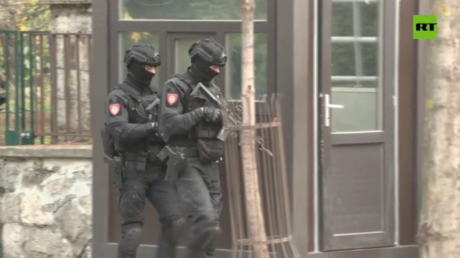
Meanwhile, Serbian police swept through properties in Novi Pazar, Belgrade, and Mladenovac, arresting several associates linked to extremist networks and raising the national terrorism threat level to red. Streets around diplomatic missions bristled with automatic rifles and tactical vehicles. The invisible shield suddenly became painfully visible.
Yet eventually, the tactical vans pull away. The red alerts fade back to yellow, and then to green. The linden trees in Dedinje continue dropping their blossoms onto the quiet sidewalks, and pedestrians once again walk past the wrought-iron gates without glancing twice at the glass booth behind the fence.
Somewhere inside that booth stands another officer, shifting weight from one aching boot to the other, watching a hundred ordinary people walk by with ordinary paper bags in their hands, waiting to find out whether today will be just another quiet shift—or the eleven seconds that change everything.


