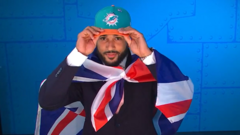
The Miami Dolphins’ selection of Seydou Traore with the 180th overall pick in the 2026 NFL Draft represents a high-ceiling arbitrage play in an increasingly globalized talent market. By selecting Traore—the first player ever drafted directly from the NFL Academy and the International Player Pathway (IPP) program—Miami has prioritized a raw "athletic ball of clay" over traditional collegiate developmental floor. The pick functions as a low-risk, high-reward bet on physical traits that are increasingly difficult to source in later rounds.
The Traore Physical Profile: A Functional Analysis
Traore stands at 6ft 4in and weighs 244lb, possessing a frame that mirrors the modern "Move" tight end archetype. His transition from wide receiver to tight end at Arkansas State and subsequently Mississippi State indicates a specific functional shift in his playstyle:
- Speed-to-Size Ratio: A 4.5-second 40-yard dash at 244lb places him in the upper percentiles of tight end speed. This creates a vertical mismatch against linebackers who lack the lateral agility to stay in phase and safeties who lack the physical mass to disrupt his catch radius.
- Post-Catch Efficiency: Traore averaged 6.5 yards after the catch (YAC) during his collegiate career. In the Dolphins’ offensive system, which relies on intermediate crossing routes and quick distribution, YAC is the primary metric for maintaining drive velocity.
- Catch Volume and Reliability: Across his collegiate career, Traore secured 131 receptions for 1,482 yards and 10 touchdowns. His production in the SEC—specifically 69 catches for 728 yards and six scores over the last two seasons at Mississippi State—proves he can produce against elite-level defensive speed.
Tactical Integration: The Dolphins Two-Tight End Calculus
The 2026 draft strategy reveals a deliberate shift in Miami’s offensive architecture. By selecting both Traore (Round 5) and Will Kacmarek (Round 3), the Dolphins are moving toward a heavy 12-personnel (one running back, two tight ends) or 13-personnel foundation. This structural change targets three specific operational goals:
- The Box Dilution Effect: By fielding multiple tight ends who are legitimate receiving threats, the Dolphins force defenses into a conflict of choice. If the defense stays in "Base" (more linebackers), Miami exploits the speed advantage of Traore or Kacmarek. If the defense moves to "Nickel" (extra defensive backs), Miami gains a mathematical advantage in the run game due to the added blocking mass at the line of scrimmage.
- Red Zone Compression Solutions: Miami’s historic reliance on pure speed (Tyreek Hill, Jaylen Waddle) faces diminishing returns in the red zone where the field is compressed. Traore’s height and 10 collegiate touchdowns provide a high-point target that the roster previously lacked.
- The International Pipeline Arbitrage: The NFL’s IPP program allows teams to scout players with shorter "football ages" (Traore only began 11-on-11 football in 2020). This lack of early-career wear-and-tear suggests a longer peak performance window, provided the technical mechanics of blocking and route-running can be refined under NFL-level coaching.
Risk Assessment and Developmental Hurdles
While the physical upside is significant, the selection carries inherent developmental risks. Traore’s scouting report highlights "raw" tendencies, which typically manifest in two areas:
- In-Line Blocking Mechanics: Transitioning from a wide receiver background to a fifth-round NFL tight end requires a massive leap in functional strength and leverage. Traore must demonstrate the ability to move defensive ends in the "C-gap" to be more than a situational pass-catcher.
- Route Discipline: In the SEC, Traore could often win on pure athleticism. In the NFL, he will face "press-man" coverage from veteran safeties who will test his release off the line.
Strategic Outlook for the Dolphins Tight End Room
Traore enters a depth chart that includes Greg Dulcich and fellow 2026 draftee Will Kacmarek. This creates an internal competition designed to solve the Dolphins’ historic lack of production from the tight end position. The cost function of a fifth-round pick is negligible compared to the potential ROI of a starting-caliber tight end.
The success of this pick will not be measured by Traore’s Year 1 reception total, but by his ability to master the "F" tight end role—the versatile, moving piece that creates mismatches across the formation. If Traore’s 4.5 speed translates to the professional game, the Dolphins will have effectively weaponized the NFL Academy’s first true success story, validating a new scouting frontier in the process.
The Dolphins must now commit to a high-repetition developmental program. Because Traore has only six years of organized football experience, his growth curve is likely steeper than a typical domestic prospect. The organization is betting that the ceiling of an international athlete with elite traits is higher than the floor of a more experienced, but physically limited, domestic alternative.