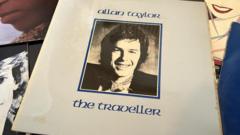
The music industry loves a fairy tale.
The current favorite narrative making the rounds involves pop titan Ed Sheeran digging through a dusty crate in a second-hand shop, unearthing a forgotten vinyl record, and single-handedly rescuing an obscure artist from obscurity. It is a heartwarming story. It checks every box for the vinyl-revival crowd, the romantic purists, and the algorithmic recommendation haters.
It is also a complete distortion of how modern culture actually works.
The media is treating this thrift-store find as a magical, lightning-strike moment of organic discovery. They are pitching a lazy consensus: that great art will inevitably find its way to the top if the right superstar happens to stumble upon it in a charity shop.
This is a dangerous delusion.
In reality, the "second-hand store discovery" is a beautifully packaged marketing trope. It obscures the brutal mechanics of distribution, intellectual property exploitation, and the curated nature of celebrity taste-making. Great music does not get attention because of fate. It gets attention because a multi-billion-dollar apparatus decides to activate a legacy catalog.
Let us dismantle the myth of the lucky break and look at the cold, hard mechanics of how the music business actually engineers "hidden gems."
The Romantic Fallacy of the Crate-Digger
Every music publication covering this story frames Sheeran’s find as a victory for raw talent. The underlying premise is flawed: If you make good music, someone will eventually find it.
I have spent nearly two decades analyzing streaming data, catalog acquisitions, and algorithmic playlisting. I can tell you exactly what happens to 99.9% of the records sitting in second-hand stores: they decompose.
The idea that global superstars spend their free time blindly rummaging through Salvation Army basements to find their next inspiration is a curated aesthetic. It is brand management. It aligns a massive, corporate pop act with the authentic, analog grit of independent music culture.
Consider the sheer mathematics of music production today:
- Over 100,000 new tracks are uploaded to streaming platforms every single day.
- The vast majority of physical records pressed in the 20th century are completely out of print, digitally unavailable, and legally trapped in copyright limbo.
- The probability of a top-tier artist finding a specific obscure record, liking it, and successfully generating mainstream traction for it purely by chance is statistically negligible.
When a superstar "finds" a record, it is rarely a solitary moment of divine intervention. It is the beginning of a highly calculated clearance and cross-promotion process.
How Catalog Resuscitation Actually Works
Let us look at the mechanics the competitor piece completely ignored. What happens after an artist like Sheeran identifies an old track? The media acts like the spotlight shifts instantly. In the real world, the machine goes to work.
1. The Sample and Interpolation Clearance Nightmare
You do not just talk about an old record and watch it become a hit. If a modern artist wants to champion an old track—or, more commonly, sample it or interpolate its melody—a army of entertainment lawyers must first locate the master rights holders and the publishing rights holders.
Often, these old records belong to defunct labels. The rights are tangled among deceased songwriters, bankrupt estates, and holding companies. I have seen major label projects delayed for years, racking up hundreds of thousands of dollars in legal fees, just trying to track down who owns 5% of a snare drum hit from 1974.
2. The Strategic Catalog Buy-Up
Why does the industry suddenly care when an old record gets "attention"? Because private equity firms and major publishers have spent the last decade buying up legacy music catalogs for billions of dollars.
When a track gets pulled from obscurity, it is rarely a win for the original, struggling artist. It is a massive windfall for the institutional investment funds that bought the rights for pennies years ago. The revival of an old track is an asset-optimization strategy. A celebrity endorsement is the ultimate catalyst to drive up the valuation of a dormant intellectual property asset.
3. Algorithmic Priming
Once the song is cleared and the celebrity speaks about it, the streaming platforms do not just let the audience find it naturally. The track is manually injected into high-profile editorial playlists. The metadata is optimized. The algorithms are fed the association between the legacy artist and the modern superstar.
The Reality Check: The listener thinks they are participating in a organic cultural revival. In truth, they are consuming a highly engineered push notification masquerading as nostalgia.
The Dark Side of the Celebrity Savior Complex
The narrative of the superstar savior creates a toxic dynamic for independent creators. It reinforces the idea that artists should not focus on building their own sustainable distribution networks, but should instead pray for a benevolent dictatorship of elite pop stars to notice them.
[Traditional Independent Path] -> Build Community -> Direct Sales -> Sustainable Career

[The Savior Myth Path]        -> Obscurity -> Celebrity Stumbles Upon Vinyl -> Corporate Monetization
Relying on a celebrity to validate an old or forgotten piece of art is not a sustainable model for culture. It is a lottery. And like the lottery, the house always wins.
When we celebrate Sheeran for finding a record, we are centering the narrative on the billionaire consumer rather than the creator. The headline should not be "Ed Sheeran found this record." The headline should be "Decades of industry gatekeeping kept a brilliant artist invisible until a corporate titan validated them." But that doesn’t generate quick clicks, does it?
Stop Asking How to Get Discovered
People looking at this story always ask the wrong question: How can I get my music into the hands of someone like Ed Sheeran?
If that is your strategy, you have already lost. The premise itself is broken. You are aiming for a statistical anomaly instead of building a predictable system.
Instead of chasing the myth of the elite co-sign, creators and industry operators need to focus on what actually moves the needle in the modern ecosystem.
Build Sovereign Audiences
Do not trust the physical crate, and do not trust the streaming playlist. Own your data. The artists who survive today are those who can reach 5,000 core fans directly via decentralized platforms, private communities, and direct physical distribution, without needing a middleman—or a passing pop star—to validate their existence.
Understand the Value of Master Rights
If you are an independent artist, do not sell your publishing rights early for quick cash. The entire reason legacy artists get exploited in these "revival" stories is because they signed away their masters fifty years ago. If your work is buried in a thrift store forty years from now, make sure your grandkids are the ones who get paid when the future equivalent of Ed Sheeran samples it.
Accept the Brutal Truth of the Crate
Thrift stores are cemeteries for failed distribution models. The records sitting in them are not there because they were ahead of their time; they are there because the systems that produced them failed to adapt, or because the creators were chewed up and spit out by the corporate machinery of their era.
The romanticization of the second-hand find is a coping mechanism for an industry that refuses to fix its broken discovery mechanisms. It turns systemic failure into a feel-good human-interest story.
Do not buy the narrative. The record in the second-hand store did not get attention because of a miracle. It got attention because the machine figured out how to make it profitable again.