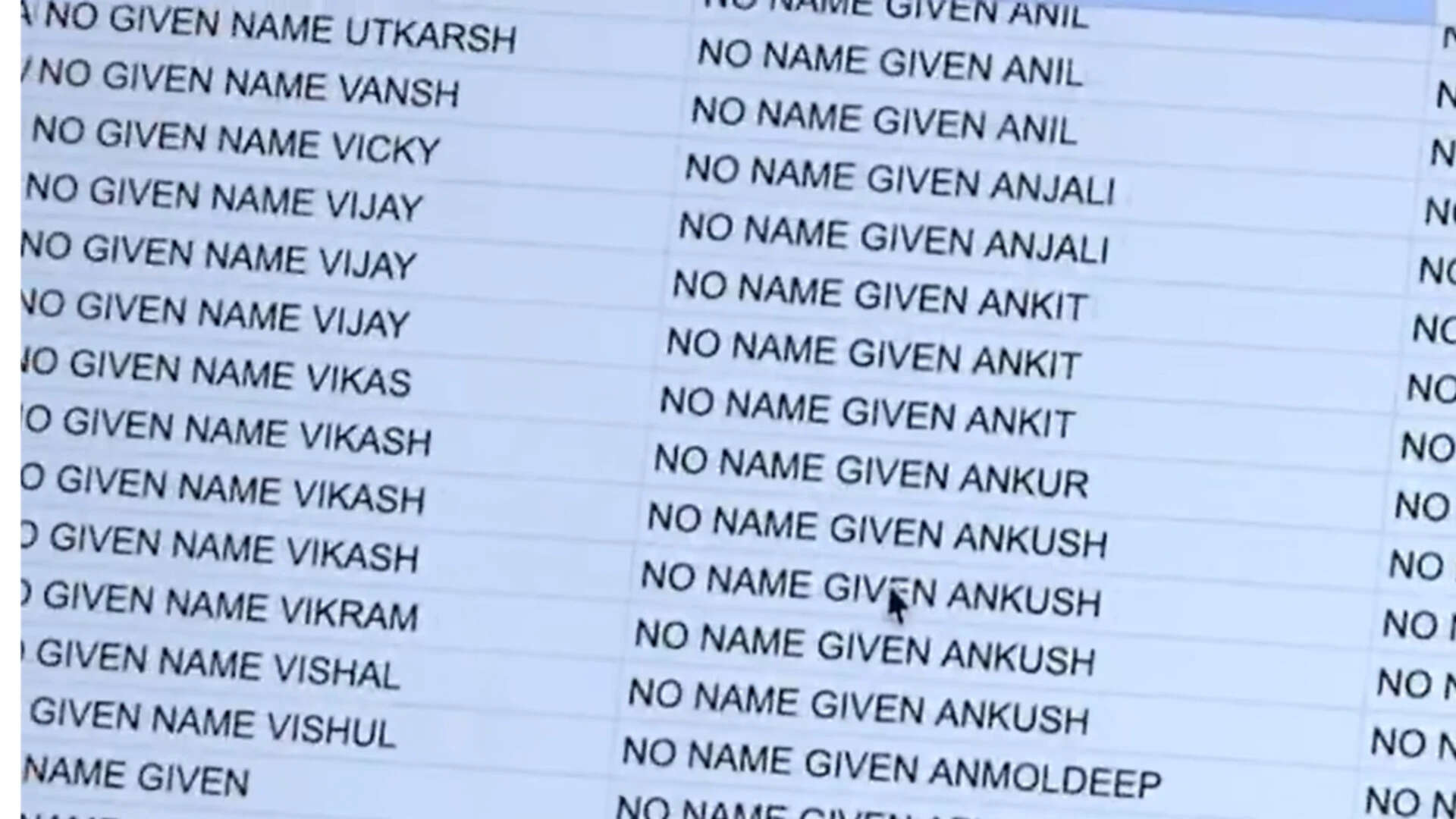
The emergence of "No Name Given" (NNG) as a recurring entry in the Federal Motor Carrier Safety Administration (FMCSA) database represents a failure of data standardization rather than a coordinated shadow economy. While populist rhetoric suggests a targeted exploitation of the trucking industry by specific demographic groups, a structural analysis of the Department of Transportation (DOT) registration process reveals that the NNG phenomenon is a byproduct of high-volume entry by sole proprietorships and the administrative friction of the Unified Registration System (URS).
The perception of a "Punjabi-specific" loophole ignores the underlying mechanics of how the trucking industry functions at the entry level. Small-scale operators, often referred to as "power-only" or "owner-operators," frequently register as sole proprietors before establishing a formal Limited Liability Company (LLC) or S-Corp. When a registrant fails to provide a "Doing Business As" (DBA) name or a legal entity name during the initial electronic filing, the system default or the manual entry by a data processing clerk often reverts to "No Name Given."
The Structural Drivers of NNG Registrations
The proliferation of these entries can be deconstructed into three primary operational drivers:
- The Sole Proprietorship Bottleneck: Unlike established fleets, new entrants often lack the legal infrastructure to brand their operations. In the Punjabi-American community—which currently accounts for a significant and growing percentage of the long-haul trucking workforce—the transition from driver to owner-operator is a primary path for capital accumulation. This rapid influx of new owners, often utilizing third-party registration services to navigate English-language bureaucratic hurdles, increases the statistical likelihood of clerical placeholders like NNG appearing in the records.
- The API and Data Entry Lag: The FMCSA’s legacy systems often struggle with the integration of state-level business filings. If a driver has filed for an Employer Identification Number (EIN) but hasn't yet received formal state recognition of a trade name, the federal system requires a placeholder to issue a USDOT number. This creates a temporal gap where an operator is legally authorized to move freight but lacks a public-facing corporate identity.
- Third-Party Filing Aggregation: High-volume "permit services" often batch-file hundreds of applications. To expedite the issuance of authority—a process that dictates when an operator can start generating revenue—these services may bypass non-essential fields. The result is a database populated with functional but unnamed entities.
Deconstructing the Fraud Narrative vs. Regulatory Reality
Claims that NNG entries are a tool for "double brokering" or "skirting safety regulations" require a comparison of the NNG cohort against the broader industry safety metrics. Double brokering—the illegal re-listing of a freight load by a carrier who was already contracted to move it—is a systemic issue in logistics, but it is driven by anonymity, not specifically by the NNG designation.
An operator with a USDOT number, even if listed as NNG, is still subject to:
- Mandatory Insurance Filings: No carrier can obtain "Active" authority without a BMC-91 or BMC-91X filing from an insurance provider. Insurance companies do not issue policies to non-existent people; they require a verified individual or tax ID.
- Process Agents: Every carrier must designate a BOC-3 (Designation of Process Agents) to receive legal documents in every state they operate. This creates a paper trail back to a physical person or office.
- Electronic Logging Device (ELD) Compliance: The mandate for ELDs means that every mile driven is tracked and attributed to a specific hardware ID.
The risk profile of an NNG carrier is essentially identical to that of a "John Doe Trucking" LLC. The danger lies not in the name, but in the fragmentation of accountability. When a carrier commits a safety violation or a "reincarnated carrier" (a company that shuts down to avoid a bad safety rating and re-opens under a new name) enters the market, they are more likely to use a fresh, professional-sounding LLC name than a conspicuous NNG designation that invites scrutiny.
The Cost Function of Logistics Demographics
The concentration of Punjabi-American entrepreneurs in the NNG data points is a function of the Immigrant Professional Network Effect. In industries with high barriers to entry but low requirements for formal domestic education, ethnic enclaves provide the necessary social capital:
- Mentorship in navigating the CDL process.
- Access to informal lending for down payments on Class 8 trucks.
- Dispatching networks that prioritize tribal or linguistic commonality.
This efficiency allows the Punjabi-American cohort to undercut traditional carriers on price, leading to market dominance in specific lanes (e.g., California to the Midwest). The "No Name Given" label is a symptom of this high-speed market entry. These operators are prioritizing the revenue-generating asset (the truck) over the brand asset (the company name).
Technical Failures in the FMCSA Database
The FMCSA’s inability to purge or correct NNG entries points to a technical debt issue. The database is a composite of decades of records. When a user searches for carriers, the presence of 10,000+ NNG entries suggests a lack of automated validation.
A "masterclass" in data hygiene would require the FMCSA to implement:
- Field Validation: Hard-coding the registration portal to reject "No Name Given," "N/A," or "None" in the legal name field.
- Cross-Reference Requirements: Mandating an active Secretary of State filing link before a USDOT number becomes "Active."
- Historical Scrubbing: Forcing existing NNG carriers to update their filings during their biennial update (MCS-150) or face immediate suspension of authority.
The current system allows these placeholders to persist because the DOT prioritizes interstate commerce flow over data cleanliness. As long as the carrier has an active insurance policy and a valid drug and alcohol clearinghouse record, the federal government views the specific string of text in the "Name" column as a secondary concern.
Identifying Real Risks: Reincarnated Carriers and Chameleon Fleets
The focus on NNG often distracts from the more sophisticated threat: Chameleon Carriers. These are entities that intentionally obfuscate their history to hide a history of crashes or "Unsatisfactory" safety ratings.
A chameleon carrier will never use "No Name Given." They will use a name that looks like an established fleet. To identify these risks, analysts must look at:
- Address Proximity: Multiple USDOT numbers registered to the same residential address or a virtual mailbox.
- Asset Transfers: A new USDOT number that suddenly acquires 20 trucks that were previously registered to a recently defunct company.
- Phone Number Correlation: Shared contact information across different legal entities.
The NNG entries are "loud" data—they are obvious, easily searchable, and fodder for social media. Chameleon carriers are "quiet" data, hidden behind legitimate-looking paperwork.
The Financial Mechanics of "Power-Only" Operations
Most NNG-registered entities operate in the Power-Only segment. In this model, the owner-operator provides the tractor and the driver, while the shipper or a third-party logistics (3PL) firm provides the trailer. This lowers the capital requirement for entry and increases the speed at which a new driver can become a business owner.
This model is highly sensitive to fuel price fluctuations and spot market rates. When the spot market drops, as it has significantly since the 2022 peak, these small, often unnamed entities are the first to face insolvency. The high churn rate in this segment further populates the database with NNG entries that were created, used for six months, and then abandoned as the operator went back to driving for a larger fleet.
Strategic Correction of the Logistics Ecosystem
To move beyond the "No Name Given" controversy, the industry must shift from a model of passive registration to active identity verification.
Freight brokers and shippers should implement the following "Hard-Gate" protocols:
- Identity Verification (IDV): Requiring the principal owner of any carrier—regardless of the name on the DOT filing—to pass a biometric or document-based ID check via services like ID.me or specialized logistics platforms.
- Vetting Thresholds: Refusing to onboard any carrier with less than 6-12 months of active authority, which naturally filters out the "placeholder" entities that have not yet formalized their business structure.
- Physical Asset Verification: Matching the truck's VIN and physical markings to the DOT registration at the point of pickup.
The NNG phenomenon is not a conspiracy; it is a signal of a decentralized, hyper-competitive market outstripping the capacity of its regulators to maintain a clean ledger. The "No Name Given" tag is the digital exhaust of an industry that is rapidly diversifying and digitizing at different speeds.
Shippers and brokers must stop viewing the FMCSA database as a definitive source of truth and start treating it as a raw data feed that requires a private-sector layer of verification. The strategic play is to build a "Known Carrier" network that relies on historical performance data and verified physical assets rather than relying on the bureaucratic accuracy of a federal registration form. Focus on the BOC-3 filings and insurance certificates; the name on the door is frequently the least important piece of data in the chain of custody.