When an unscripted clip of French football captain Kylian Mbappé referring to a meme of a "Chinese dictator" surfaced in October 2026, the resulting collapse of his commercial infrastructure in mainland China took less than 48 hours. Standard sports journalism treats these incidents as isolated public relations missteps or cultural misunderstandings. That framing misses the structural reality: modern global sports intellectual property operates under an asymmetric market-access regime where a single historical or political friction point triggers automated, multi-tiered institutional retaliation.
To understand why one of the world’s highest-earning athletes issued a trilingual apology within days, one must examine the mechanics of commercial contagion, state-media signaling, and cross-border contractual vulnerability. For an alternative view, consider: this related article.
The Anatomy of the Incident
The factual baseline of the October 2026 controversy demonstrates how hyper-localized internet humor collides with sovereign historical narratives when stripped of context.
- The Origin Event: During behind-the-scenes footage filmed in April 2026 for the French football podcast The Bridge, Mbappé reacted to an internet meme superimposing his face onto an image of Mao Zedong. Within European football culture, fans routinely edit Mbappé’s likeness onto authoritarian figures to satirize his perceived influence over club management and media narratives—a running joke centered on the nickname "the dictator". In the clip, Mbappé did not mention Mao by name, noting instead that he used the meme with friends, while referring to the figure depicted as a Chinese dictator.
- The Distribution Lag: The footage remained dormant until late October 2026, when it circulated widely on social media. Once translated and contextualized for audiences on Chinese platforms like Weibo and Dongqiudi, the European subtext evaporated, leaving only the characterization of the People’s Republic of China’s founding leader.
- The Cascade: Within hours of trending on Weibo, domestic sponsors terminated contracts, international luxury houses scrubbed localized campaigns, state broadcasters suspended match airings, and La Liga leadership intervened.
The Three-Tiered Retaliation Architecture
Unlike Western consumer boycotts, which rely on decentralized purchasing decisions and rarely achieve sustained revenue impact, commercial backlash in China operates through a synchronized three-tier mechanism. Related analysis regarding this has been provided by CBS Sports.
Tier 1: Algorithmic Amplification and Self-Censorship
The initial shockwave occurs on domestic social platforms, where trending topic lists (such as Weibo’s Hot Search) concentrate public attention. Simultaneously, sports media outlets execute preemptive self-censorship. Notably, Chinese football portal Dongqiudi and state-affiliated newspapers like Global Times condemned the remarks while refusing to translate or republish the exact phrasing. By withholding the verbatim quote while amplifying the outrage, media gatekeepers establish a moral boundary without propagating the offending characterization. Platform moderation follows immediately; Mbappé’s account on Rednote (Xiaohongshu) was muted for violating community guidelines, cutting off his direct communication channel with domestic fans before he could mount an unmediated defense.
Tier 2: Domestic Equity Defense
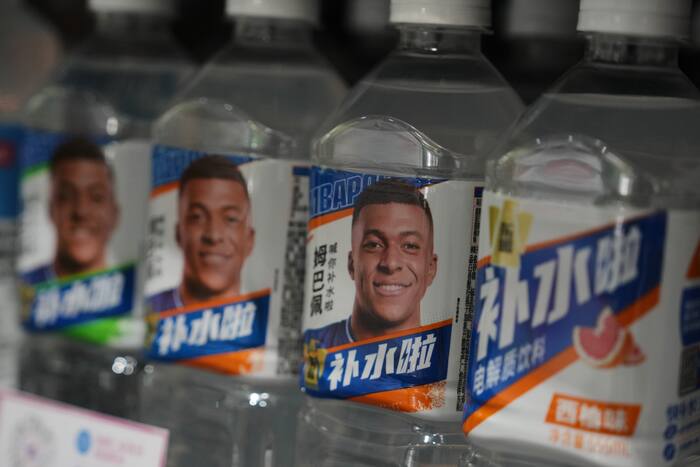
Publicly traded Chinese consumer brands face immediate market penalties if they remain associated with a politically compromised endorser. Following the viral spread of the clip, domestic sponsors—including dairy producers Mengniu and Shanghai Milkground Food Tech, alongside beverage maker Eastroc Beverage (Dongpeng)—experienced downward stock pressure prior to issuing termination statements. For these firms, severing ties is not merely ideological alignment; it is an urgent risk-management maneuver to halt equity erosion and prevent state-media censure, which Guangming Daily framed through the idiom of "eating Chinese food and then smashing the Chinese pot".
Tier 3: Institutional Chokepoints and League Contagion
The decisive mechanism that forces individual compliance is the escalation from personal endorsements to institutional broadcast rights. China Media Group (CMG) suspended broadcasts of Spanish league matches and games featuring Mbappé, explicitly demanding apologies not just from the player, but from Real Madrid and La Liga.
This creates a collective-action problem for the rights holder. While an individual athlete might absorb the loss of three regional beverage contracts, a top-tier European football league cannot absorb the blacklisting of its broadcast feed in a primary growth market. The intervention of La Liga president Javier Tebas—who issued a rapid public statement emphasizing the league's commitment to its Chinese partnerships and fans—illustrates how institutional pressure transfers directly onto the athlete.
The Cost Function of Global Endorsements
To evaluate Mbappé’s decision to apologize in French, Mandarin, and English on October 27, one must model the asymmetric financial exposure of a tier-one global athlete. An athlete’s commercial portfolio divides into two distinct buckets with different sensitivity thresholds:
- Domestic Chinese Partnerships: High visibility, high regulatory risk, and zero tolerance for political friction. These deals are terminated immediately upon controversy to protect the sponsor's domestic standing.
- Western Multinational Sponsors: Global brands such as Nike, Dior, Rimowa, Hublot, and On Running operate dual-track reputation strategies. During the October 2026 backlash, these brands removed promotional content featuring Mbappé specifically from their Chinese Weibo accounts while maintaining their broader global relationships.
This geo-fenced scrubbing reveals the true economic pressure point. Western multinationals do not need to fire an athlete globally to appease Beijing, provided the athlete neutralizes the crisis quickly enough to prevent a broader boycott of the parent brand. Had Mbappé refused to apologize, those multinational sponsors would have faced escalating pressure to choose between their global ambassador and their mainland retail operations—the exact dynamic that cost the NBA hundreds of millions of dollars following Daryl Morey’s 2019 tweet.
Furthermore, geopolitical signaling from Washington complicated the optics without altering the financial math. When the U.S. House Select Committee on China publicly urged Mbappé not to apologize, it introduced a secondary reputational cost in the West: the perception of capitulating to foreign censorship. However, Western political commentary carries zero financial penalty for a European footballer, whereas Chinese institutional blacklisting carries immediate, quantifiable losses for the athlete, his club, and his league. In rational economic terms, absorbing transient Western criticism is strictly preferable to triggering a multi-year commercial freeze in Asia.
The Structural Failure of Athlete Media Governance
The operational flaw exposed by the Mbappé incident is not the existence of Chinese political red lines—those have been well-documented since the 2019 NBA crisis—but the failure of modern athlete media teams to audit archival and behind-the-scenes content.
The "Off-Air" Vulnerability
The clip in question was recorded six months prior to its release during pre-show preparations. Modern sports media increasingly favors informal, long-form podcast environments designed to humanize athletes and generate viral micro-clips. Yet the informal setting lowers an athlete’s cognitive guard while retaining global broadcast reach. Management teams routinely vet official press releases and sponsored social media posts, but fail to maintain editorial veto power over raw B-roll captured by third-party media partners.
Context Collapse Across Linguistic Boundaries
In communication theory, context collapse occurs when a message intended for a specific audience with shared cultural priors is instantaneously delivered to a global audience lacking those priors. The "dictator" nickname applied to Mbappé in France is an ironic commentary on dressing-room politics. When translated into Mandarin without the accompanying lore of French sports media, the irony disappears, leaving a literal historical characterization of a figure whom the Chinese Communist Party enshrines as a foundational national icon.
The Limits of Apology Mechanics
While Mbappé’s trilingual apology satisfied state broadcaster CCTV—which pivoted to a "listen to what he says and watch what he does" posture—apologies function asymmetrically across the three tiers of retaliation:
- Institutional Broadcasts: Usually restored once the formal contrition satisfies state media requirements and protects diplomatic face.
- Multinational Geo-Fencing: Slowly reversed over a cooling-off period of six to eighteen months, once social media sentiment dissipates.
- Terminated Domestic Contracts: Almost never reinstated. Once a domestic company announces a severance "with immediate effect", the contractual relationship is permanently impaired, and competitors rarely step into the void until at least one full tournament cycle has passed.
Tactical Risk Mitigation for Global Sports Entities
Managing tier-one athletic talent requires treating geopolitical compliance with the same rigor as injury prevention or tax structuring. Organizations and representation agencies managing globally exposed athletes must implement three operational controls:
- Contractual Veto over Unaired Footage: Talent agreements for podcasts, documentaries, and shoulder programming must include mandatory pre-publication review clauses for all behind-the-scenes audio and video, eliminating the six-month delayed-release trap that caught Mbappé’s team.
- Red-Line Briefing Protocols: Media training cannot rely on generic advice to "avoid politics." Talent must receive specific, updated briefings on sovereign sensitivities—including historical figures, territorial disputes, and national symbols—alongside explicit instructions never to engage with politically themed internet memes, regardless of how benign the local joke appears.
- Pre-Drafted Crisis Playbooks: Because equity markets and state broadcasters react within hours, agencies cannot spend three days debating the philosophical merits of free expression. Pre-approved, culturally calibrated holding statements must be ready to deploy within six hours of a trending spike on Weibo to prevent Tier 2 corporate terminations from escalating into Tier 3 league-wide broadcast suspensions.
As global sports properties increasingly rely on international broadcast rights and cross-border sponsorships to fund escalating player wages, the margin for unscripted cultural friction will continue to shrink. Representations that fail to enforce strict editorial control over informal media appearances will repeatedly force their clients into high-profile capitulations, trading long-term brand equity for short-term damage control.