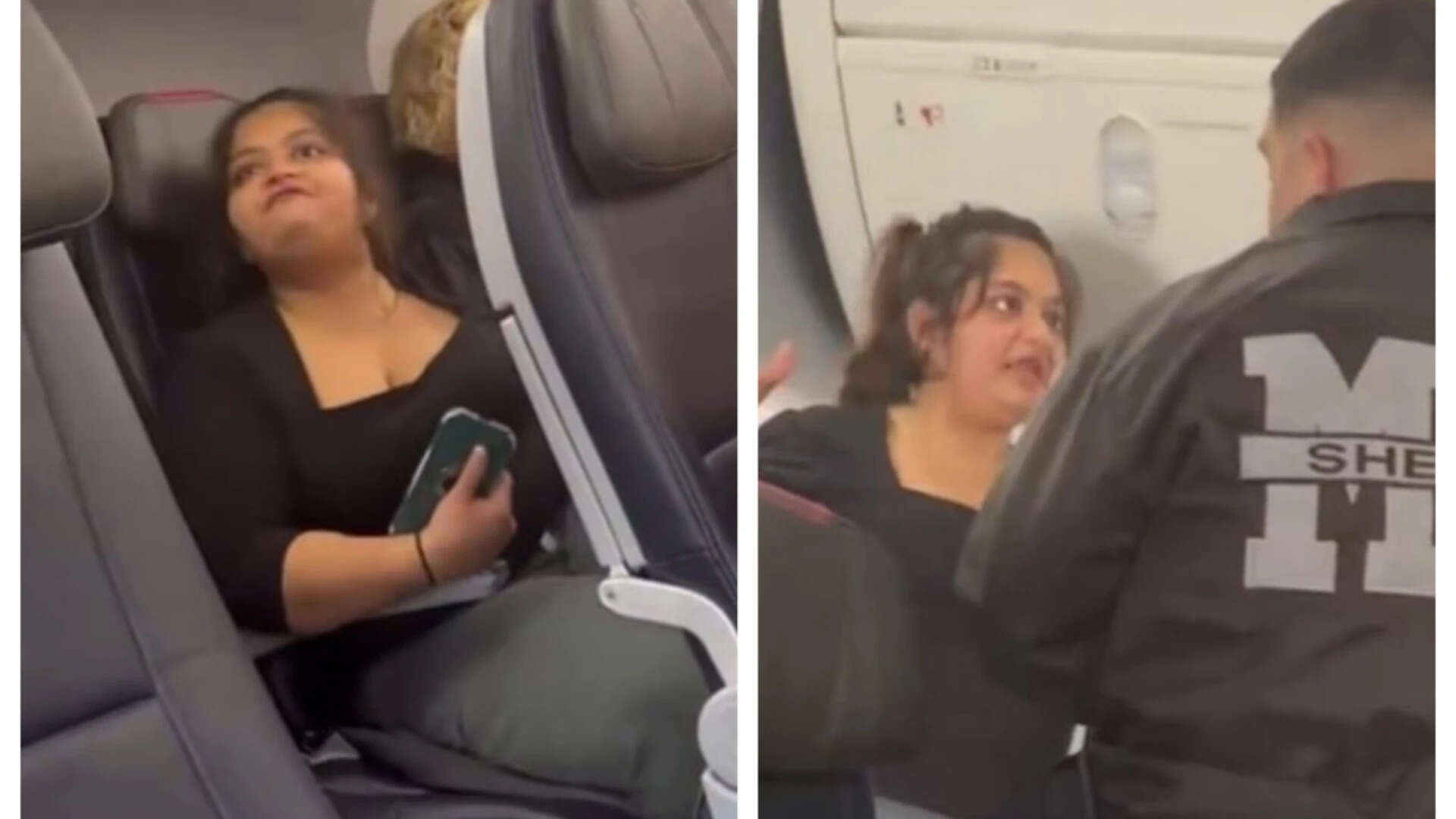
The removal of a passenger from an American Airlines flight following a dispute over mobile device audio usage serves as a definitive case study in the friction between individual perceived rights and the contractual reality of commercial aviation. While the passenger framed the incident as an infringement on free speech, the event is more accurately analyzed through the lens of Contract of Carriage (CoC) enforcement and the operational necessity of cabin environmental control. In high-density, pressurized environments, the cost of a single behavioral outlier scales exponentially as it threatens the "Time-to-Taxi" and "Slot Adherence" metrics that dictate airline profitability.
The Hierarchy of Authority in Civil Aviation
The fundamental misunderstanding in this disruption stems from a failure to recognize the legal shift that occurs once a passenger crosses the threshold of the aircraft. Public spaces and private commercial vessels operate under distinct legal architectures.
- The Captain’s Absolute Authority: Under Federal Aviation Regulations (FARs), specifically 14 CFR § 91.3, the pilot in command is the final authority on the operation and safety of the aircraft. This is not a democratic function. If a passenger’s behavior—regardless of the duration (the "30-second" claim)—is deemed a distraction to the crew or a nuisance that could escalate, the captain possesses the unilateral right to offload that individual.
- The Contract of Carriage (CoC): Upon ticket purchase, a passenger enters a binding legal agreement. American Airlines’ CoC explicitly permits the refusal of transport for passengers whose conduct is "disorderly, loud, or offensive." The definition of "loud" is not determined by a decibel meter but by the subjective professional judgment of the flight lead.
- The FAA Reauthorization Act Mandates: Modern aviation law has increasingly prioritized the protection of crew members from interference. Verbal abuse directed at crew members, which occurred in this instance during the offloading process, transitions the event from a civil customer service dispute into a potential federal offense under 49 U.S.C. § 46504.
The Myth of Constitutional Venue
The invocation of "free-speech America" during a cabin dispute represents a categorical error in legal theory. The First Amendment restricts government interference with speech; it does not grant a right to amplify digital media in a private commercial cabin.
The Private Property Barrier
An aircraft is a private asset. Just as a restaurant can enforce a dress code or a "no cell phone" policy, an airline enforces a "Quiet Environment" policy to ensure the safety and comfort of the collective. When a passenger plays a video at high volume without headphones, they are not exercising a right; they are committing a breach of the behavioral terms of their contract.
The Collective Safety Function
Noise pollution in an aircraft is a safety variable. Crew members must be able to communicate safety instructions, and passengers must be able to hear "chimes" or announcements. A passenger who refuses to use headphones creates a communication "dead zone" in their immediate vicinity. The refusal to comply with a direct crew instruction to cease the noise is the primary trigger for removal, not the noise itself. The "30-second" duration cited by the passenger is irrelevant to the logic of the intervention; the violation occurs the moment the instruction is ignored.
The Operational Cost of Non-Compliance
For an airline, a passenger removal is a significant financial loss. The decision to return to the gate or delay a pushback is never made lightly.
- Fuel Burn and Slot Loss: Tarmac delays can cost upwards of $50 to $100 per minute in fuel and labor. Losing a takeoff slot at a congested hub like DFW or CLT can ripple into a 45-minute delay, impacting the "Downstream Utilization" of the aircraft for the next four flights in its rotation.
- The Crew Duty Clock: Flight crews are subject to strict "Duty Day" limits. A disruption that causes a gate return can push a crew into "timing out," necessitating a full crew swap and potentially canceling the flight entirely.
- The Contagion Risk: Behavioral science indicates that "Unruly Passenger" incidents can have a multiplier effect. If one passenger successfully flouts the authority of the crew, it degrades the crew's ability to manage the cabin during an actual emergency. Immediate removal serves as a structural reinforcement of cabin hierarchy.
Categorizing the Escalation Ladder
The incident followed a predictable path of escalation that reveals where the passenger’s strategy failed.
Phase 1: The Non-Normative Action
The passenger played audio without headphones. In the high-density environment of an economy cabin, this is a breach of social and contractual norms.
Phase 2: The Correction Resistance
The crew issued a corrective instruction. At this point, the cost to the passenger was zero—simply put on headphones or mute the device. The passenger chose to litigate the validity of the request rather than comply. This shifted the infraction from "Nuisance" to "Non-Compliance with Crew Member Instructions."
Phase 3: Verbal Hostility and Moral Framing
By swearing at the crew and invoking constitutional rights, the passenger signaled that they were no longer a rational actor within the airline's safety framework. The use of profanity is a "Hard Trigger" for removal in almost all US-based carrier manuals.
The Regulatory Gap in In-Flight Etiquette
While the FAA has a zero-tolerance policy for interference, there is a lack of specific, codified federal rules regarding digital audio in cabins. This creates a "Grey Zone" that passengers often attempt to exploit. However, the industry is moving toward a standard where:
- Personal Electronic Device (PED) Policies are being updated to specify "Headphone-Only" usage for all audible media.
- Internal Blacklists (No-Fly Lists) are being shared more frequently between carriers to prevent "Serial Disrupters" from jumping from one airline to another.
The limitation of this strategy is the "Human Factor." Crew members are often exhausted and may have varying thresholds for what they consider "loud." This inconsistency can lead to a perception of unfairness, but from a legal and operational standpoint, the crew's discretion remains the ultimate arbiter.
Strategic Recommendation for Travelers and Industry Stakeholders
The resolution of the "Headphone Dispute" is not found in constitutional law but in the adherence to the hierarchical structure of the flight deck.
For the passenger, the only viable path to avoid removal once an instruction is given—even if the instruction feels arbitrary—is immediate compliance followed by a post-flight formal grievance. Attempting to win a debate at 30,000 feet (or at the gate) is an operational impossibility because the crew cannot risk the safety implications of an unresolved conflict.
For the airline, the strategy must shift from reactive removal to preventative boarding communication. Explicitly stating the "No Speaker" policy during the safety briefing—and linking it to the federal prohibition on interfering with crew duties—removes the "Grey Zone" that disrupters use to justify their behavior.
The incident on American Airlines was not a failure of free speech; it was a successful execution of a safety protocol designed to isolate a behavioral variable before it could impact the aircraft's "Time-on-Wing" efficiency and the safety of the collective. The passenger did not lose their rights; they simply reached the end of their contract.
The next evolution in cabin management will likely involve the integration of AI-monitored acoustic sensors to detect non-compliant noise levels automatically, removing the subjective "He-Said-She-Said" element from crew enforcement and placing the burden of proof on objective data. Until then, the Captain's word remains the law of the cabin.