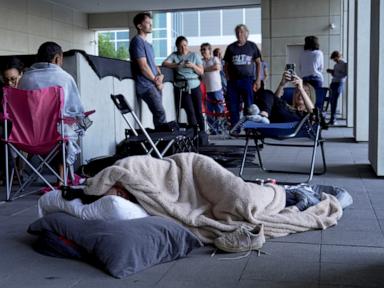
The physical constraints of a judicial venue create an artificial supply bottleneck when a legal proceeding intersects with national political friction. At the Fourth District Court in Provo, Utah, the preliminary hearing for Tyler James Robinson—the individual charged with the aggravated murder of Turning Point USA co-founder Charlie Kirk—exhibits a severe structural imbalance between public demand and institutional capacity. State District Judge Tony Graf must evaluate the state’s evidence to determine probable cause, yet the secondary optimization problem occurs outside the chamber doors. With only 14 seats allocated for the general public on a first-come, first-served basis, the court has inadvertently established a high-stakes economy governed by queues, resource expenditure, and security protocols.
To analyze this phenomenon requires moving past the superficial spectacle of citizens sleeping on pavement. The scenario represents a classic case of fixed supply meeting highly elastic, politically motivated demand. You might also find this connected coverage insightful: Why Sheikh Hasina Is Betting Everything On A Shock December Return To Bangladesh.
The Microeconomics of the 14 Seat Constraint
When an asset is fixed at an absolute volume of 14 units per day, price theory dictates that if the monetary price is set to zero, the clearing price shifts entirely to time allocation and opportunity cost. The courthouse administration relies on non-monetary rationing via numbered wristbands distributed each morning. This structural framework induces distinct transactional behaviors among participants.
- The Opportunity Cost of Time: Spectators arriving at 9:00 p.m. the previous evening for an afternoon session sacrifice up to 18 hours of productivity or leisure. For an independent media operator or a dedicated political advocate, this cost is factored into the value of acquiring unmediated sensory data from the courtroom.
- Arbitrage and Proxy Queueing: The strict enforcement of non-transferability mechanics by court security highlights attempts to exploit the system. Security officials noted instances where individuals acquired matching commercial wristbands to bypass the checkpoint, necessitating a shift to labeled, verified tracking mechanisms. Furthermore, the practice of proxy queuing—where one individual holds a physical position for another—presents a structural loophole that security personnel have had to actively suppress to maintain equitable access.
- Information Asymmetry: The motivation to occupy these physical seats, despite the availability of digital livestreams, stems from an information deficit. Digital broadcasts isolate the frame to the witness stand, the lectern, and the bench. They omit the non-verbal interactions within the gallery, such as the spatial dynamics between the victim's widow, Erika Kirk, high-profile observers like Donald Trump Jr., and the defendant. For certain actors, capturing these omitted variables justifies the physical investment.
Institutional Volatility and Risk Management
The influx of high-interest spectators alters the operational baseline of the courthouse. The physical space must pivot from a standard bureaucratic venue to a high-security containment zone. This shift introduces specific friction points across the court's infrastructure. As reported in latest articles by Associated Press, the implications are worth noting.
[High Profile Political Case]
       │
       ▼
[Absolute Fixed Supply: 14 Public Seats]
       │
       ▼
[Rationing via Overnight Queuing] ──► [Security Bottlenecks & Policy Shifts]
       │                                     │
       ▼                                     ▼
[Secondary Market Vulnerabilities]    [Prohibition of Structural Assets (Tents)]
The first structural vulnerability emerges from the physical accumulation of camp infrastructure on municipal property. Court Director of Security Chris Palmer implemented an administrative adjustment prohibiting tents, sleeping pads, and external structures on the courthouse steps. This policy alters the physical cost function of the queue: by stripping participants of protective gear against environmental elements, the institution increases the physical discomfort of the wait, theoretically dampening marginal demand from casual observers while prioritizing highly motivated actors.
The second operational friction point involves balancing the constitutional mandate for an open trial against the preservation of judicial integrity. The defense previously sought to close portions of the preliminary hearing, a motion rejected by Judge Graf on the grounds that closure was not narrowly tailored. Consequently, the court must absorb the operational overhead of managing a volatile crowd. Security personnel must enforce a behavioral decorum inside the room to ensure that jurors, witnesses, and family members do not feel isolated or observed under a psychological microscope by the immediate gallery.
The Strategic Function of Preliminary Proceedings
The intense competition for access underscores a systemic misunderstanding of the preliminary hearing’s function. This proceeding does not determine ultimate guilt or innocence; it serves as a probability threshold assessment. The prosecution, led by the Utah County Attorney’s Office, faces a precise mandate: establish a reasonable probability that the defendant committed the crime of aggravated murder.
The state’s strategy relies heavily on technical and objective evidence to clear this threshold. Investigators presented analytical overlays of surveillance footage tracing the suspect’s movements across the Utah Valley University campus on September 10, 2025. The data establishes a clear timeline of preparation: an initial arrival in casual attire, a subsequent clothes change to highly concealed garments, a calculated approach to the roof of the Losee Center, and the maintenance of a prone position until the discharge of a single round at 12:23 p.m.
The introduction of forensic data—specifically DNA profiles recovered from a towel wrapping the suspected Mauser 98 rifle found in nearby woods—further solidifies the state’s evidentiary chain. In contrast, the defense strategy focuses on exposing systemic volatility within these collection mechanisms. By cross-examining investigators on the limitations of transfer DNA and questioning the absolute custody chain of items found at the scene, the defense attempts to lower the probability metric below the statutory threshold required for a trial.
The structural limitation of this legal phase means that the public investment in observing the preliminary hearing yields no final verdict. It merely confirms or denies the transition of the case into a formal trial structure, where the supply-demand imbalance for courtroom access will inevitably intensify.
The current queue dynamics demonstrate that when a public asset cannot be scaled to meet demand, the system will optimize around those willing to bear the highest physical and operational friction. Court administrations facing similar high-profile actions cannot rely on standard structural arrangements; they must proactively design dynamic rationing systems that account for proxy manipulation, safety overhead, and physical space limitations long before the opening gavel.