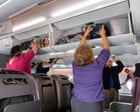
Low-cost carrier business models rely on baseline unbundling where the base fare purchases point-to-point transportation and all additional operational friction points are priced as optional variables. When an airline introduces structured fees for overhead locker access, such as Jetstar establishing charges up to $52 for carry-on baggage stored in overhead bins, it represents a fundamental adjustment to the marginal cost structure of passenger throughput. This operational shift addresses an inefficient commons problem in cabin real estate by shifting the financial burden of boarding delays and spatial competition back to the individual consumer.
To understand why airlines restructure baggage pricing, one must analyze the physical constraints of narrow-body aircraft. Passenger throughput is dictated by boarding speed, which is constrained by seat-row congestion and overhead bin capacity. When passengers bring maximum-allowable carry-on bags free of charge, the marginal cost of bin space approaches zero for the traveler, but the time cost and aircraft turnaround penalty rise exponentially for the operator. Jetstar charging up to $52 for overhead storage transforms a zero-cost commons asset into an economically rationed resource.
The economic mechanism governing this policy functions as a Pigouvian tax designed to internalize the negative externalities of boarding friction. Each extra piece of rolling luggage introduced into the cabin increases the time required for passengers to clear the aisle, extending gate turnaround times. For a low-cost carrier operating a high-frequency, point-to-point network, aircraft utilization rate is the primary driver of unit profitability. Ground time generates zero revenue. By pricing overhead bin access, the airline shifts traveler behavior through price signals, diverting high-density luggage into checked holds and accelerating boarding velocity.
The Operational Cost Function of Cabin Baggage
Traditional legacy carriers bundle overhead bin access into the ticket price because their fare structures absorb the variance in turnaround times across mixed-fleet networks. Low-cost carriers operate on compressed turnaround windows, frequently targeting twenty-five minutes or less from block-in to block-out. Every minute an aircraft sits idle at the gate due to overhead bin saturation erodes the margin advantage of the high-frequency operational model.
The cost function of cabin baggage involves three distinct variables:
- Spatial Saturation: The physical volume of the overhead bins divided by the aggregate volume of passenger luggage. On a fully booked Airbus A320 or Boeing 737, physical capacity is typically exhausted by the first forty percent of boarding passengers.
- Time Displacement: The seconds consumed per passenger stabling items, compounded by aisle blockages that halt the progression of subsequent travelers.
- Gate Intervention Cost: The labor expenditure and delay penalties incurred when gate agents must forcibly check oversized or unauthorized bags at the jetbridge.
When overhead bin space is unpriced, demand infinitely outstrips supply after the first boarding zones clear. This creates a classic tragedy of the commons where early boarders capture scarce spatial rents while late boarders bear the operational friction through gate-checking delays. The introduction of a $52 fee acts as a rationing device, artificially reducing demand for overhead space until it matches physical capacity.
Behavioral Responses and Revenue Mechanics
Traveler reaction to ancillary pricing follows a predictable elasticity curve based on trip purpose and time sensitivity. Business travelers, whose tickets are frequently expensed or who operate under strict schedule constraints, exhibit low price elasticity for time-saving measures. For this cohort, a $52 fee is a negligible friction cost compared to the risk of waiting at a baggage carousel upon arrival. Consequently, business flyers continue to utilize overhead storage, transferring the cost directly to corporate travel budgets while preserving the airline's ancillary yield per passenger.
Leisure travelers, conversely, display high price elasticity. When confronted with an overhead locker fee, this segment alters packing behavior or selects checked baggage options if the bundled alternative is less expensive. This behavioral modification reduces the total volume of cabin bags presented at the gate, directly addressing the root cause of boarding congestion.
The revenue architecture of this strategy operates on two distinct ledgers:
- Direct Ancillary Yield: The immediate cash flow generated from passengers who pay the fee at booking or at the airport. Airport-collected fees are significantly higher than pre-booked charges, functioning as a penalty rate to deter gate-side friction.
- Indirect Turnaround Efficiency Gains: The preservation of aircraft utilization schedules, which lowers crew and leasing costs per available seat mile.
The Mechanics of Gate Enforcement and Operational Bottlenecks
Implementing baggage fees at scale introduces severe operational challenges at the airport terminal. If the fee schedule relies entirely on gate-agent discretion, enforcement inconsistency degrades passenger trust and creates counter-productive boarding queues. To maintain throughput integrity, airlines must automate compliance verification through standardized baggage sizers and digital ticketing gates that flag non-compliant fare classes before the passenger reaches the jetbridge.
The risk profile of strict overhead baggage enforcement centers on customer friction and brand perception. Low-cost carriers operate within a thin margin of tolerance regarding customer dissatisfaction. If the penalty for non-compliance is perceived as an aggressive cash grab rather than an operational necessity, brand equity deteriorates, leaving the carrier vulnerable to competitors who absorb these friction costs into baseline pricing. However, data from early-adopting carriers indicates that once behavioral norms adjust across the customer base, gate-side disputes decline sharply as passengers self-select into compliant packing habits prior to arrival at the airport.
Strategic Outlook on Ancillary Expansion
The deployment of tiered pricing for overhead locker space marks a maturation phase in airline unbundling strategies. Carriers have moved beyond seat selection and basic checked baggage into the monetization of physical cabin infrastructure. As aircraft manufacturers design future interiors with enlarged overhead compartments, the baseline capacity increases, but passenger demand scales in parallel.
Airlines that successfully manage this dynamic do not merely collect ancillary revenue; they weaponize pricing architecture to protect the operational clock. The viability of high-frequency aviation depends entirely on predictable asset turnaround. Charging for overhead locker access aligns traveler incentives with the mathematical realities of fleet utilization, ensuring that the physical limitations of the cabin do not compromise the economic velocity of the network.