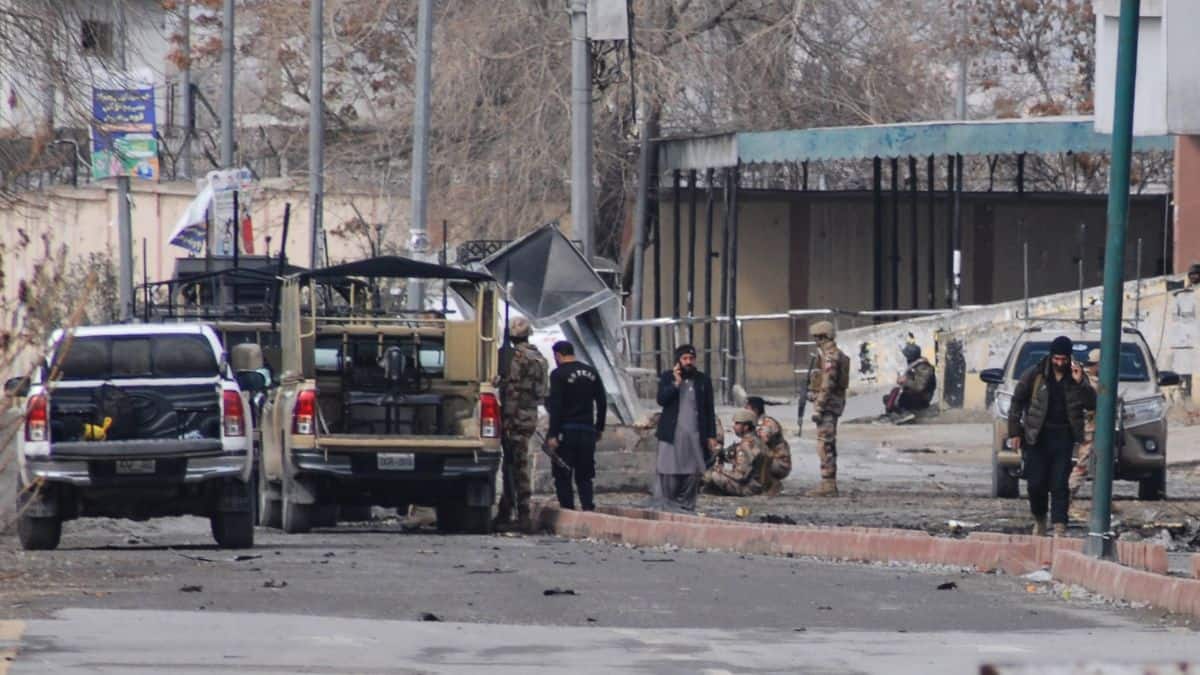
The road through Kohat is not just a stretch of asphalt. It is a vein of history, a winding passage through the rugged, sun-bleached hills of Khyber Pakhtunkhwa where the air often tastes of diesel and ancient stone. In the district of Lachi, the silence is usually heavy, broken only by the occasional bleat of a goat or the low rumble of a passing truck. But on a Tuesday that began like any other, that silence was shattered by the rhythmic, deafening percussion of automatic gunfire.
When a police van moves through these regions, it carries more than just officers. It carries the weight of a state trying to hold its ground. Inside that particular vehicle was Deputy Superintendent of Police (DSP) Jamil Samad Khan, a man whose rank suggests authority, but whose presence on that road spoke of a far grittier reality. He wasn't sitting in a fortified office behind layers of concrete. He was on the front lines, moving through the dust, where the boundary between peace and chaos is as thin as a uniform's fabric.
The ambush was not a random act of violence. It was a calculated erasure.
Reports indicate that the vehicle was targeted in the Araish Khel area of Lachi. The attackers, hidden by the unforgiving terrain, unleashed a hail of bullets that left no room for escape. In the span of a few frantic minutes, seven lives were extinguished. Seven families were dismantled. The DSP, along with six of his subordinates, became another grim statistic in a region that has seen far too many.
To understand the gravity of this event, one must look past the headline. A "police van ambush" sounds clinical. It sounds like something that happens in a movie or a distant, disconnected world. But for the people of Kohat, this is the sound of their brothers, fathers, and sons being torn away. Imagine a young constable, perhaps only a few years into his service, checking his reflection in the morning to ensure his belt is straight. He kisses his child, promises to be home for dinner, and steps out into a landscape where the shadows of the mountains can hide a thousand threats.
The tactical reality of Khyber Pakhtunkhwa (KP) is a puzzle of shifting loyalties and porous borders. The province has become a crucible. Over the last year, there has been a documented surge in militant activity, a rising tide that the police are expected to hold back with limited resources and immense bravery. While the military handles large-scale operations, the local police—the "Jawans"—are the ones walking the beat, manning the checkpoints, and driving the vans that become targets.
They are the softest targets with the hardest jobs.
Consider the ripple effect of a single bullet. When a DSP is killed, it isn't just a loss of leadership; it is a signal sent by insurgents that no one is safe. It is an attempt to demoralize the entire force. When six additional officers fall beside him, it creates a void in six different households. We are talking about pension papers that will never replace a father's hand on a shoulder. We are talking about empty chairs at wedding feasts and the suffocating quiet of a home that used to be filled with the mundane complaints of a tired man coming off a double shift.
The geography of the attack matters. Kohat sits as a gateway, a point of transit between the settled areas and the more volatile tribal belts. Lachi, specifically, has seen its share of blood before. The attackers know these roads. They know the curves where a driver must slow down. They know the spots where the cellular signal dips and a call for backup might take those precious extra seconds to connect. This wasn't just an assault; it was an execution of local knowledge used for malice.
There is a tendency in international media to view these incidents as a "Pakistan problem," a localized conflict that exists in a vacuum. This is a mistake. The instability in KP is a barometer for the region’s security. When the thin blue line of the provincial police begins to fray under the pressure of constant ambushes, the security of the entire corridor is compromised.
Statistics tell us that 2023 and early 2024 have been some of the deadliest periods for Pakistani security forces in a decade. But numbers have a way of numbing the soul. They don't tell you about the smell of spent gunpowder mixing with the scent of rain-drenched earth. They don't describe the sight of a charred vehicle, its windows spider-webbed by lead, sitting abandoned on a road while investigators mark the ground with yellow chalk.
The response from the government follows a predictable pattern. High-level meetings are called. Condemnations are issued. "The sacrifices of our martyrs will not go in vain," the officials say. But for the survivor—perhaps a lone officer who missed the shift, or a cousin who now has to lead a funeral procession—those words feel hollow. They want to know why the armored vehicles are so few. They want to know how the intelligence failed to see the movement in the hills.
The truth is that the police in this region are fighting a ghost war. They are fighting an enemy that doesn't wear a uniform, that disappears into the civilian population, and that chooses the time and place of every engagement. It is an exhausting, 24-hour vigilance that erodes the nerves. Every parked bike could be a bomb. Every group of men on a hillside could be a lookout party.
The loss of DSP Jamil Samad Khan is particularly stinging because it represents the loss of experience. In a force where institutional memory is often cut short by violence, losing a senior officer means losing a mentor. He was the one who knew which village elders to trust, which trails were frequently used by smugglers, and how to balance the iron fist of the law with the velvet glove of community policing. You cannot replace that with a fresh recruit and a month of training.
As the sun sets over the Kohat tunnels and the shadows lengthen across the valleys of Lachi, the sirens eventually fade. The bodies are moved. The wreckage is towed away. But the blood stays in the cracks of the pavement for a little while longer, a dark reminder of the price of a badge in this part of the world.
There is no easy fix. No amount of "robust" policy or "synergy" between departments can instantly heal a borderland that has been bleeding for forty years. It requires a fundamental shift in how the state protects its protectors. It requires more than just eulogies; it requires the kind of systemic support that ensures a police van isn't a rolling coffin.
Tonight, in seven homes across the province, the lights will stay on late. There will be no dinner conversations about the day's small victories or the heat of the afternoon. There will only be the sound of mourning—a high, keening wail that rises from the valley and gets lost in the indifferent peaks of the Suleiman Range.
The road to Lachi remains open, winding and treacherous, waiting for the next patrol to round the bend.