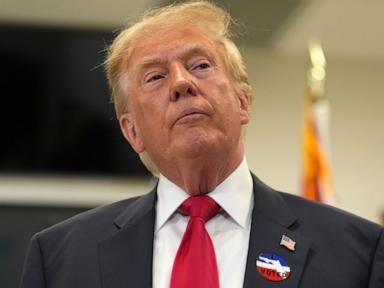
Donald Trump walked into a Palm Beach County polling location to cast an early in-person midterm ballot, a routine civic act transformed into a high-stakes political signal. On the surface, the event looks like standard political theater—a prominent figure fulfilling a basic democratic duty near his Mar-a-Lago residence. Beneath the photo opportunities and brief remarks to waiting reporters, however, lies a calculated strategic shift that exposes the widening gap between populist rhetoric on election integrity and the cold math of modern campaign operations.
For years, the core message from the top of the Republican ticket was unambiguous. Mail-in ballots were framed as inherently suspect, early voting windows were treated as opportunities for systemic manipulation, and Election Day itself was elevated to the sole legitimate venue for casting a vote. Yet when the time came to participate in the midterm cycle, Trump did not wait until Tuesday. He joined millions of Floridians taking advantage of the state’s expansive early voting infrastructure.
This is not merely a personal scheduling convenience. It is the visible tip of a massive, quiet overhaul in how conservative political machines operate on the ground—an admission that unilateral disarmament in the pre-Election Day vote race is a losing formula.
The Mechanics of Florida's Voting System
To understand why this single ballot matters, you have to look at the machinery governing elections in the Sunshine State. Florida does not run a uniform, statewide voting apparatus; instead, it operates through 67 distinct county Supervisors of Elections, all bound by a strict statutory framework passed by the Republican-controlled legislature in Tallahassee.
When Trump cast his ballot in Palm Beach County, he entered a system specifically engineered for speed, redundancy, and auditability. Florida law mandates a minimum eight-day early voting period beginning ten days before Election Day and ending three days prior, though counties have the statutory discretion to expand that window up to 14 days. Palm Beach County routinely utilizes the maximum allowable timeframe, operating dozens of regional sites equipped with real-time electronic poll books.
The process itself leaves little room for the administrative friction that plagues other jurisdictions. A voter presents an acceptable form of government-issued photo and signature identification—typically a Florida driver’s license or a U.S. passport. Poll workers verify the voter's registration status instantaneously against the statewide Florida Voter Registration System (FVRS). Once checked in, the system flags the voter's record across every precinct in the state, making it technically impossible to cast a second ballot elsewhere or to have a previously requested mail ballot tabulated.
Crucially, Florida relies exclusively on paper ballots marked by hand and fed directly into optical scan tabulators at the precinct level. There are no paperless touchscreen machines. Every single vote generates a physical, voter-verified paper trail stored in locked, tamper-evident ballot boxes, ready for mandatory post-election audits or machine recounts.
By choosing early in-person voting over mail-in voting, Trump threaded a very specific political needle. He utilized the convenience of the extended calendar while avoiding the specific mechanism—unsupervised mail-in ballots—that he has spent years attacking.
The Math That Forced a Strategic Retreat
Political rhetoric is free, but elections are won on spreadsheets. For two consecutive cycles, Republican strategists watched a predictable and devastating pattern unfold across battleground states. Democratic campaigns treated Election Day not as a single event, but as a deadline—banking hundreds of thousands of votes weeks in advance through aggressive mail-in and early-voting drives.
Republicans, taking their cues from the top of the ticket, overwhelmingly held their fire until the final Tuesday.
The vulnerability of that approach is elementary to anyone who has ever managed a field operation. When your entire voter base waits until a single 12-hour window to show up, you become hostage to variables entirely outside your control. A severe storm system stalling over a crucial suburban county, an unexpected software glitch in electronic check-in pads, a localized power outage, or simple traffic congestion during rush hour can depress turnout by two or three percentage points. In modern American politics, a two-point drop in high-propensity precincts is fatal.
Moreover, waiting until Election Day ruins campaign resource allocation. Every dollar spent reminding a voter to go to the polls is a dollar wasted if that person has already voted. When campaigns have access to daily voter rolls—which show who has voted, though never how they voted—they can immediately scrub banked voters from their turnout lists.
Consider a hypothetical campaign operating in a tight swing district with 50,000 targeted low-propensity voters. If 20,000 of those voters cast their ballots during the first week of early voting, the campaign’s field directors can reallocate every door-knocker, phone banker, and digital ad dollar toward the remaining 30,000 holdouts during the final stretch. If all 50,000 wait until Tuesday, the campaign has to spend massive capital trying to reach everyone simultaneously in a chaotic 12-hour sprint, inevitably leaving thousands of reachable votes on the table.
The data from recent cycles proved beyond doubt that demonizing early voting depressed Republican turnout among sporadic voters—the exact demographic populist movements rely on to win. Casting a ballot early in Palm Beach County was the most direct way to signal to hesitant supporters that using the early window was no longer an act of ideological betrayal.
The Florida Blueprint Versus National Rhetoric
The irony of the Palm Beach photo-op lies in the stark contrast between Florida’s actual election laws and the broader national narrative surrounding voting reform. Following the 2020 election, Florida Governor Ron DeSantis and the state legislature passed sweeping election bills—most notably Senate Bill 90 and Senate Bill 524—that tightened rules around drop boxes, required voters to request mail ballots more frequently, and created a dedicated Office of Election Crimes and Security.
Yet even after those restrictions were enacted, Florida retained one of the most accessible early-voting frameworks in the country. Lawmakers in Tallahassee were careful not to dismantle the in-person early voting infrastructure that had historically benefited older, reliable Republican voters in retirement communities like The Villages and along the Gulf Coast.
In fact, Florida’s transformation from the ultimate purple swing state—the epicenter of the 2000 recount crisis—into a reliable Republican stronghold is largely a story of mastering early and absentee voting. For decades, the Republican Party of Florida ran the gold standard of absentee ballot chase programs. It was only when national messaging turned against pre-Election Day voting that those margins temporarily narrowed, forcing state party operatives to spend millions re-educating their own base on how to use a system they had previously dominated.
When Trump stepped up to the scanner in Palm Beach, he was validating a system that state-level Republicans never actually wanted their voters to abandon. The tension between national grievance politics and local turnout mechanics had finally reached a breaking point, and pragmatism won.
What Happens Inside the Tabulation Room
For average voters watching the news coverage, the mechanics of what happens after a ballot slides into the optical scanner remain opaque, fueling much of the suspicion that dominates modern political discourse. In Florida, the lifecycle of an early vote is strictly compartmentalized to prevent both internal tampering and premature leaks.
At the close of each day during the early voting period, poll workers at every site execute a strict closing protocol. The optical tabulators print out a physical "zero tape" at the start of the period proving no votes are stored in memory, and at the end of each day, they generate a status report confirming the total number of ballots cast matches the number of voters checked in on the electronic poll books.
Crucially, no results are tabulated or transmitted during the early voting period. The encrypted memory cards remain sealed inside the machines, and the physical paper ballots are removed, placed into serialized, tamper-evident transfer cases, and transported under dual-party supervision—meaning at least two officials of different political affiliations must accompany the materials—back to the central Supervisor of Elections headquarters.
Under Florida statute, canvassing boards are permitted to begin processing and feeding mail-in ballots through high-speed central tabulators weeks before Election Day, and early voting totals are compiled securely in the background. However, releasing a single number before 7:00 p.m. on Election Day—when the last polls close in the Panhandle’s Central Time Zone—is a third-degree felony.
This statutory wall explains why Florida routinely reports 90 percent or more of its statewide vote within two hours of polls closing, even when tens of millions of ballots are cast. While states like Pennsylvania, Wisconsin, and Arizona spend days processing mail ballots because their legislatures prohibited pre-canvassing, Florida’s system front-loads the administrative labor. The ballot Trump cast in Palm Beach was already processed, verified, and sitting in an encrypted database long before the networks began projecting winners on Tuesday night.
The Voter Registration Shift in Palm Beach County
The location of the vote carries its own quiet significance. Palm Beach County was once an impenetrable Democratic fortress—the infamous home of the "butterfly ballot" in 2000 and a reliable vote sink that Democratic statewide candidates depended on to offset conservative margins in North Florida and the rural interior.
That demographic reality has eroded steadily over the past decade. Driven by an influx of wealthy transplants from the Northeast, shifting allegiances among working-class and Hispanic voters, and relentless voter registration drives, the Democratic registration advantage in Palm Beach County has shrunk dramatically. While Democrats still hold a plurality in the county, Republicans have chipped away at the margin year after year, flipping local municipal seats and turning once-safe blue precincts competitive.
Statewide, the shift is even more pronounced. In 2021, for the first time in modern Florida history, registered Republicans outnumbered registered Democrats. By the time this midterm ballot was cast, the Republican statewide registration advantage had ballooned to over one million voters.
In that context, a high-profile early vote in Palm Beach is not a defensive maneuver to save a struggling campaign. It is a victory lap in a state that has fundamentally realigned, designed to export that turnout model to tougher battlegrounds in the Rust Belt and the Southwest.
The Persistence of the Mixed Message
Despite the clear visual of casting an early ballot, the underlying contradiction in conservative election strategy remains unresolved, creating a persistent headache for down-ballot candidates and local party chairs.
You cannot spend forty-eight weeks of the year telling voters that the electoral system is fundamentally rigged, that drop boxes are stuffed by operatives, and that voting rules are designed to disenfranchise conservatives, and then expect those same voters to enthusiastically embrace early voting during the final two weeks of a campaign. Skepticism, once weaponized, is nearly impossible to turn off on command.
Local Republican organizers across the country routinely report encountering voters at the doors who refuse to cast an early or mail-in ballot because they believe waiting until Election Day makes their vote "harder to steal." That belief has zero basis in how optical scanners or central tabulators actually function—an early in-person ballot in Florida goes into the exact same type of machine and database as an Election Day ballot—yet the perception persists because it was reinforced for years by the movement's loudest voices.
Furthermore, this mixed messaging puts immense pressure on election administrators. County supervisors—many of them lifelong Republicans who take fierce pride in running clean, transparent elections—find themselves caught between a political base demanding radical overhauls to secure systems and the reality that unnecessary rule changes often create the very lines, delays, and administrative confusion that fuel conspiracy theories.
The New Standard for Campaign Survival
Modern American elections are no longer single-day sprints; they are multi-week logistics operations. Every major political operation now functions like a data-driven supply chain, tracking individual voters from the moment ballots drop to the second the polls close.
By stepping into a Palm Beach early voting center, Trump tacitly acknowledged a truth that campaign managers have known for twenty years: you cannot win an election under modern rules while playing by the calendar of the 1980s. Moral victories about how elections ought to be conducted do not seat members of Congress, confirm judges, or pass legislation. Only banked votes count.
Whether the broader conservative base fully absorbs that lesson—or continues to view early voting with deep suspicion despite watching their standard-bearer participate in it—remains the central tactical question hanging over every close race on the map. The ballot box in Palm Beach accepted the paper without friction, the scanner tallied the ink in less than a second, and the campaign immediately crossed one more high-propensity voter off its target list.