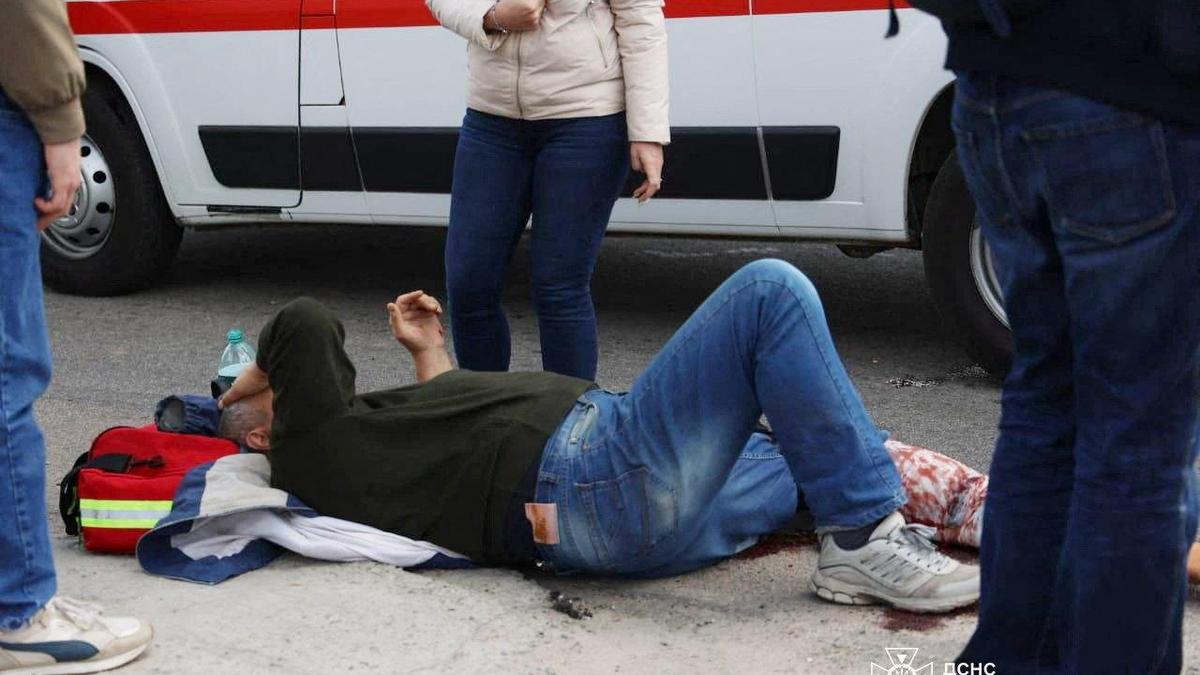
The siren in Dnipro provides no comfort because the math of modern warfare has turned against the civilian. On July 3, 2024, a coordinated Russian strike involving ballistic missiles and explosive drones tore through a shopping center and medical facility, leaving at least five dead and dozens more pulling glass from their skin. While mainstream reports tally the casualties and move on, the grim reality is that this was not a random act of cruelty. It was a data-driven exploitation of Western supply chain delays and the physical limits of Ukraine’s thinning air defense umbrella.
Dnipro sits as a vital logistical artery for the Ukrainian front. By striking at the heart of the city’s civilian infrastructure during peak hours, Moscow isn't just seeking to kill; they are testing the exhaustion levels of the Patriot and IRIS-T batteries stationed nearby. Every missile launched forces a choice: save the shopping mall or save the power substation. On this Wednesday, the mall lost. For a different view, read: this related article.
The Geometry of a Targeted Strike
To understand why five people died in a city that is supposedly protected by world-class hardware, you have to look at the composition of the attack. It wasn't a single "rogue" missile. It was a sophisticated swarm designed to overwhelm the radar’s ability to prioritize targets.
Russian commanders have shifted their doctrine. They now launch slow-moving Shahed drones to force Ukrainian operators to "light up" their radar systems. Once the radar is active, it becomes a beacon. Then comes the Iskander-M—a ballistic missile that travels at hypersonic speeds during its final approach. Related reporting regarding this has been published by The Guardian.
The physics are brutal. An Iskander-M launched from the occupied Crimea or the Kursk region gives a city like Dnipro roughly four to six minutes of warning. If the air defense battery is busy tracking ten different drones, the split-second window to intercept the ballistic threat narrows to almost nothing. This isn't a failure of bravery; it is a failure of saturation.
Why the Shopper Becomes a Target
There is a cold logic to hitting a shopping center. Beyond the immediate terror, these strikes serve to disrupt the internal economy of Ukraine’s industrial hubs. Dnipro is home to the Yuzhmash aerospace plant and various defense contractors. By making the city unlivable for the families of those workers, Russia exerts a pressure that battlefield gains cannot replicate.
The wreckage at the scene—mangled storefronts and charred vehicles—tells a story of a city trying to maintain a facade of normalcy. People were buying groceries. They were heading to the gym. The Russian Ministry of Defense often claims these sites are "temporary deployment points for foreign mercenaries," a boilerplate excuse that has become a dark joke among local journalists. There were no mercenaries at the Dnipro mall; there were only people trying to survive a Wednesday.
The Shell Game of Western Aid
The blood in Dnipro is partially on the hands of bureaucratic inertia. For months, Kyiv has pleaded for a minimum of seven additional Patriot batteries. As of this strike, those batteries remain tangled in the red tape of NATO member states or are "under maintenance" in distant depots.
Air defense is a zero-sum game.
When a battery is moved to protect the capital in Kyiv, a city like Dnipro is left exposed. When a battery is moved to the front lines to stop Russian glide bombs from obliterating the infantry, the civilian centers become shooting galleries. Russia knows exactly how many interceptor missiles Ukraine has left in its inventory. They are running a war of attrition against the American and European industrial base, betting that they can produce cheap missiles faster than the West can produce expensive interceptors.
The Cost Disparity
- Shahed-136 Drone: Roughly $20,000 to $50,000.
- Iskander-M Missile: Approximately $3 million.
- Patriot PAC-3 Interceptor: Nearly $4 million per shot.
Ukraine is often forced to fire two interceptors at a single incoming missile to ensure a kill. You do not need a degree in economics to see that this is unsustainable. Moscow is effectively "buying" Ukrainian civilian lives by forcing the expenditure of high-end Western tech on low-end Russian junk, while occasionally slipping a high-end Iskander through the gap.
The Psychological Front and the Normalization of Terror
There is a dangerous trend in how the international community perceives these strikes. A "missile kills five" headline barely registers on the global stock ticker anymore. We have entered a phase of the conflict where mass casualty events are treated as background noise.
This normalization is exactly what the Kremlin wants. If the world stops being shocked, the political will to send more sophisticated weaponry evaporates. The residents of Dnipro, however, do not have the luxury of apathy. For them, the sound of a motorcycle engine can trigger a panic attack because it mimics the low hum of a Shahed drone.
The Medical Crisis Behind the Numbers
While the death toll stood at five, the number of "wounded" hides a more complex medical reality. Shrapnel wounds from ballistic missiles are not clean. They involve high-velocity debris—glass, rebar, plastic—that creates jagged tracks through human tissue. The hospitals in Dnipro are already strained by the influx of soldiers from the nearby Donbas front. A civilian strike of this magnitude effectively shuts down the local healthcare system for days as surgeons pivot to emergency trauma care.
The strike hit near a medical facility this time. This isn't just a physical blow; it's a strike against the city's recovery capacity. If you kill the doctors or destroy the operating theaters, the lethality of every subsequent strike increases exponentially.
The Strategic Failure of "De-escalation"
For two years, the prevailing logic in Washington and Brussels was that providing Ukraine with long-range strike capabilities would "escalate" the war. The tragedy in Dnipro proves that the opposite is true. By denying Ukraine the ability to strike the airfields and launch sites deep inside Russian territory, the West has granted Moscow a "safe zone" from which to murder civilians.
The missiles that hit Dnipro were likely launched from sites that Ukraine is forbidden from targeting with Western-supplied ATACMS or Storm Shadow missiles. We are essentially asking Ukraine to play a game of goalie where they aren't allowed to cross the center line, while the opposing team has an unlimited supply of pucks.
If the goal is to stop the killing in Dnipro, the solution isn't just more "shields." It is the destruction of the "swords."
The Intelligence Gap
Investigative leads suggest that Russian reconnaissance drones, like the Orlan-10, are now loitering over cities like Dnipro for hours before a strike. They are providing real-time battle damage assessment and корректировка (adjustment) for the missile crews. The fact that these drones can hover over a major metropolitan area with relative impunity suggests a critical gap in short-range electronic warfare and mobile AA units.
The West has focused on the "big ticket" items like the Patriot, but the lack of simple, cost-effective Gepard-style systems or electronic jammers is what allowed the reconnaissance for the Dnipro strike to happen in the first place.
The Infrastructure of Grief
Walking through the impact zone, the smell is the first thing that hits you. It is a mix of ozone, pulverized concrete, and the metallic tang of blood. This isn't the "clean" war seen in grainy black-and-white drone footage. This is the messy, visceral destruction of a European city.
We must stop looking at these incidents as isolated tragedies. They are part of a coherent, long-term strategy to depopulate the eastern half of Ukraine. If you cannot hold the territory, you make it a graveyard. That is the Russian mandate.
The international response to the Dnipro strike has followed the usual script: "strongest possible terms" of condemnation and promises of future aid packages. But for the families of the five who died, the "future" is a moot point. They are the victims of a global hesitation that treats air defense as a luxury rather than a fundamental human right in a zone of conflict.
The next time a siren wails over the Dnieper River, the people will run for the subways not because they trust the technology above them, but because they know they have been left to defend themselves with little more than luck and the remnants of a dwindling stockpile. The math hasn't changed, and until the West decides that a Russian launch site is a more valid target than a Ukrainian shopping mall, the blood in Dnipro will continue to flow.
Stop looking for a "turning point" in the headlines. The turning point was months ago, when the world decided that some lives were worth the risk of escalation and others were merely statistics in a war of attrition. Dnipro is not a headline; it is a warning of what happens when a nation is given enough to survive, but never enough to win.