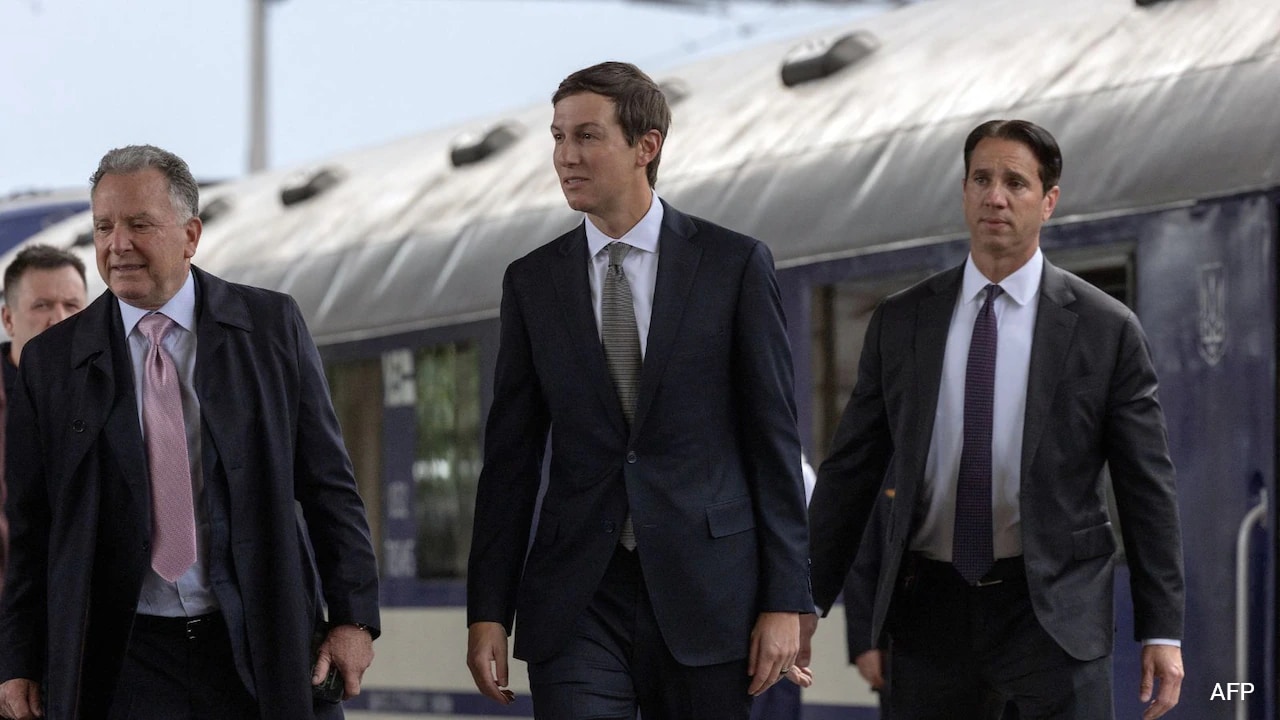
Diplomatic engagement during an active war of attrition follows strict operational constraints where symbolic gestures routinely mask deep incentive misalignment. When United States envoys Steve Witkoff and Jared Kushner arrived in Kyiv via railway after high-level consultations in Moscow, the event was framed as a renewed executive push to stabilize the conflict. Yet, evaluating this diplomatic mission requires stripping away political rhetoric to examine the actual mechanics of the temporary localized pause, the strategic calculations of the belligerents, and the structural limitations plaguing external mediation.
The immediate trigger for the visit was a short-term, reciprocal halt in aerial strikes orchestrated to facilitate safe passage for the delegation. This temporary cessation exposes the core asymmetry of the current theater. Moscow's agreement to pause strikes on Kyiv for a targeted window, mirrored by a corresponding Ukrainian commitment to halt certain retaliatory operations, functions as a confidence-building measure of minimal military significance. In protracted conventional conflicts, short-term truces do not alter strategic trajectories; rather, they serve as informational reconnaissance missions. Both state actors utilize the pause to measure the opponent's immediate operational responsiveness, test command-and-control integrity, and posture for international audiences.
The Divergent Cost Functions of Moscow and Kyiv
Understanding why high-level diplomatic missions yield minimal structural breakthroughs requires analyzing the opposing cost functions governing decision-making in the Kremlin and the Office of the President of Ukraine.
For Moscow, the utility of continuing offensive military pressure remains high relative to the perceived costs of diplomatic compromise. Kremlin leadership operates under the assumption that time and material exhaustion favor their broader operational objectives. Territorial demands remain anchored to maximalist positions, and temporary localized halts are deployed selectively to manage international optics without conceding strategic momentum on the front lines. The cost function for Russia dictates that engaging with external intermediaries carries near-zero risk as long as hard-power advancements continue in the active combat zone.
Conversely, Kyiv operates under an existential cost function where territorial concessions equal permanent structural vulnerability. Ukrainian leadership faces severe domestic and strategic constraints: any negotiated framework that institutionalizes territorial loss without airtight, enforceable security guarantees creates an unacceptable long-term hazard. Consequently, the reception of foreign delegations in Kyiv is characterized by low baseline expectations. The primary objective for Ukrainian statecraft during such visits is not an immediate peace accord—which remains mathematically improbable given the distance between stated war aims—but rather the operational anchoring of Western partners to prevent drift in military and financial support.
The Logistics of Mediation Without Leverage
External mediation fails when the mediator lacks asymmetric leverage over the core belligerents. The current White House diplomatic strategy relies heavily on personal envoy channels rather than traditional institutional statecraft. While direct dialogue channels maintain communication lines, they suffer from structural vulnerabilities:
- The Enforcement Vacuum: A peace proposal lacks viability if the mediating power cannot impose economic or military penalties for non-compliance. Without immediate punitive levers against Russian supply chains or enhanced, unconditional provisions for Ukrainian defense, diplomatic proposals remain non-binding suggestions.
- Asymmetric Information Flow: Envoys moving sequentially between Moscow and Kyiv often encounter tailored narratives designed to manipulate Western perception. Moscow emphasizes battlefield realities and purported openness to political solutions, while Kyiv highlights the continuous bombardment of civilian infrastructure and the absolute necessity of territorial integrity.
- Domestic Political Compulsions: External administrations facing domestic pressure for foreign policy wins often compress complex, multi-year geopolitical struggles into compressed timelines, forcing premature frameworks that ignore ground-level operational realities.
The reliance on railway transport for foreign delegations underscores the degraded state of regional infrastructure and the complete absence of contested airspace safety. Commercial aviation routes remain severed, and the physical vulnerability of capital infrastructure dictates that high-level diplomacy must crawl along nineteenth-century rail corridors rather than landing via modern air mobility. This logistical constraint serves as a physical manifestation of the broader diplomatic deadlock: movement is possible, but only under heavily negotiated, highly fragile temporary exemptions.
Strategic Trajectory
The structural reality governing the Russia-Ukraine conflict indicates that high-profile diplomatic shuttles will continue to generate cyclical headlines without altering the fundamental military balance. As long as the marginal utility of continued fighting exceeds the perceived benefits of a compromised settlement for both primary actors, localized pauses will function merely as tactical pauses in a prolonged war of attrition. Future diplomatic interventions will only gain traction if structural economic pressures or severe resource constraints fundamentally alter the internal cost functions of the belligerent states, a threshold that current mediation frameworks have not yet managed to cross.


