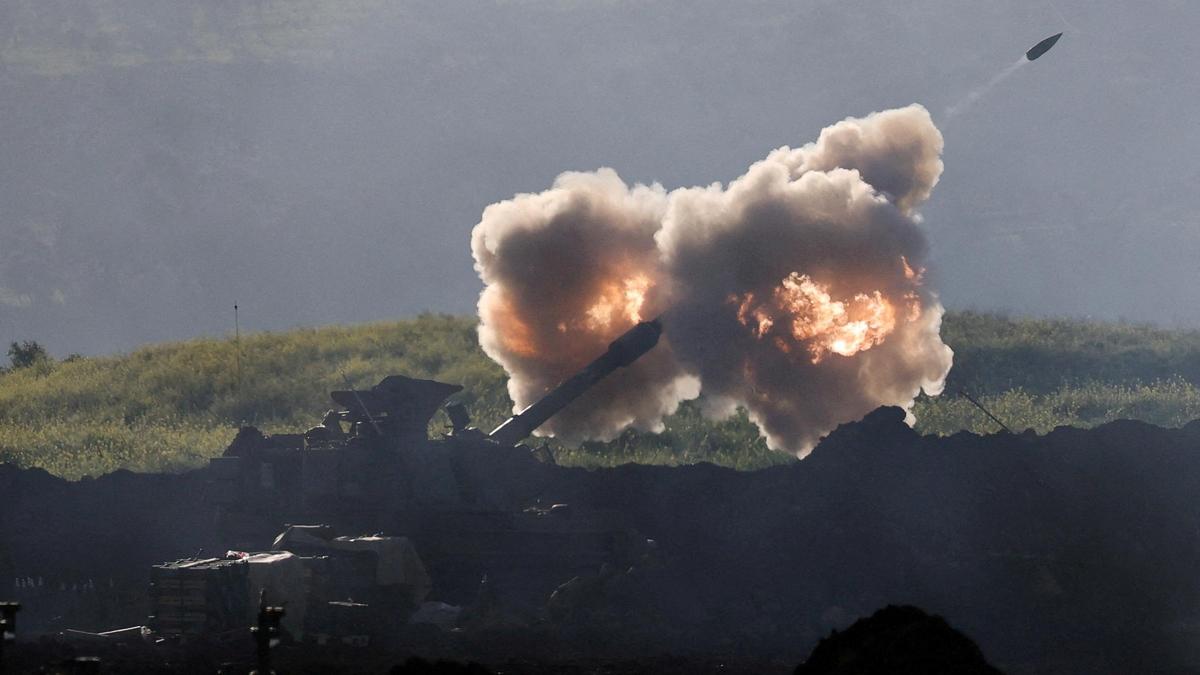
The illusion of distance died this week in the central Indian Ocean. When two Iranian intermediate-range ballistic missiles (IRBMs) arched toward the coral atoll of Diego Garcia, they didn't just target a runway; they dismantled a decades-old Western assumption that certain strategic hubs were simply too far away to be touched. For fifty years, this "unsinkable aircraft carrier" served as the ultimate sanctuary for U.S. and British power, a place where B-52 bombers could sleep soundly while the Middle East burned 4,000 kilometers to the north. That sanctuary is gone.
The facts of the strike attempt are chilling in their simplicity. According to intelligence reports confirmed by the Wall Street Journal, Tehran launched two missiles—likely variants of the Khorramshahr-4—spanning a distance that roughly doubles Iran’s previously claimed operational limit of 2,000 kilometers. One missile suffered a mid-flight malfunction, plummeting into the sea. The second was engaged by a U.S. Navy destroyer firing an SM-3 interceptor. While the Pentagon remains tight-lipped on whether the "kill" was successful, the miss was as good as a hit for Iran’s propaganda machine. They have proven they can reach out and touch the most vital logistics node in the Southern Hemisphere.
The 4000 Kilometer Lie
For years, Iranian Foreign Minister Abbas Araghchi maintained a polished narrative: Tehran’s missile program was "strictly defensive," capped at a 2,000-kilometer range to respect European sensitivities. This week's launch exposed that cap as a diplomatic fiction. By targeting an island 3,800 to 4,000 kilometers away, Iran has effectively informed NATO that the entire European continent—from Athens to London—is now within the theoretical crosshairs of its mobile launchers.
The hardware used in this strike represents a significant leap in engineering. The Khorramshahr-4 is a liquid-fueled beast capable of carrying a warhead exceeding one tonne. More importantly, it features maneuverable re-entry capabilities designed specifically to frustrate Aegis-equipped destroyers. This isn't the "bottle rocket" technology of the 1990s. This is a sophisticated delivery system that bridges the gap between regional skirmishes and intercontinental threats.
A Base Built on Stolen Ground
To understand why Diego Garcia is the prize, you have to look at its history—a narrative defined by Cold War pragmatism and what many international jurists call a "crime against humanity." In the late 1960s and early 70s, the British government forcibly evicted the entire native population, the Chagossians, to make way for the U.S. base. These people were loaded onto ships and dumped in Mauritius and the Seychelles, their pet dogs gassed in sheds to ensure no one would stay behind.
This historical baggage is currently exploding into a modern sovereignty crisis. Just months ago, the UK government under Keir Starmer signed a treaty to hand sovereignty of the Chagos Archipelago back to Mauritius. The deal includes a 99-year lease for the Diego Garcia base, intended to provide "legal certainty" for the U.S. military. However, the ink was barely dry before Donald Trump slammed the deal as "an act of great stupidity," arguing that Mauritius—a nation with increasing economic ties to China—could eventually buckle under pressure and evict the Americans anyway.
The Strategic Value of the Atoll
Why fight over a strip of coral? Diego Garcia is the "fulcrum" of the Indian Ocean for three reasons:
- Bomber Reach: It is one of only two bases in the Indo-Pacific (the other being Guam) capable of hosting heavy, nuclear-capable bombers like the B-1B and B-2 Spirit.
- Maritime Chokepoints: It sits equidistant from the Strait of Hormuz, the Bab-el-Mandeb, and the Malacca Strait. If you control Diego Garcia, you monitor the oil that powers the global economy.
- Space and Surveillance: The island hosts a critical U.S. Space Force tracking station and a GPS ground antenna. It is a literal node in the digital "nervous system" of global warfare.
The British Dilemma
The timing of the Iranian strike is no coincidence. It followed a shift in British policy where London finally allowed the U.S. to use Diego Garcia for "offensive" operations against Iranian assets threatening the Strait of Hormuz. Previously, the UK had restricted the base to "defensive" roles to avoid becoming a direct combatant. Tehran’s response was a clear message: If you let them launch from there, we will fire at you.
This puts the UK in an impossible position. They are trying to exit their colonial past by returning the islands to Mauritius, while simultaneously being dragged into a high-stakes missile duel that puts British territory in the line of fire. Critics in the House of Commons are already pointing out that the "security" promised by the 2025 treaty looks remarkably fragile if the base can be targeted with impunity by a middle-tier power.
Reality Check on Interception
While the U.S. military celebrates the "successful" defense of the atoll, industry analysts are less optimistic. The SM-3 interceptor is a marvel of technology, but it operates on a "hit-to-kill" basis. In a saturation attack—where Iran fires twenty missiles instead of two—the math fails. There are only so many interceptors on a destroyer, and each one costs significantly more than the missile it is trying to stop.
If even one conventional warhead were to crater the runway at Diego Garcia, the U.S. ability to project power across the Middle East and the South China Sea would be paralyzed for weeks. The "fortress" is now a target, and the distance that once protected it has been bridged by the physics of Iranian propulsion.
The question is no longer whether Iran can hit Diego Garcia, but whether the West is willing to defend a 99-year lease on an island that has suddenly become the most dangerous piece of real estate in the Indian Ocean.
Ask yourself if the current U.S. administration is prepared to escalate to a full-scale regional war the moment a single Iranian missile finally finds its mark on that runway.