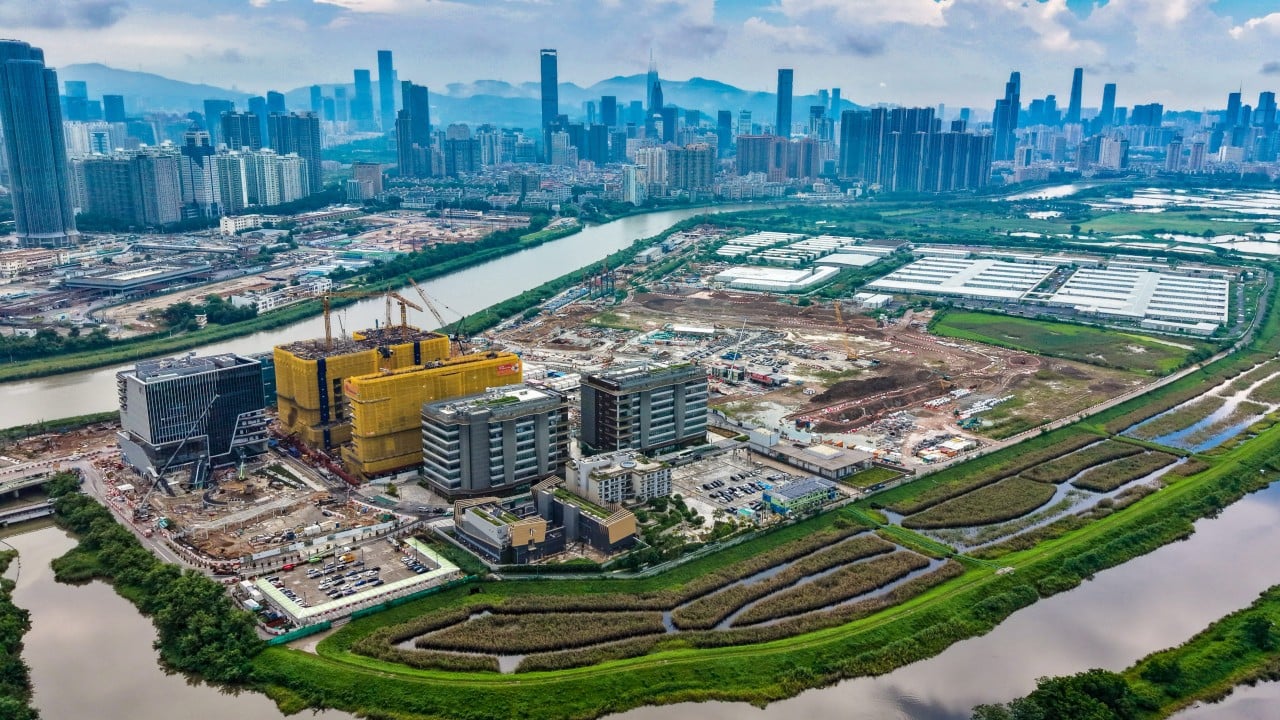
Hong Kong’s legislative approval of the Northern Metropolis acceleration bill marks a fundamental shift from consensus-driven urban planning to state-directed infrastructure execution. By compressing statutory land resumption timelines, bypassing multi-stage zoning objections, and centralizing executive authority over land assembly, the Hong Kong Special Administrative Region (HKSAR) government is attempting to solve its chronic supply bottleneck through regulatory engineering. This legislative maneuver trades procedural friction for capital velocity, directly targeting the critical path delays that have historically stalled large-scale development across the New Territories.
The Structural Anatomy of the Bottleneck
To understand why legislative intervention became necessary, one must examine the traditional Hong Kong land development lifecycle as a sequential queuing system. Historically, bringing raw agricultural or brownfield land in the New Territories to market required navigating three distinct, non-overlapping regulatory gates: For a different view, see: this related article.
- Statutory Town Planning: Rezoning under the Town Planning Ordinance, which exposed projects to multiple rounds of public representation, further representation, and protracted Town Planning Board hearings.
- Land Resumption and Clearance: Acquiring fragmented private landholdings—often held under centuries-old ancestral trusts (Tso and Tong entities)—under the Lands Resumption Ordinance, where compensation disputes and occupant clearance routinely added three to five years to project schedules.
- Site Formation and Infrastructure Provision: Engineering works governed by separate environmental impact assessments (EIAs) and road/drainage gazettals, each carrying independent objection mechanisms.
In systems engineering terms, these processes operated in series rather than in parallel. A delay at any single node halted the entire downstream pipeline. For the Northern Metropolis—a planned 30,000-hectare zone spanning Yuen Long and North District intended to house 2.5 million people and anchor Hong Kong’s innovation and technology sector—operating under legacy statutory timelines would have pushed full build-out well past the 2040s. The opportunity cost of that delay is measurable in lost cross-border economic integration with Shenzhen and continued downward pressure on corporate competitiveness caused by commercial real estate scarcity.
The Three Mechanisms of Regulatory Compression
The newly passed legislation does not alter the physical engineering requirements of the Northern Metropolis; instead, it re-architects the administrative operating system governing land assembly and project initiation. This restructuring relies on three primary mechanisms. Similar reporting on this matter has been provided by Business Insider.
1. Parallel Processing of Statutory Approvals
The bill decouples land resumption from final zoning approval. Under prior rules, the government generally could not initiate formal resumption procedures until the underlying Outline Zoning Plan (OZP) had survived all statutory challenges. The revised framework permits the Lands Department to commence resumption and compensation negotiations concurrently with town planning processes. By shifting sequential dependencies into parallel workflows, the administration eliminates years of idle time between planning gazettal and physical site possession.
2. Truncation of Objection Windows
Public consultation under the legacy framework allowed for iterative objection cycles that organized interest groups and landowners frequently used to extract higher compensation or stall development indefinitely. The new legislation compresses the statutory period for submitting objections and restricts the Town Planning Board's obligation to hold repetitive hearings on substantially similar representations. While citizens retain the right to submit written objections, the administrative mechanism for converting those objections into multi-year delays has been neutralized.
3. Centralization of Executive Discretion
By granting designated project authorities streamlined powers to approve site formation, roadworks, and environmental mitigation measures under a unified mandate, the bill reduces inter-departmental coordination failure. In complex megaprojects, bureaucratic friction between the Development Bureau, the Transport and Logistics Bureau, and the Environmental Protection Department often creates internal gridlock. Centralizing decision-making authority establishes a single point of accountability, aligning bureaucratic incentives with schedule adherence rather than risk avoidance.
Economic Trade-Offs and Capital Allocation Risks
Applying Coase theorem and transaction cost economics to urban land assembly reveals why state-led compulsion is often deployed when private negotiation fails. In the Northern Metropolis, land ownership is severely fragmented across thousands of small lots, brownfield operators (such as logistics yards, recycling depots, and vehicle repair workshops), and rural villages. Private developers attempting to assemble contiguous parcels face classic holdout problems: the final landowners in an assembly zone demand disproportionate rents, capturing the surplus value created by the infrastructure investment.
Statutory resumption solves the holdout problem by replacing voluntary market exchange with compulsory acquisition at assessed statutory rates. However, accelerating this process introduces three distinct financial and operational risks for the HKSAR government.
Front-Loaded Fiscal Exposure
Compressing the timeline for land resumption forces the government to crystallize its capital expenditure obligations immediately. Under the Enhanced Conventional New Town Approach (ECNTA), the government pays statutory compensation—indexed to agricultural and building land values—upon taking possession, years before the newly formed land can be auctioned to private developers or monetized via public-private partnerships. In a high-interest-rate environment or a sluggish property market, front-loading tens of billions of Hong Kong dollars in resumption payouts widens the fiscal deficit and strains public reserves before any revenue recovery occurs.
Brownfield Displacement and Supply Chain Friction
The Northern Metropolis currently hosts roughly 1,600 hectares of active brownfield sites. While visually disorganized, these sites perform essential back-of-house economic functions for Hong Kong, including container storage, construction material staging, and waste recovery. Accelerating site clearance without simultaneously bringing multi-story industrial buildings online risks creating an immediate operational shock for the local logistics and construction sectors. If displaced operators cannot relocate, their cost increases will pass directly into consumer prices and public works construction bids.
Valuation Mismatch in Land Premiums
The financial viability of Hong Kong’s infrastructure model relies on land value capture: the state acquires low-value rural land, invests in rail and road connectivity, and captures the resulting appreciation through land sales and lease modification premiums. When regulatory timelines are compressed during a cyclical downturn in commercial and residential real estate, the spread between resumption costs and market land premiums narrows. If private developers lack the balance sheet capacity or risk appetite to bid aggressively for newly cleared sites, the government is left holding an expensive, illiquid land bank.
The Geopolitical and Spatial Logic of Cross-Border Integration
Analysts who view the Northern Metropolis solely through the lens of local housing supply miss its primary strategic function. The megaproject is an exercise in spatial economics designed to reorient Hong Kong’s economic center of gravity northward toward the Guangdong-Hong Kong-Macao Greater Bay Area (GBA).
For decades, Hong Kong’s economic engine was concentrated around Victoria Harbour—Central, Admiralty, and Tsim Sha Tsui—optimized for global financial services, maritime trade, and westward-facing capital flows. Meanwhile, the northern border functioned as a buffer zone, intentionally underdeveloped to maintain a clear regulatory and physical boundary with mainland China.
Shenzhen’s rapid transformation into a global hardware and technology hub inverted that spatial logic. Today, the highest-growth economic cluster in southern China sits directly across the Shenzhen River in Nanshan, Futian, and Luohu. By developing the San Tin Technopole and the Hong Kong-Shenzhen Innovation and Technology Park in the Lok Ma Chau Loop, the Northern Metropolis creates a contiguous innovation corridor.
The acceleration bill is the institutional prerequisite for synchronizing Hong Kong’s development speed with Shenzhen’s execution velocity. Without legislative compression, Hong Kong’s multi-decade planning cycles would render it incapable of matching Shenzhen’s infrastructure rollout, leaving Hong Kong’s research universities and financial institutions physically disconnected from mainland manufacturing and commercialization ecosystems.
Execution Vulnerabilities and Institutional Limits
Legislation removes statutory barriers, but it cannot manufacture engineering capacity, labor supply, or private sector capital. As the Northern Metropolis transitions from legislative approval to physical execution, three operational constraints will determine whether the projected timeline holds.
- Construction Labor and Cost Inflation: Hong Kong already suffers from one of the highest construction costs globally, driven by an aging skilled workforce and strict labor importation quotas. Simultaneously executing the Northern Metropolis, the Kau Yi Chau Artificial Islands, and major railway expansions (such as the Northern Link) will trigger severe competition for specialized engineering talent and concrete/steel supply, pushing tender prices upward regardless of how fast land is resumed.
- Private Sector Co-Investment Hesitancy: The government’s fiscal blueprint assumes substantial private capital participation through land swaps, build-operate-transfer (BOT) models, and direct land acquisitions. However, major Hong Kong property conglomerates are currently prioritizing deleveraging over long-horizon land banking. Legislative speed does not alter a developer's weighted average cost of capital (WACC) or internal hurdle rates.
- Governance of Novel Financing Vehicles: To bypass traditional budget constraints, policymakers have floated issuing infrastructure bonds and establishing specialized statutory corporations to manage specific zones within the metropolis. If these entities lack clear commercial mandates or suffer from bureaucratic overlap with existing government departments, speed gains achieved during land resumption will be lost during project financing and procurement.
Strategic Imperatives for Capital Allocators and Operators
For real estate developers, institutional investors, and corporate real estate teams evaluating exposure to the Northern Metropolis, the passage of this bill invalidates historical assumptions regarding Hong Kong development timelines. Waiting for traditional zoning milestones to de-risk entry will result in missing the primary value-capture window.
1. Re-index Land Acquisition Models to Statutory Resumption Schedules
Developers holding agricultural land reserves within the Northern Metropolis boundaries must immediately audit their holdings against the revised ECNTA thresholds. With resumption timelines compressed, the window to assemble contiguous sites for in-situ land exchange applications is narrowing. Landowners must either commit capital to meet minimum site-area requirements immediately or prepare for compulsory cash resumption at statutory rates, which caps upside participation.
2. Target Industrial and Logistics Infrastructure Early
The clearest near-term market inefficiency lies in the displacement of brownfield operators. Institutional capital should prioritize acquiring or developing modern, high-specification multi-story logistics and industrial facilities in adjacent sub-markets (such as Tuen Mun and Kwai Tsing) or designated industrial zones. As clearance accelerates over the next 24 months, displaced logistics operators will face inelastic demand for compliant warehouse space, driving sustained rental yield outperformance in industrial assets relative to Grade-A office space.
3. Structure Joint Ventures Around Cross-Border R&D Mandates
Corporate occupiers and venture-backed technology firms should treat the San Tin Technopole not as a conventional real estate play, but as a regulatory arbitrage vehicle. Organizations establishing dual-headquarters operations that bridge Hong Kong’s common-law intellectual property protections and international capital access with Shenzhen’s hardware prototyping supply chains should negotiate directly with the Northern Metropolis Coordination Office for bespoke land grants or subsidized lease terms before standard commercial pricing mechanisms take effect.