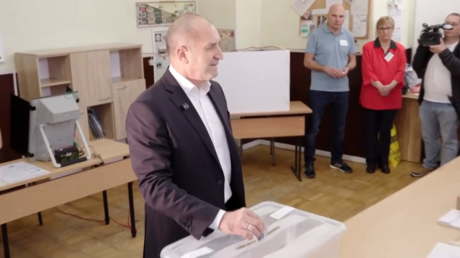
The eighth time is not a charm; it is a reckoning. As Bulgarians head to the polls today, April 19, 2026, the exhausted narrative of "voter apathy" has been replaced by a volatile, high-stakes surge. Turnout is projected to hit 60%, nearly doubling the abysmal 34% seen in mid-2024. But this is not a celebration of democratic health. It is a desperate, final attempt by a hollowed-out electorate to find a pilot for a plane that has been in a flat spin for five years.
At the center of this storm is Rumen Radev, the former fighter pilot and recently resigned President who has traded his ceremonial robes for the sharp elbows of parliamentary combat. By abandoning the presidency in January to lead his Progressive Bulgaria coalition, Radev has effectively blown up the traditional political map. He isn't just running for Prime Minister; he is running against the very system he once presided over, promising to "drown the bought vote in a sea of free ones."
The Mirage of Stability
For years, the West viewed Bulgaria through the lens of a "rotating" pro-European government—a fragile marriage of convenience between the center-right GERB party and the reformist PP-DB. That experiment ended in a spectacular, mud-slinging divorce last December when tax hikes and stalled judicial reforms triggered the largest street protests in a decade.
The collapse of that coalition wasn't just a political failure; it was the death of the centrist consensus. Voters realized that the "pro-European" label was often used as a shield to protect an oligarchic status quo. While Sofia’s elite argued over Eurozone entry, which officially occurred on January 1, the rural heartland watched inflation erode their savings.
Radev’s brilliance—or his danger, depending on who you ask—lies in his ability to fuse anti-corruption fire with a unapologetic pro-Russian lean. He is the only candidate successfully speaking to two vastly different groups: the young protesters in Sofia who want the judiciary cleaned up, and the older, Kremlin-sympathetic voters who believe the EU has turned Bulgaria into a second-class colony.
The Kremlin’s Balkan Trojan Horse
While the rest of the European Union has largely shuttered its doors to Moscow since 2022, Radev is calling for "practical relations" based on "mutual respect." This is more than just diplomatic nicety. Bulgaria remains the most vulnerable point in NATO’s eastern flank, a country where energy dependence and historical ties to Russia are woven into the national fabric.
Radev’s opposition to military aid for Ukraine and his skepticism regarding the pace of EU integration have set off alarm bells in Brussels. If his coalition secures the projected 35% of the vote, he won't have a majority, but he will have a mandate to reshape Bulgaria’s foreign policy.
The "Why" behind his rise is simple: he has positioned himself as the only "clean" actor in a room full of tainted veterans. Boyko Borissov, the leader of GERB, is still haunted by the shadows of his long tenure, and Delyan Peevski, the power-broker behind the Movement for Rights and Freedoms, remains under US and UK sanctions for corruption. In a field of villains, the man in the cockpit looks like a savior.
The Judicial Bottleneck
Radev’s most ambitious—and controversial—promise is the "total dismantling of the oligarchic model." He is seeking a supermajority of 160 votes in the 240-seat parliament to overhaul the Supreme Judicial Council and appoint a new Prosecutor General.
To a weary public, this sounds like justice. To constitutional scholars, it sounds like a power grab. The risk is that in the quest to purge the "old guard," Radev may inadvertently create a new, unchecked executive power. History in the Balkans has a nasty habit of replacing one set of oligarchs with another, usually under the guise of "the people’s will."
The Arithmetic of Another Failure
Even with a massive turnout, the math of the Bulgarian parliament remains brutal. If Radev hits 35%, he still needs partners.
- The Reformists (PP-DB): They share his anti-corruption goals but find his pro-Russian stance toxic.
- GERB: Borissov remains the second-largest force with roughly 18%, but a coalition with Radev would be a suicide pact for both.
- The Extremists: Parties like Revival share Radev’s Euroscepticism but are often too radical for a formal government role.
If Radev cannot bridge these divides, Bulgaria faces a ninth election by the autumn. This is the "hidden" crisis: the country is currently operating on the fumes of interim cabinets and caretaker budgets. Since 2021, no government has lasted long enough to implement a four-year strategy. Schools, hospitals, and infrastructure projects are stalled because the people holding the checkbook change every six months.
A Republic at the Breaking Point
The high turnout today isn't a sign of hope; it’s a sign of exhaustion. Bulgarians aren't voting because they've found a candidate they love; they are voting because they cannot afford the cost of another collapse. The rise of Radev marks the end of the post-1989 era where the path to the West was the only one available.
Bulgaria is now a laboratory for a new kind of European politics—one that is anti-corruption but also anti-Brussels, populist but disciplined, and deeply, dangerously comfortable with Moscow.
The ballots are being counted, but the outcome is already clear: the old Bulgaria is gone, and the new one is being led by a man who knows exactly how to fly a jet, but has yet to prove he can land a country.