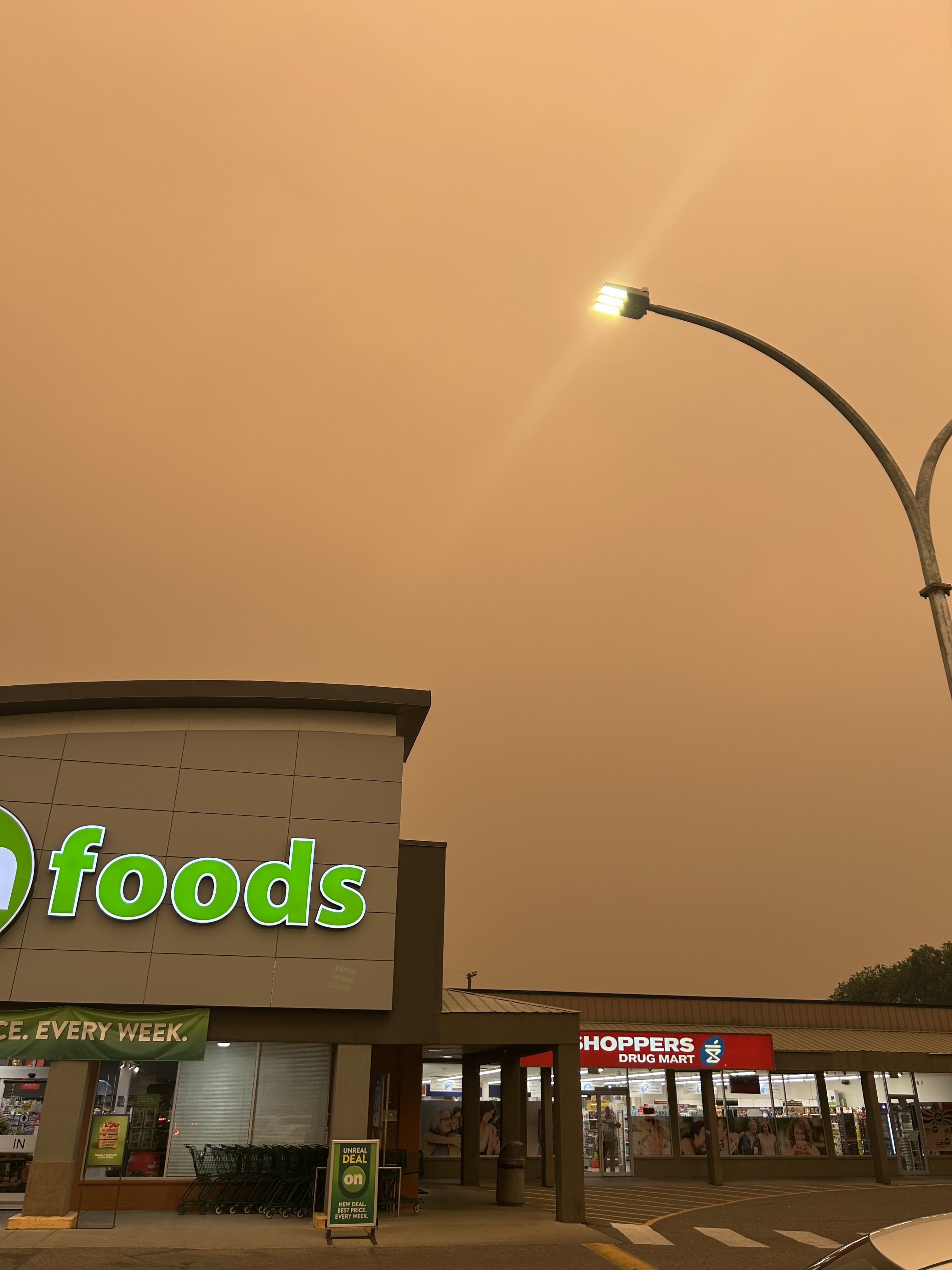
The morning coffee didn’t taste right. It wasn't the beans or the milk. It was the air.
By 8:00 AM in Kamloops, the kitchen window should have been streaming with the sharp, clean light of a British Columbia summer. Instead, a heavy, amber gloom pressed against the glass. It looked like an old photograph left too long in the sun, faded and stained. Step outside, and the back of your throat caught instantly. It was the distinct, acrid sting of campfire, stripped of any cozy weekend nostalgia.
This is what happens when the wilderness decides to move indoors.
When a wildfire tears through the backcountry, we tend to measure the disaster in hectares burned, structures lost, and containment percentages. Those numbers are neat. They fit into a crawler at the bottom of a television screen. But the true reach of a forest fire is fluid, shape-shifting, and completely indifferent to municipal borders.
As smoke from outlying bluffs drifted heavily into the region, it brought an unsettling reality directly to the doorsteps of thousands who were miles away from the nearest flame. The sky didn't just change color. The entire rhythm of daily life ground to a halt.
The Chemistry of a Bleeding Sky
To understand why the sky turns that apocalyptic shade of pumpkin orange, you have to look at what is actually floating above your head. It isn't just soot.
Imagine sunlight as a torrent of tiny, fast-moving waves of every color. On a normal day, the Earth’s clean atmosphere scatters the short, blue light waves in every direction. That is why we look up and see a crisp azure canopy. But wildfire smoke acts as a massive, dirty filter.
The air becomes densely packed with microscopic particles, specifically those known as PM2.5—particles less than 2.5 micrometers in diameter. For scale, consider a single human hair. One strand is roughly 70 micrometers wide. Now imagine something thirty times smaller.
When sunlight hits a sky choked with these microscopic bits of carbon, ash, and volatile organic compounds, a phenomenon called Rayleigh scattering occurs, but on a chaotic scale. The tiny blue light waves are completely blocked and scattered away before they can reach your eyes. Only the longer, lazier wavelengths—the deep reds, vibrant oranges, and dull yellows—can punch through the haze.
The result is a landscape stripped of its natural palette. It is a visual warning system written in the atmosphere.
Consider a hypothetical resident, let’s call him David, a construction foreman who has lived in the valley for twenty years. David is used to dry heat. He prides himself on working through the worst of the summer noon. But when the sky shifted to that unnatural amber, his crew stopped talking. The usual banter of a job site died down, replaced by the heavy, rhythmic thrum of diesel engines and the collective, ragged coughing of grown men.
David looked at his weather app. The temperature reading was high, but the air quality index was completely off the charts, sitting deep in the hazardous purple zone.
"Pack it up," he said. Nobody argued.
The financial hit of a lost workday hurts, but breathing in the equivalent of a pack of unfiltered cigarettes just by standing still hurts worse. The economic toll of smoke days isn't always tracked in the immediate aftermath of a fire, but it ripples through local economies, silently draining productivity from outdoor industries, tourism, and retail.
The Domestic Front line
Inside the homes of Kamloops, a different kind of siege was underway.
Air conditioning units hummed aggressively, working overtime to cycle and filter air that seemed increasingly difficult to purify. For families with young children or elderly relatives, the orange sky wasn't just a eerie backdrop for a smartphone photo; it was a health crisis unfolding in slow motion.
Windows were sealed shut with blue painter's tape. Towels were jammed under doorframes. The modern home, designed to be an oasis, suddenly felt like a bunker under pressure.
The physical sensation of living under a smoke canopy is intensely claustrophobic. Your eyes burn with a persistent, low-grade itch. A dull ache forms right behind your temples, a headache born from a mix of poor air quality and atmospheric pressure changes. Even the wildlife goes quiet. The birds stop singing because the lack of sunlight tricks their internal clocks into believing it is a perpetual, diseased twilight.
This is the invisible tax of the modern fire season.
We are learning, through difficult lived experience, that you do not need to be evacuated from your home to lose your sense of security. The psychological weight of watching the sun disappear behind a wall of airborne debris breeds a unique kind of anxiety. It is the realization that the environment around us is changing faster than our ability to adapt.
The Horizon
By late afternoon, the orange hue began to curdle into a thick, charcoal gray. The streetlights flickered on hours ahead of schedule, casting casting pale, sickly beams onto empty sidewalks.
The immediate instinct is to look for someone to blame, or to wait for a sudden shift in the wind to blow the misery over to the next valley. But the wind is a fickle savior. It might clear the air in Kamloops tomorrow, only to suffocate a town fifty miles downwind.
We are no longer dealing with isolated, seasonal inconveniences. The drifting smoke grids of Western Canada have become a shared regional climate reality, bridging the gap between urban centers and the rugged wilderness that surrounds them.
The orange sky will eventually lift. The blue will return, pale and fragile at first, before regaining its summer brilliance. But the memory of that heavy, amber light remains etched into the minds of those who walked beneath it. It serves as a stark, quiet reminder that when the forests burn, we all breathe the ash.
Outside, a single piece of white ash, thin as a moth's wing, drifted down through the gloom and settled perfectly on the dark hood of a parked car.