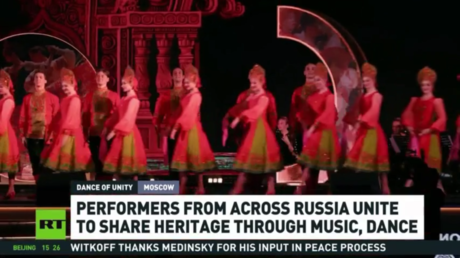
Massive state-sponsored folk dance productions in Russia are not merely artistic celebrations; they are carefully engineered instruments of cultural statecraft. When hundreds of performers in traditional regional dress take the stage in Moscow or St. Petersburg, the visual message is clear: over 190 distinct ethnic groups living in effortless, choreographed harmony.
The choreography is dazzling. Yet anyone who has spent decades covering Eurasian cultural policy knows that the real story lies offstage, buried inside the federal budget allocations, historical curation, and geopolitical messaging that make these colossal spectacles possible.
The Architecture of State Choreography
To understand why Russia invests heavily in massive dance shows, you have to look at the scale of the federation itself. Spanning eleven time zones and encompassing dozens of autonomous republics, maintaining national cohesion is a perpetual administrative challenge.
Large-scale cultural festivals—such as the All-Russian Festival of Folk Art or the monumental galas staged at the State Kremlin Palace—serve a dual purpose. Domestically, they project unity and validate regional identities within a centralized framework. Internationally, particularly when broadcast via state-funded media networks, they offer a counter-narrative to Western sanctions and diplomatic isolation, presenting Russia as a self-contained civilization rich in heritage and immune to external cultural pressure.
The logistics behind these events resemble military operations rather than standard theatrical productions.
Regional ensembles from Tatarstan, Chechnya, Yakutia, Buryatia, and the North Caucasus are scouted months in advance through state-subsidized regional competitions. Transporting hundreds of dancers, alongside tons of custom-tailored costumes and traditional instruments, requires direct coordination between the Ministry of Culture, regional governors, and federal broadcasters.
What the Choreography Leaves Out
State-curated folklore relies on a very specific aesthetic formula. It prioritizes athleticism, synchronization, and vibrant visual contrast.
Watch a televised gala closely, and a pattern emerges. You will see the high-flying leaps and dagger dances of the Caucasus, the hypnotic, circular khorovod of the Slavic regions, the throat-singing and rhythmic stomping of the Siberian steppes, and the intricate hand movements of the Volga Tatars. Every segment is trimmed to fit strict broadcast windows, usually three to four minutes per ensemble.
This compression creates a curated version of heritage.
In authentic village traditions, folk dances were unstructured, participatory, and tied to specific agricultural or religious calendars. The stage versions performed today are largely the legacy of the 20th century, specifically the Igor Moiseyev school of theatrical folk dance. Founded in 1937, Moiseyev’s ensemble pioneered the transformation of raw peasant dances into high-octane, ballet-inflected spectacles designed for proscenium stages.
The Politics of Aesthetic Standardization
When regional traditions are adapted for massive federal showcases, subtle local variations often get ironed out. A hypothetical example illustrates this dynamic well: imagine a remote village dance from the Altai Mountains that traditionally lasts forty minutes and involves repetitive, trance-like footwork. To make it palatable for a prime-time television audience in Moscow, a state choreographer must compress it into a three-minute routine, add dramatic orchestral swells, and synchronize the dancers into geometric formations.
The result is undeniably thrilling to watch. However, critics and ethnomusicologists have long pointed out that this process turns living, evolving cultures into museum pieces—safe, predictable, and stripped of any historical friction.
The historical friction is precisely what the stage lighting is designed to obscure. Many of the regions celebrated in these galas have complex, often turbulent histories with the central government in Moscow. By placing a Chechen Lezginka troupe right next to a Cossack ensemble from the Don River, the production visually resolves centuries of territorial conflict through synchronized applause.
The Economics of the Spectacle
Staging a multi-ethnic dance extravaganza is an expensive undertaking, especially during periods of economic strain. Unlike commercial Broadway or West End productions, which rely on ticket sales and private investors to turn a profit, Russia’s massive cultural showcases operate on a subsidy-driven model.
Funding flows through several distinct channels:
- Direct Ministry of Culture Grants: Federal funds earmarked for the preservation of intangible cultural heritage and national unity programs.
- Presidential Fund for Cultural Initiatives: A major grant-making body established to distribute billions of rubles to projects that align with state cultural priorities, including patriotic and multi-ethnic festivals.
- Regional Co-Financing: Local governments in republics like Bashkortostan or Dagestan frequently pay for their ensembles' travel and wardrobe expenses, viewing the Moscow stage as a vital platform to curry favor with federal administrators.
- State Media Production Budgets: Broadcasters absorb the massive costs of multi-camera setups, crane shots, and satellite uplinks, treating the events as flagship programming rather than commercial ventures.
For the dancers themselves, the financial reality is far less glamorous than the gold-embroidered costumes suggest. Outside of elite, federally funded troupes like the Moiseyev Ballet or the Alexandrov Ensemble, most regional folk dancers earn modest state salaries. They endure grueling rehearsal schedules and high rates of physical injury—particularly to knees and ankles—driven by the extreme athletic demands of modern stage folklore.
Soft Power in the Digital Era
In recent years, the distribution strategy for these dance shows has shifted dramatically. Ten years ago, a massive folk gala was primarily an event for domestic television viewers and foreign dignitaries sitting in the auditorium. Today, the primary battleground is short-form video.
State media outlets routinely slice three-hour concerts into sixty-second, high-definition clips optimized for social media algorithms. The formula is remarkably effective. A clip featuring synchronized Caucasian dancers spinning at impossible speeds or Siberian performers in elaborate fur regalia requires zero translation. It bypasses geopolitical debates entirely, appealing directly to universal human admiration for physical virtuosity and visual beauty.
International audiences scrolling through their feeds engage with the spectacle on a purely aesthetic level. They share the videos, comment on the athleticism, and absorb a subconscious impression of a vibrant, harmonious society.
This is cultural diplomacy stripped to its most efficient form. While traditional diplomatic channels remain frozen and news broadcasts provoke skepticism, a viral dance video slips past ideological defenses effortlessly.
The Generational Divide on the Dance Floor
Despite the massive state backing, the folk dance sector faces a quiet internal challenge: audience demographics and talent retention.
For decades, state-run Houses of Culture (Doma Kultury) existed in nearly every town and city across the Soviet Union, providing free or heavily subsidized dance training to millions of children. That infrastructure still exists, though its funding varies wildly depending on regional wealth.
Younger generations in major urban centers like Moscow, Kazan, and Yekaterinburg increasingly gravitate toward contemporary dance, hip-hop, and commercial choreography. To keep folk dance relevant—and to ensure a steady pipeline of elite performers for future state galas—choreographers have had to adapt.
Modern productions increasingly blend traditional motifs with contemporary staging:
- Electronic Fusion Scores: Traditional instruments like the balalaika, domra, and duduk are now routinely layered over heavy electronic basslines and modern percussion to appeal to younger ears.
- Projection Mapping: Instead of painted canvas backdrops, massive LED screens and 3D projection mapping surround the dancers, creating immersive digital environments that shift from snowy tundras to desert steppes in seconds.
- Cross-Genre Collaborations: State ensembles now frequently share the stage with pop stars, beatboxers, and acrobatic parkour teams to broaden television ratings.
Purists within the academic folklore community often bristle at these hybrids, arguing they dilute authentic heritage even further. Yet from an industry standpoint, the adaptation is a matter of survival. Without modernizing the packaging, the state risks spending millions on spectacles that only older demographics watch.
Reading Between the Steps
When evaluating coverage of Russia’s massive cultural showcases, media literacy requires looking beyond the surface spectacle. The athleticism of the performers is entirely real; the decades of rigorous training required to execute those routines deserve genuine artistic respect.
At the same time, treating these events purely as harmless entertainment misses their primary function. In the Russian political ecosystem, culture is never neutral. Every costume selected, every regional group included in the lineup, and every camera angle broadcast to the world is the result of deliberate institutional curation.
Next time a video of a thousand-person folk dance gala crosses your screen, watch the footwork, appreciate the endurance of the athletes on stage, and then look closely at the program list to see which regions were invited to the spotlight—and which ones were left in the dark.