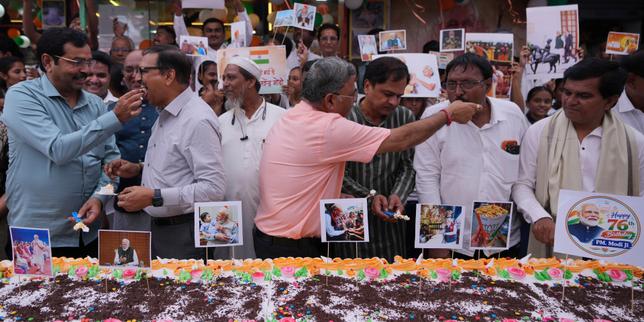
Power requires staging. In New Delhi, political dominance is rarely whispered; it is broadcast on giant LED screens, stamped onto millions of welfare ration bags, and amplified through a meticulously coordinated machinery of state-adjacent adulation. When the ruling apparatus turns its full attention toward an individual birthday, the event stops being a personal milestone and becomes an exercise in political reinforcement.
The celebrations surrounding Narendra Modi's birthday offer a clear window into how contemporary political legitimacy is manufactured in the world's largest democracy. Every September, the Indian political calendar shifts into high gear. What began decades ago as traditional party events have evolved into multi-week political campaigns branded under specific banners, merging governance with hero worship.
Understanding this phenomenon requires moving past the surface-level spectacle of cake-cutting ceremonies or blood donation drives. We must examine the mechanics of political branding, the centralizing tendencies of modern governance, and the deliberate blurring of lines between state infrastructure and personal identity.
The Architecture of Mass Adulation
Political marketing is not new. Every major political party uses rallies, advertisements, and public relations campaigns to elevate its leadership. Yet, the scale and structural integration observed during these annual observances represent a different tier of political engineering.
The strategy relies on a dual approach: grassroots mobilization paired with top-down media saturation. Local party cadres compete to organize the largest blood donation camps, distribute the highest number of assistive devices to disabled citizens, or plant record-breaking quantities of saplings. These activities are undeniably charitable in appearance, but their underlying architecture is entirely political. Every distribution center features prominent portraits of the Prime Minister. Every welfare kit serves as a physical reminder of personal benevolence rather than institutional entitlement.
This transformation of state-administered welfare into personal patronage alters the social contract. Citizens stop viewing government programs as rights guaranteed by the constitution and start interpreting them as gifts from a singular figurehead.
From Party Leader to National Embodiment
To sustain this level of devotion, political communication must transcend traditional partisan boundaries. The narrative frames the leader not merely as a politician winning elections, but as an indispensable force protecting national interests against domestic and external threats.
During these birthday periods, media channels—both traditional television networks and digital platforms—flood the public sphere with retrospective documentaries, biographical hagiographies, and testimonials from prominent figures across business, sports, and entertainment. Dissenting voices are drowned out by a deafening chorus of praise, creating an environment where questioning the utility or expense of these spectacles is branded as unpatriotic.
This strategy draws power from historical precedents of charismatic authority, where institutions are systematically weakened or subordinated to the will of a single individual. When the fate of a nation is linguistically fused with the physical well-being of its leader, any critique of policy transforms into an attack on the country itself.
The Economy of Visibility
Mass optics demand substantial financial backing. While official party accounts maintain that these events are funded through voluntary donations and grassroots fundraising, the sheer logistical footprint tells a more complex story. Billboards line major metropolitan highways for weeks. Full-page newspaper advertisements dominate national dailies. Digital ad campaigns target millions of mobile screens across diverse linguistic demographics.
This visibility creates an asymmetric political marketplace. Opposition parties struggle to compete against a permanent campaign infrastructure that operates 365 days a year, hitting maximum velocity during these annual celebrations. When every government achievement is retroactively tied to an individual birthday milestone, ordinary administrative work becomes indistinguishable from electioneering.
The Institutional Cost
Concentrating authority and adoration within a single office alters how government institutions function. Bureaucrats learn quickly that career progression depends on proximity to the central narrative. Policy initiatives are designed for maximum photographic impact rather than long-term structural efficacy.
Consider the rollout of signature infrastructure projects or digital public goods. While many of these initiatives deliver tangible benefits to millions of citizens, their implementation is consistently framed around a single protagonist. When institutions become dependent on personal charisma for their momentum, they lose the resilience required to withstand political transitions or economic shocks.
Furthermore, this dynamic suppresses internal party democracy. When all political capital flows upward toward one individual, regional leaders have little incentive to build independent followings or debate policy directions openly. Loyalty replaces competence as the primary currency within the political ecosystem.
The Long-Term Trajectory
Political cultures built on charismatic centralization face a distinct set of vulnerabilities. They rely on uninterrupted momentum and continuous economic or nationalist victories to justify the immense concentration of power.
As the celebrations conclude each year and the banners come down, the underlying socio-economic realities of the country remain untouched by the pageantry. Unemployment figures, agrarian distress, and regional disparities do not vanish beneath layers of publicity. They persist, waiting for the political machinery to address them through structural reform rather than symbolic gestures.
The spectacle will return next September, bigger and more coordinated than before. Until the electorate demands a separation between institutional governance and personal cults, the pageantry will remain the defining feature of contemporary political life.