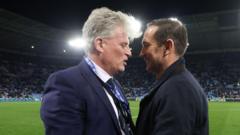
The lazy narrative in English football is currently obsessed with "stability." Owners are praised for holding onto big names. Fans are told that continuity is the only path to the promised land of the Premier League. When Doug King, Coventry City’s owner, tells the press he isn't "worried" about Chelsea sniffing around Frank Lampard, the media eats it up as a sign of strength.
They are wrong.
King isn’t being stoic; he’s being a businessman who knows something the pundits won’t admit: Frank Lampard is a transition manager, not a foundational one. If Chelsea—a club currently run like a high-stakes casino—wants to bail Coventry out of the Lampard experiment early, King should be booking the private jet himself.
The Myth of the Big Name Manager in the Championship
The Championship is a meat grinder. It doesn’t care about your Champions League medals or how many goals you scored from midfield in 2005. Success in this division is built on tactical rigidity, grueling fitness cycles, and a recruitment system that finds value in the bargain bin of Ligue 2 or the Eredivisie.
Lampard represents the "Celebrity Manager" era. It’s an era defined by optics over output.
When a club like Coventry hires a Lampard, they aren't just hiring a coach. They are hiring a PR department. It keeps the club in the headlines. It makes the fans feel like they belong in the big leagues. But look at the data from Lampard’s previous stints. His Derby County side—often cited as his "success" story—was stacked with generational talents like Mason Mount, Harry Wilson, and Fikayo Tomori. They finished sixth. They had the highest wage bill in the club's history relative to revenue.
That isn't tactical genius. That’s an expensive engine barely making it to the finish line.
The Chelsea Carousel is Coventry’s Get Out of Jail Free Card
The current talk suggests that Chelsea might want Lampard back in some capacity—whether as a caretaker, a sporting liaison, or a desperate attempt to reconnect with a disgruntled fanbase. Most Coventry supporters view this as a threat.
It’s actually a windfall.
Imagine a scenario where a mid-table Championship side gets to pocket a compensation fee for a manager who hasn't yet proven he can sustain a promotion charge without a Premier League budget. It is the ultimate "sell high" moment.
If Lampard stays, Coventry remains tied to his specific, often chaotic style of play. If he leaves now, Doug King can pivot to the real trend that is actually winning trophies: the Continental Specialist.
Why the "Tactical Ceiling" is Real
Lampard’s tactical profile has always been a "Vibes-First" approach. His teams are often high-energy but structurally porous. At Everton and during his second stint at Chelsea, the Expected Goals Against (xGA) metrics were a nightmare. He relies on individual brilliance to bail out a lack of defensive shape.
In the Championship, that is a recipe for a 12th-place finish.
The managers currently dominating the English second tier—the ones getting promoted and staying up—are the technicians. Look at the impact of Kieran McKenna at Ipswich or Enzo Maresca’s run with Leicester. These aren't "big names." They are systems-obsessed coaches who treat a football pitch like a chessboard.
Coventry has a history of punching above its weight through smart recruitment and tactical identity. Transitioning from the long-term stability of Mark Robins to the star-power of Lampard was a gamble. Doubling down on it when a Premier League club offers an exit ramp is just bad business.
The Egos and the "Step-Up" Culture
Let’s be brutally honest about the power dynamic. Frank Lampard does not view Coventry City as a destination. He views it as a repair shop for his reputation.
The moment a job in the top flight—or a sentimental return to West London—becomes a reality, his focus shifts. This isn't an indictment of his character; it's the reality of the modern game. Why would Coventry want a manager who is constantly looking over his shoulder for the next "better" thing?
The "People Also Ask" sections of the internet are full of questions like "Is Frank Lampard a good manager?" The answer is nuanced: He is a great figurehead. He is a mediocre architect.
Coventry doesn't need a figurehead. They need someone who understands the $100 million implications of a botched January transfer window.
The Real Cost of "Not Being Worried"
Doug King’s public nonchalance is a tactic. He knows that if he looks desperate to keep Lampard, the compensation fee drops. If he looks unbothered, the price goes up.
But there is a danger in this posture. If King actually believes his own hype—if he truly thinks Lampard is the only man who can lead Coventry back to the Promised Land—he is ignoring the structural flaws in Lampard's coaching history.
The "lazy consensus" says that losing a manager mid-season is a disaster. The data suggests otherwise. Clubs that replace underperforming or "distracted" managers often see a statistical "bounce" that lasts up to 10 games—enough to secure a playoff spot or avoid a slide into irrelevance.
What Coventry Should Be Doing Instead
Stop checking the headlines for Chelsea’s next move. Start scouting the Bundesliga 2.
The smartest clubs in the UK are currently looking at coaches who have mastered "Positional Play" on a budget. They are looking for the next Thomas Frank or Roberto De Zerbi. These are men who increase the value of every player on the pitch.
Does Frank Lampard increase player value?
- At Derby: Yes, but mostly for players on loan from Chelsea.
- At Chelsea (Round 1): He gave youth a chance, but failed to organize a defense.
- At Everton: He nearly oversaw a historic relegation.
If I’m a Coventry shareholder, I’m not worried about Lampard leaving. I’m worried about him staying long enough to burn through the remaining goodwill of the post-Robins era.
The Fallacy of "Premier League Experience"
One of the biggest lies in football is that you need a manager who has "been there" to get you "there."
This is objectively false. The most successful promotion campaigns of the last five years have come from managers who had zero previous experience in the Premier League. They brought fresh ideas, modern sports science, and a lack of ego.
Lampard brings a heavy suitcase of "how we did it at Chelsea." That baggage is heavy. It’s expensive. And in the cold, wet Tuesday nights in Stoke, it’s completely useless.
The truth nobody admits is that Lampard needs Coventry more than Coventry needs Lampard. He needs the club to prove he isn't a "bust" in the dugout. Coventry, meanwhile, just needs a coherent plan. Those two goals are not the same.
If Todd Boehly calls, Doug King shouldn't just answer the phone. He should offer to drive the car.
The risk isn't that Lampard goes back to Chelsea and succeeds. The risk is that he stays at Coventry and continues the trend of "almost, but not quite" that has defined his managerial career. Coventry is a proud club with a fanbase that has suffered enough. They deserve a specialist, not a superstar on a redemption tour.
Chelsea's interest isn't a crisis. It's a lucrative exit strategy for a club that needs to stop looking at the names on the back of the tracksuits and start looking at the points on the board.
Let him go. Take the money. Hire a tactician. Win.