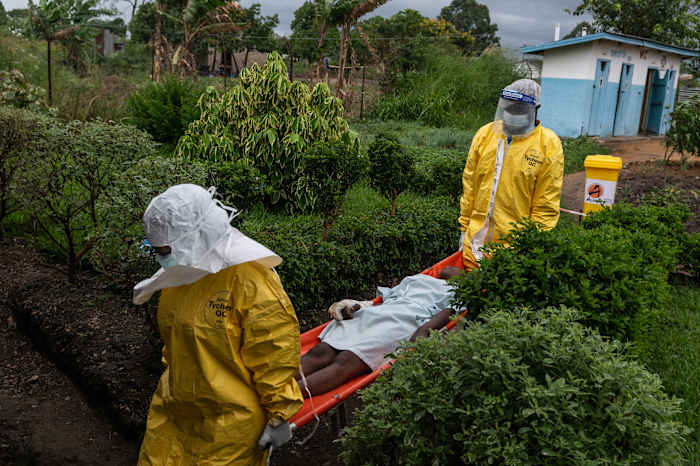
Front-line workers fighting a lethal Ebola outbreak in the Democratic Republic of the Congo are dropping their tools and walking away. They aren't running from the virus itself, though it has already killed nearly 600 people in less than two months. They're striking because the Congolese government hasn't paid them a single single franc since the crisis began in mid-May.
Imagine risking your life daily in an outbreak zone, facing both a deadly pathogen and violent community backlashes, only to find out your paycheck doesn't exist. That's the grim reality in Ituri province, the current epicenter of the rare Bundibugyo Ebola strain. Doctors, nurses, contact tracers, and burial teams are flat-out refusing to work until they receive their promised wages and hazard bonuses.
This isn't a minor administrative hiccup. It is an active disaster. The virus is already moving faster than the official response, and pulling the plug on human resources ensures things will get catastrophically worse.
The Breaking Point in Bunia
The situation boiled over in Bunia, Ituri's capital. Front-line staff issued a 24-hour ultimatum to provincial and national authorities. When the deadline passed with empty promises, workers took to the streets. On Monday, protestors outside the Rwampara Ebola treatment center burned tires, forcing police to intervene to restore order. By Tuesday, a quiet, unannounced walkout began crippling containment efforts.
The numbers paint a horrifying picture of how fast this crisis is expanding. The latest health ministry data shows 1,708 recorded cases and 580 deaths. Because the Bundibugyo strain has no approved vaccine or standard treatment protocol, managing symptoms and tracking contacts are the only real shields against total community transmission.
Right now, those shields are dropping. Dr. Biensi Kano, a member of the local epidemiological surveillance committee, stated that the lack of pay directly exposes their families to brutal socio-economic struggles. People can't buy food or pay rent on a promise.
High Risks and Zero Pay
Working on an Ebola front line in eastern Congo requires immense bravery. Health workers routinely face intense local skepticism and physical violence. Many residents don't believe the virus is real or suspect that medical teams are importing the disease for profit.
Dr. Ben Bakule, a community investigator, recounted escaping death in late May when an angry mob attacked his team while they traced contacts in Djugu territory. He noted that workers are spending their own money on transport just to get to work, risking their lives for absolutely nothing in return.
Epidemiologists like Dr. Ghislain Maneba are working day and night at the Rwampara health zone, trying to educate a terrified public while their own bank accounts sit empty. The contrast between official rhetoric and ground reality is stark. Last month, Health Minister Roger Kamba visited the mining hub of Mongbwalu and boldly claimed that all response staff would be fully supported because the government had the cash. The workers say they haven't seen a dime.
Why the Funds Are Blocked
Bureaucrats blame logistical bottlenecks for the dry pipeline. Akilimali Pierre, an incident manager at Congo's National Institute of Public Health, pointed out that the temporary closure of the Bunia airport has crippled the physical flow of funds into the region.
But for a nurse eating one meal a day after a 16-hour shift, logistical excuses don't cut it. Eastern Congo's healthcare system has suffered from chronic underinvestment for decades. When international aid agencies scramble to bring in basic supplies like masks, gloves, and boots, systemic corruption and administrative incompetence frequently stall the cash meant for the actual human beings inserting the IV lines.
This strike happens at the worst possible moment. International researchers are just beginning to enroll patients for clinical trials to test new treatments specifically for the Bundibugyo virus. If treatment centers are understaffed or shut down completely because doctors walk out, these critical medical trials will fall apart before they even start.
Immediate Steps to Stabilize the Outbreak
Resolving this crisis requires skipping the usual bureaucratic channels. The national government must bypass local structural bottlenecks to deliver immediate cash payments directly to front-line workers in Ituri.
International donors and the World Health Organization need to establish a direct, audited financial pipeline that guarantees hazard pay reaches medical staff without passing through multiple layers of state distribution. Local authorities must simultaneously secure the physical safety of contact tracing teams by engaging trusted community leaders to dispel rumors about the virus. Without immediate, tangible pay in the hands of these doctors and nurses, the outbreak will slip entirely out of control.