The bay does not care about your property lines.
It never did. For decades, we drew lines in the mud, poured gray concrete down to the water’s edge, and called it a boundary. We built highways on top of salt marshes and turned tidal creeks into underground concrete culverts, thinking we could out-engineer the rhythm of the moon. We were wrong. Every year, the high tides creep a little higher up the pylons of the Dumbarton Bridge. Every storm season, the salty water licks closer to the electrical substations and the office parks where people write code that changes the world. You might also find this similar story interesting: Global AI Coordination Is Just Cartel Protection For Incumbents.
Then there is Palo Alto. Not the glittering downtown of venture capital firms and espresso bars, but the forgotten edge where the city meets the bay.
Stand there on a foggy morning, and you smell the sulfur and the thick, ancient tang of decomposing cordgrass. For generations, this was a place we tried to conquer. Now, it is a place where we are learning to surrender, very carefully, on our own terms. As discussed in recent articles by The Verge, the results are widespread.
Consider what happens next.
The Five Hundred Foot Answer
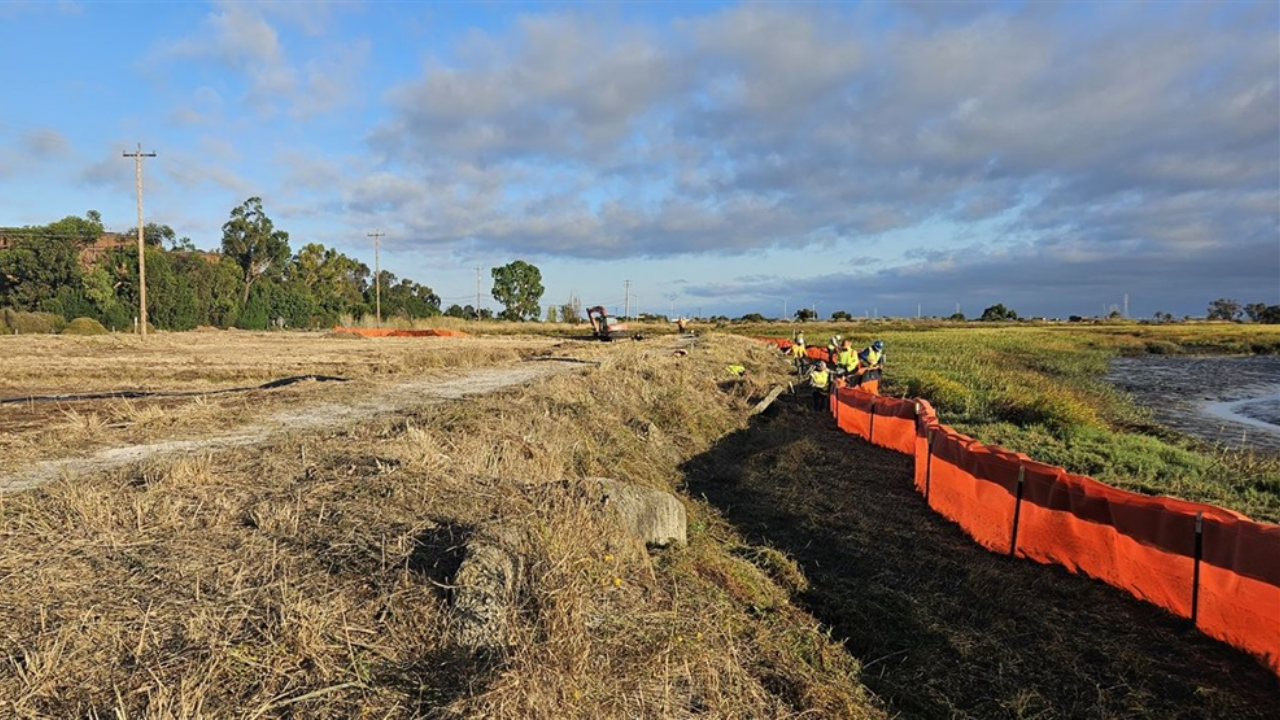
Out in the mudflats, tucked behind the levees that protect wastewater treatment plants and tech campuses from drowning, sits a strange new shape. It is a 500-foot-long horizontal levee.
Forget the traditional image of a levee. A traditional levee is a brutal wall of dirt or stone. It says stop. It stands there until the water gets too high, gets saturated, slumps, and fails. It is a monument to human stubbornness.
This new structure is different. It is a slope, wide and gradual, engineered to mimic the gentle transition from land to sea that existed here before the Spanish arrived with cattle. It is a ramp of earth, planted with native pickleweed, gumplant, and alkali sacaton, built not to keep the water out, but to absorb its blow.
Water is heavy. A cubic yard of ocean water weighs over two thousand pounds. When a storm surge pushes against a vertical concrete seawall, that energy has nowhere to go. It crashes upward, splashing over the top, scouring the foundation. But when water climbs a horizontal levee, it frictionally exhausts itself. It gets tangled in the deep, fibrous roots of wetland plants. It spreads out. It loses its temper before it ever reaches the high ground.
And that is only half the trick.
The Second Life of Water
Walk backward from the bay toward the city, past the settling ponds, and you find the invisible engine driving this entire transformation.
It is treated wastewater.
Every day, millions of gallons of water slide down residential shower drains in Palo Alto, flush through toilets, rinse off dishes, and wind up at the regional water quality control plant. Twenty years ago, treating that water meant cleaning it just enough to pump it safely out into the deeper parts of the San Francisco Bay, a process that consumed massive amounts of electricity and dumped millions of gallons of nutrient-rich freshwater into a saltwater ecosystem that did not quite know what to do with it.
Someone looked at that pipeline and asked a radically simple question.
What if we cleaned it twice, and gave it back to the earth?
Today, advanced purification processes strip pathogens, pharmaceuticals, and excess nutrients from that effluent until it is remarkably clean. Instead of flushing it away, engineers pump that treated water into the upper edge of the horizontal levee.
From there, gravity takes over.
The water does not flow in pipes. It weeps. It percolates invisibly through layers of gravel, sand, and soil, traveling slowly downward toward the bay. As it moves underground, the soil and the plant roots act as a living filter, polishing the water further while keeping the roots of the marsh vegetation perpetually hydrated, even during the searing dry months of the California summer.
We are feeding the marsh with our own leftovers.
The Architecture of Humility
It is easy to romanticize nature, but what is happening here is not a return to wilderness. It is an industrial-scale orchestration of biology.
Think of it as a sponge that knows how to clean itself.
For more than a century, civil engineering was dominated by the ideology of straight lines and hard materials. Steel beams. Concrete aprons. Riprap boulders hauled in from distant quarries to armor the shoreline. It was an expensive, brittle way to live. Every winter storm tested the armor. Every decade, the sea level rose an inch or two, requiring the armor to be made higher, thicker, heavier, until the cost of holding back the water outgrew the value of the land behind it.
The horizontal levee changes the math.
It is a living asset. Unlike a concrete wall, which degrades the moment it is poured, a living levee heals. If a heavy storm tears up some cordgrass, the remaining plants spread runners and fill the gap by next spring. If sediment drops out of the bay during a high tide, the marsh surface quietly builds itself upward, keeping pace with the rising sea.
It is adaptive infrastructure. It grows where concrete cracks.
Yet, getting here required crossing a desert of regulatory hesitation and institutional inertia. Bureaucracies do not like ambiguity. Regulators want permits for things they can measure with a ruler: height, width, compressive strength. How do you permit a living system that changes its shape, hosts migrating shorebirds, and relies on microbial communities to do the heavy lifting of water filtration?
Engineers and ecologists spent years testing soil compaction rates, monitoring heavy metal uptake in plant tissues, and tracking salinity gradients. They had to prove to skeptical water boards that the treated wastewater would not trigger massive algae blooms or harm endangered species like the Ridgway’s rail, a secretive bird that nests exclusively in the dense pickleweed of these very marshes.
They had to learn to speak the language of biology.
What the Mud Remembers
Go back to the edge of the bay as the afternoon sun begins to drop behind the Santa Cruz Mountains.
The wind picks up, kicking whitecaps across the shallow water. Out on the mudflats, a flock of American avocets probes the wet sediment with slender, upturned bills, hunting for brine shrimp and invertebrates. They do not know about municipal bond measures or sea-level rise projections. They just know the mud feels right.
This is the quiet revelation of the project. We are not saving the planet out of pure altruism. We are saving ourselves by remembering how the world worked before we paved it over.
The horizontal levee in Palo Alto is small—only five hundred feet long, a tiny stitch along a frayed coastline. But it is a prototype for a hundred miles of San Francisco Bay shoreline, and thousands of miles of vulnerable coastlines from New York to Jakarta. It is proof that we do not have to choose between retreating entirely from the water and building Fortress Earth.
There is a third way. It is messy, it is green, and it smells faintly of low tide.
It is the sound of water soaking quietly into the earth, finding its way home at last.