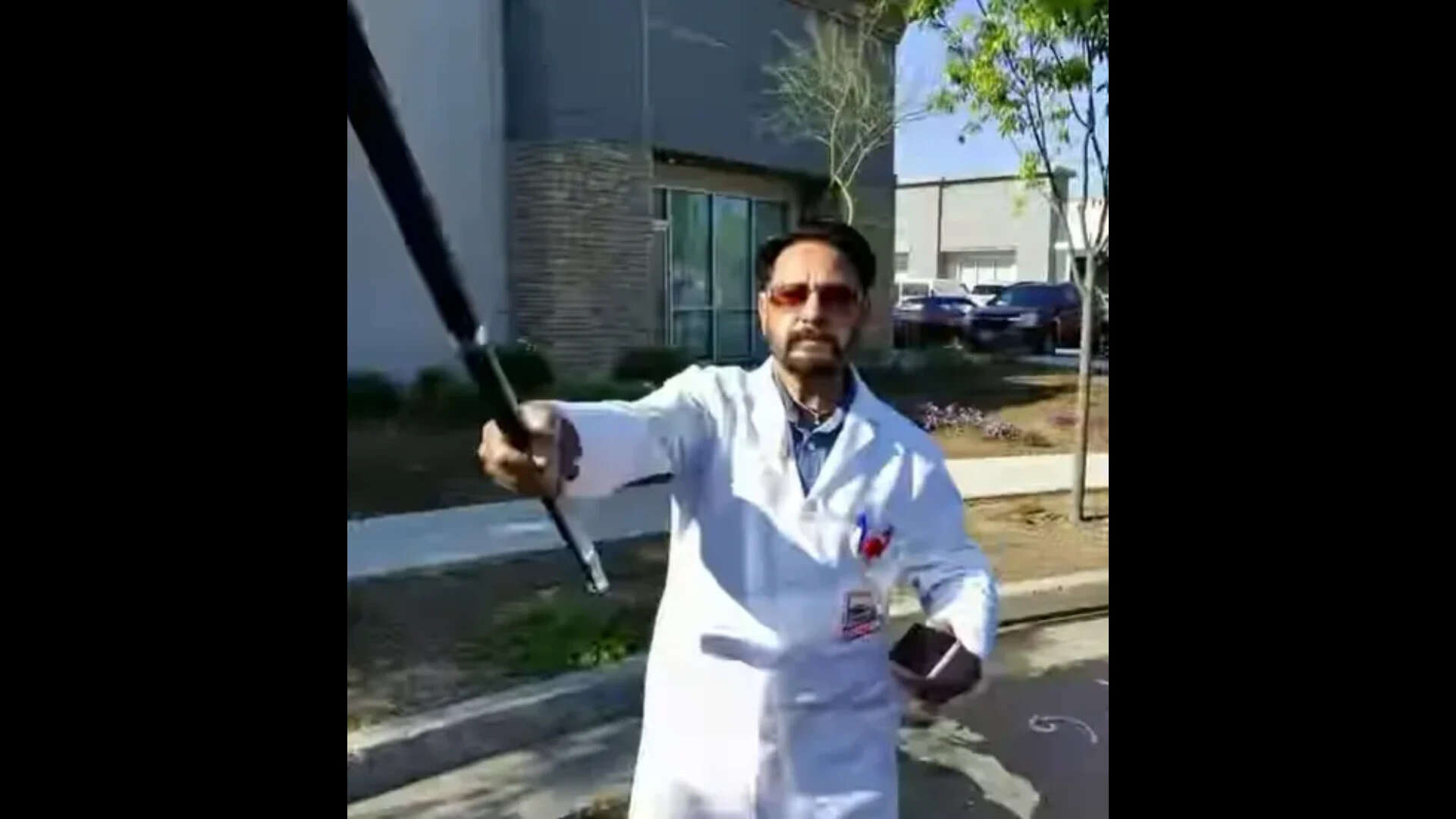
The asphalt in a New Jersey parking lot doesn't just hold heat. It radiates a specific, suffocating kind of tension. On a Tuesday that should have been mundane, the shimmering waves rising from the blacktop met a different kind of heat: the internal combustion of a human being pushed to the edge.
He is a doctor. A man trained in the delicate arts of preservation and patience. A man whose hands are usually occupied with the sterile precision of healing. But in the video that stripped away his privacy and broadcast his worst moment to the world, those hands were gripped around a wooden cane. He wasn't using it for support. He was wielding it like a weapon in a territorial dispute over a few square feet of painted lines.
The scene is jarring because it shatters our collective archetype of the "healer." We want our physicians to be monolithic figures of calm, existing on a plane above the petty frustrations of a crowded shopping center. We forget that beneath the white coat is a nervous system. We forget that the same brain capable of memorizing the complexities of the human circulatory system is also susceptible to the primitive roar of the amygdala.
The Invisible Weight of the White Coat
Consider the life of a high-achieving professional in a high-stakes environment. It isn't lived in a vacuum. It is a slow accumulation of microscopic stressors. It’s the 4:00 AM page from the hospital. It’s the insurance paperwork that never ends. It’s the weight of being a success story in a diaspora that demands nothing less than perfection.
For an Indian-origin physician in America, the stakes are often silent but immense. There is a "model minority" myth that acts as a straitjacket, requiring one to be twice as composed and half as reactive as everyone else. You carry your culture, your family’s sacrifices, and your professional reputation every time you step out of your front door.
Then, you find yourself in a parking lot.
The spot is yours. Or you think it is. Someone cuts you off. The engine idles. The air conditioning hums, but it’s not enough to cool the blood. In that moment, the parking spot isn't just a place to leave a car. It becomes a stand-in for every perceived slight, every hour of overtime, and every bit of suppressed anger that has built up over a decade.
The doctor didn't just snap. He unspooled.
The Anatomy of a Public Shaming
The camera phone has become the modern guillotine. When the woman filming the encounter began to record, she wasn't just capturing a disagreement; she was capturing the precise moment a career began to tilt.
The video shows the doctor, identifiable by his profession and his background, waving the cane with a frantic, desperate energy. He shouts. He gestures. He looks like a man who has lost the map of who he is supposed to be.
Social media reacts with the speed of a wildfire. Within hours, the comments sections are a battlefield. To some, he is a "thug in a suit." To others, he is a victim of "Karen" culture, baited into a reaction by someone who knew exactly where the record button was. But the truth is rarely found in the extremes of a comment thread.
The truth is in the sound of the cane hitting the pavement.
That hollow thack is the sound of a breakdown. It is the sound of a man who has spent so much time caring for others that he has forgotten how to regulate himself. This is not an excuse for aggression. It is a diagnosis of a societal condition. We are living in a world where the margins for human error are shrinking to zero, while the pressure to perform is expanding toward infinity.
When the Shield Becomes the Sword
There is a profound irony in using a cane—a tool designed to help the vulnerable walk—as an instrument of intimidation. It serves as a perfect metaphor for the way our defense mechanisms can betray us.
In a medical setting, a doctor’s authority is his shield. It allows him to command a room, to make life-or-death decisions, and to maintain order in the middle of chaos. But when that authority is taken out of the clinic and into the wild, lawless world of a suburban parking lot, it becomes a liability. The "commander" persona doesn't work when you’re arguing about a Hyundai occupying a space you wanted.
The doctor in the video attempted to use his status as a weapon, but the world no longer respects the "Do You Know Who I Am?" defense. In fact, the higher your status, the harder the world wants to see you fall.
The Cost of the Viral Cycle
We watch these videos for a shot of cheap dopamine. We feel a flicker of moral superiority as we judge the man with the cane. "I would never do that," we tell ourselves. "I am more evolved."
But are we?
Or are we all just one bad day, one missed meal, and one stolen parking spot away from our own viral moment? The doctor’s face in that video is the face of a man who realized, perhaps a second too late, that the digital ink never dries. He was a healer on Monday. He was a meme on Tuesday. By Wednesday, his practice, his reputation, and his peace of mind were in shambles.
The invisible stakes here aren't about traffic laws or parking ordinances. They are about the fragility of the human ego in a hyper-monitored age. We are witnessing the death of the "private mistake."
If this man had lost his temper in 1994, he would have gone home, felt ashamed, apologized to his spouse, and been a better man the next day. In 2026, his shame is a global commodity. It is sliced into ten-second clips, captioned with snark, and served to millions of people who will never know his name, only his rage.
The Quiet After the Scream
Imagine the car ride home after that encounter.
The adrenaline begins to ebb, leaving behind the cold, metallic taste of regret. The cane is back on the passenger seat. The parking spot—the thing that felt like the most important thing in the world five minutes ago—is miles away, occupied by someone else.
The doctor enters his house. Maybe he looks at his medical degree on the wall. He looks at his hands. They are shaking. He knows. He knows that the world saw him, and he knows that the version of him they saw is the only one they will ever believe in.
This is the hidden cost of our modern friction. We have built cities that are too crowded, lives that are too busy, and a digital infrastructure that rewards our worst impulses. We have turned our public spaces into arenas where the prize is a parking spot and the penalty is your soul.
The video ends, but the story doesn't. There is no "delete" button for the psyche. There is only the long, slow process of trying to find the healer again inside the man who held the cane.
The next time you see a person unraveling in public, look past the anger. Look for the exhaustion. Look for the cracks in the armor. You aren't watching a villain; you are watching a mirror.
The blacktop is still hot. The lines are still painted. And somewhere, someone else is circling the lot, looking for a place to land, unaware that they are carrying a fire that could burn their whole life down in the time it takes to put the car in park.