You smell the asphalt first.
It is the smell of a Tuesday afternoon in July, when the sun bakes the parking lot behind the community center until the tar bubbles like pitch. Inside, under the fluorescent hum of a ceiling that hasn't seen a fresh coat of paint since the nineties, thirty folding chairs sit in a semi-circle.
Twenty-eight of them are empty.
On one of the remaining two sits a woman named Sarah. She has lived on Elmwood Avenue for thirty-two years. She knows the exact pitch of the groan the old maple tree makes when the winter ice gets too heavy for its western bough. She knows the name of every dog within a four-block radius. And tonight, she is clutching a yellowed water bill like a weapon, waiting for Mike Layton.
Local government is rarely televised. It does not arrive with the blare of brass bands or the high-definition gloss of a presidential debate. It arrives in the quiet crunch of gravel under a station wagon tire, in the grease pencil marking a pothole for cold-patch, in the tiny, brutal arithmetic of a property tax assessment that goes up four percent while your pension stays dead still.
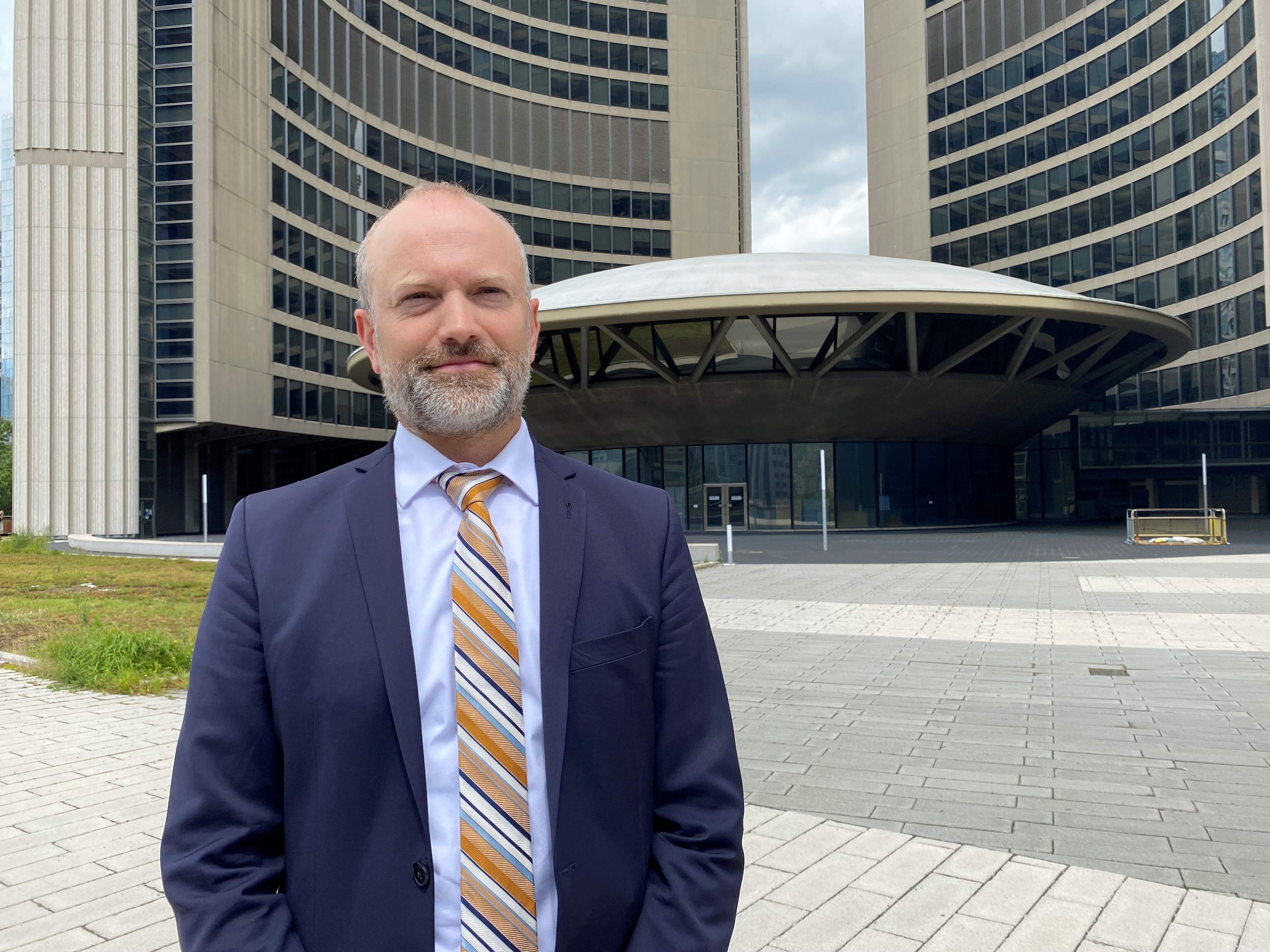
When Mike Layton steps through the gymnasium doors, he doesn't look like a savior. He looks tired. He wears a blue button-down shirt with the sleeves rolled up to the elbows, exposing forearms tanned by too many hours standing at asphalt plants and park district ribbon-cuttings. He carries a battered leather briefcase that has swallowed a thousand zoning maps and community complaints.
He is running for city council again. And if you ask most people on the street why that matters, they will shrug. They will talk about national politics, about the theater of cable news, about the distant, monolithic forces that shape our lives from thousands of miles away. They will look right past the curb outside their front door.
That is the mistake.
The Geography of Neglect
Consider what happens when a city stops paying attention to its own plumbing.
It starts with a puddle. Not a grand, poetic lake, just a depression in the macadam where the rainwater pools after a spring squall. The city engineer marks it as low priority. Budget constraints. The arterial roads need resurfacing. The downtown revitalization project requires matching funds. So the puddle stays.
By autumn, the freeze-thaw cycle has done its work. The water slips into microscopic cracks in the foundation, expands with the stubborn fury of ice, and fractures the base. By winter, the municipal plow catches the jagged lip of the broken asphalt and rips away a two-foot chunk of the street.
By spring, Sarah’s station wagon bottoms out on the way to the grocery store.
This is the invisible architecture of municipal decline. It is not ideological. It is mechanical. It is the slow, grinding erosion of the things we take for granted until they break.
Mike Layton built his entire political life around the unglamorous mechanics of that broken street. He didn't start as a crusader. He started as a guy who got tired of calling the Department of Public Works and hearing a recorded voice telling him his call was important.
"People don't want a philosophy," Layton told me once, sitting on the tailgate of his truck while a distant freight train rattled the tracks across the valley. "They want to know why their basement floods every time it rains for more than twenty minutes. They want to know why their kids have to cross a four-lane highway with no crosswalk to get to the middle school. You fix the drain, or you fix the crosswalk. Everything else is just talk."
The Anatomy of an Election That Nobody Watches
The municipal election cycle is a ghost town.
In national races, turnout swells like a rising tide, fueled by millions of dollars in advertising, high-stakes polarization, and the comforting illusion of total transformation. But municipal elections? They are decided by a handful of votes cast by people who remember when the grocery store downtown was a hardware store.
Statistically, local council races often see turnout slump below twenty-five percent. Think about that for a second. One out of every four eligible citizens decides who manages the police budget, who approves the zoning variance for the new industrial park, and who decides whether your neighborhood gets a bike lane or another strip mall.
The stakes are microscopic and monumental all at once.
When Layton first ran for office six years ago, he was a contractor by trade. He knew how to read blueprints, how to estimate the cost of a foundation, and how to tell when someone was trying to cut corners on rebar. That background made him uniquely dangerous to the status quo.
Politicians love grand visions. They love ribbon-cuttings for glass-and-steel monoliths that look great in glossy campaign brochures. Layton was the guy who looked at the architectural renderings and asked where the stormwater runoff was going to go when the parking garage went in.
"Everyone wants the shiny thing," he said during a candidates' forum that drew roughly the same audience as a high school junior varsity volleyball game. "Nobody wants to pay to replace the sixty-year-old clay pipes buried twenty feet under Main Street. But I’ll tell you right now: if the pipes go, the shiny thing doesn't matter."
That kind of pragmatism doesn't viralize on social media. It doesn't generate breathless commentary cycles. It earns you a headache at a zoning board meeting while three developers explain why environmental impact studies are cutting into their profit margins.
The Human Equation
Let’s be honest. Local politics is boring until it is catastrophic.
It is the bureaucratic equivalent of flossing. You don't think about it until the tooth starts throbbing at two in the morning.
This is why campaigns like Layton’s are so difficult to wage. How do you make a population care about storm sewer separation before their basements are filled with three feet of brackish water? How do you make a millennial living in a downtown loft care about residential zoning density limits until their rent spikes by thirty percent?
You do it by connecting the abstract policy to the living room floor.
Take the zoning debate that defined Layton's second term. The city wanted to fast-track a mixed-use commercial development near the old textile mill. On paper, it looked like progress. Investment. Jobs. Tax base expansion.
The developers brought charts. They brought projections. They brought slick PowerPoint presentations with cheerful green trees photoshopped into the rendering.
Layton brought a map of the local water table and a list of thirty families whose wells had gone dry during the drought of two years prior.
"You can build whatever you want," he told the council that night, his voice dropping an octave so that even the reporters in the back row stopped typing and looked up. "You can put glass towers all the way to the river. But if the aquifer can't support the draw, those people down on the east side aren't going to have water to brush their teeth. And no amount of tax revenue is going to pump water out of a dry well."
The vote was close. It always is when money meets gravity.
They compromised. They downsized the project, mandated greywater recycling systems, and forced the developer to shoulder the cost of upgrading the neighborhood feeder mains. It wasn't a clean Hollywood victory. The developer whined about regulations. The neighborhood association still felt it was too big.
That is what winning looks like in local government. It is a series of slightly bruised compromises that keep the lights on and the water running.
The Cost of Looking Away
We live in an age of hyper-connectivity where we know the intimate details of political scandals happening three thousand miles away, but we couldn't tell you the name of the person who sits in the third seat on the county commission.
We outsource our civic attention to the loudest voices in the room.
And while we are looking at the screen, the quiet machinery of our immediate environment grinds on without us. The potholes widen. The zoning laws change in the dark. The local paper shrinks to a single stapled sheet of paper, leaving no one to watch the council meetings where the real decisions are made.
When Mike Layton walks back out to his truck after the community center meeting, Sarah is still standing there by the door. She doesn't have a petition. She doesn't have a campaign contribution. She just has a question about whether the city is ever going to fix the culvert at the end of her driveway before the autumn rains start.
He doesn't give her a speech. He pulls a small, grease-stained notebook from his breast pocket, clicks his pen, and writes her address down right underneath the grocery list.
"Thursday morning," he says. "I’ll swing by with the inspector before the regular meeting."
She nods, satisfied, and walks back to her station wagon.
The parking lot is dark now. The asphalt is cooling, releasing that faint, mineral scent of dust and heat into the night air. Somewhere down the street, a streetlight flickers once, catches, and holds.


