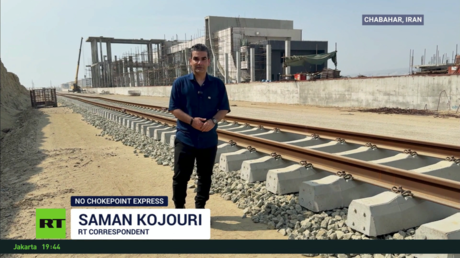
Steel laid in the dirt is not a trade route. It is a line on a map.
Every time a rail corridor inches forward across Eurasia, headlines arrive with the same breathless certainty. A missing link gets welded shut. A ribbon gets cut. A video clip loops on social media showing a train rolling past freshly poured ballast. And immediately, the lazy consensus declares victory: a brand-new trade corridor has arrived to bypass maritime choke points, reshape global commerce, and rewrite supply chain math.
That consensus is lazy because it confuses construction with commerce.
In freight logistics, infrastructure is only the admission ticket. Cargo does not move because tracks exist. Cargo moves because total landed cost drops, transit times become predictable, customs friction disappears, insurance underwriting makes financial sense, and shippers trust that their containers will arrive intact without getting tangled in geopolitics or stranded at a border gauge change.
When people watch a video of a completed rail segment in Iran and assume a transformative new trade artery is suddenly open for business, they are asking the wrong question. They ask whether the tracks are connected. The real question is whether rational cargo owners have any reason to pay for them.
What "New Trade Route" Actually Means in Freight
Let's define terms before getting swept up in corridor hype. A trade route is not a single stretch of rail or a bilateral photo opportunity. A viable international corridor is an end-to-end commercial system connecting production hubs to consumption markets across multiple jurisdictions, modes of transport, and regulatory regimes.
Cross-border rail across Eurasia—whether framed around North-South transit toward the Indian Ocean or East-West overland links—lives or dies on network reliability. Rail excels at point-to-point bulk and containerized haulage over medium-to-long distances when dwell times are short and border procedures are standardized. It fails quickly when a single bottleneck adds days of uncertainty.
I have watched logistics teams and industrial exporters burn millions chasing flashy overland shortcuts because a map made the distance look shorter than ocean shipping. A straight line on a globe looks seductive in a boardroom deck. In the real world, a 1,000-mile ocean leg with zero border stops and predictable sailing schedules routinely beats a shorter overland route slowed by customs inspections, terminal congestion, or bilateral friction.
Maritime shipping has survived for centuries not because ships are fast—they aren't—but because ocean lanes scale cheaply, standardize containers globally, and move staggering volumes without asking permission from five different customs authorities along the way. Rail cannot match that scale on most lanes. To win cargo away from ocean vessels or established corridors, an overland route has to earn its keep every single week.
The Physics and Economics That Videos Hide
A video of a train moving down a newly completed rail link shows momentum. It does not show friction.
In rail operations, friction is where margins go to die. Consider the structural realities that every corridor promoter has to wrestle with:
- Gauge breaks and transshipment: Rail networks across Eurasia do not share a single track gauge. Shifting containers or bogies between different gauges—or transferring cargo between rail, road, and port terminals—adds cost, equipment constraints, and time. Every transfer is another point where a shipment can stall.
- Empty backhauls: Profitable corridors need balanced trade flows. If trains run full in one direction and return half-empty or deadhead back, unit economics deteriorate fast. Someone has to pay for the round trip.
- Dwell time at borders: Moving at 40 or 60 miles per hour between stations means very little if cargo sits for days waiting on paperwork, inspection queues, or railcar allocation. Transit reliability matters far more to supply chain planners than top-line track speed.
- Sanctions, compliance, and banking: International trade is not just physical movement; it is payment clearing, marine and transit insurance, correspondent banking, and compliance screening. When geopolitical risk clouds financing or insurance coverage, mainstream multinational shippers hesitate, even when physical tracks are open.
None of those realities are secret to seasoned transport economists. Scholars and freight analysts who study Eurasian connectivity—from transport geographers like Jean-Paul Rodrigue, whose work on freight corridors and chokepoints remains foundational, to trade economists tracking non-tariff border friction—have spent years pointing out that hard infrastructure is often the easiest part of corridor building. Getting institutions, tariffs, schedules, and cargo volumes to align is the hard part.
Imagine a scenario where a logistics manager in East Asia or Central Asia is tasked with moving high-value manufactured goods or industrial inputs to a distant market. On paper, a newly finished rail link shaves days off a theoretical transit map. In practice, the manager compares a single-bill-of-lading ocean routing with established schedules and standard insurance against an overland chain involving multiple handoffs, potential border delays, and tighter compliance scrutiny. Unless the overland option offers clear cost and reliability advantages—not just a ribbon-cutting—the manager keeps the cargo on proven lanes.
Dismantling the "People Also Ask" Myths
When news breaks about a completed rail link in Iran, search queries spike with predictable questions. Most of them start from a flawed premise.
"Does this mean global shipping lanes are about to be bypassed?"
No. Bypassing major maritime routes at scale requires massive capacity, deep-water port integration, seamless intermodal transfer, and broad commercial trust. A rail link can create regional alternatives or niche routing options for specific commodities and specific bilateral partners. It does not flip the global maritime map overnight. Ocean freight moves the overwhelming share of global trade volume because ships carry what overland trains simply cannot absorb.
"Will freight rates drop immediately along the corridor?"
Rates do not drop just because trackage expands. Early corridor operations often face high per-unit costs due to low initial cargo density, return-trip imbalances, and operational kinks. Competitive pricing comes later—only if volumes scale steadily and terminal efficiency improves. Until then, moving freight through complex multi-country links can cost more, not less, than sticking to mature routes.
"Is a completed rail link automatically a geopolitical win?"
Connectivity carries leverage, not guarantees. Building a link gives a country more physical options and potential transit relevance, especially for landlocked neighbors seeking access to warm-water ports or regional markets. Yet physical proximity does not automatically translate into commercial dominance. Neighbours still negotiate transit fees, security guarantees, border staffing, and commercial terms. If the economics stay clunky, partners will still use alternative routes whenever they can.
Where the Contrarian Bet Can Backfire
Being contrarian about corridor hype does not mean dismissing infrastructure altogether. There is a real risk on the other side of the argument, too.
If you write off every rail project as a white elephant, you can miss slow-burn shifts. Infrastructure compounds over decades, not quarters. Feeder lines get built. Customs processes get digitized after years of headaches. Regional industrial clusters form around stations and dry ports. A route that looks uneconomical or underutilized in year one or two can become useful for specific bulk goods, regional trade, or contingency routing ten years down the line.
I have also seen skeptics get caught off guard when political will forces state-backed volumes onto a route regardless of pure commercial margin. Governments can subsidize tariffs, mandate state-owned enterprise shipments, or prioritize strategic ties over short-term profit. When state backing props up a corridor, train movements can rise even while private-sector commercial adoption lags.
Acknowledging those limits keeps skepticism sharp rather than lazy. The mistake is assuming either instant commercial triumph or permanent irrelevance.
How Smart Operators Actually Evaluate New Corridors
If you run supply chains, finance trade, or analyze industrial strategy, stop reacting to completion videos. Treat every newly finished rail link like an unseasoned startup with great blueprints and unproven unit economics.
- Audit the handoffs, not the track: Map every border crossing, gauge change, terminal lift, and customs clearance step from origin factory to final destination. Count the friction points. That is where your schedule will break.
- Test the backhaul math: Ask who is filling the trains going the other way. A corridor with strong one-way demand and weak return cargo faces steep pricing pressure unless balanced by regional trade.
- Price the soft costs: Factor in transit insurance availability, cross-border payment friction, demurrage or detention equivalents, and working capital tied up in longer or more variable transit times.
- Start with pilot lots, not wholesale shifts: Never rip out a core supply chain lane based on a headline. Run small, well-monitored trial shipments using commodities that can tolerate schedule variance while you measure real-world dwell times.
- Watch container and wagon availability: Tracks do not move freight by themselves. Look at rolling stock supply, terminal crane capacity, and chassis or truck availability at the transfer points.
Tracks make movement possible. Cargo makes a route real. Until the freight shows up consistently—and keeps coming back—all you have is steel waiting to prove its worth.