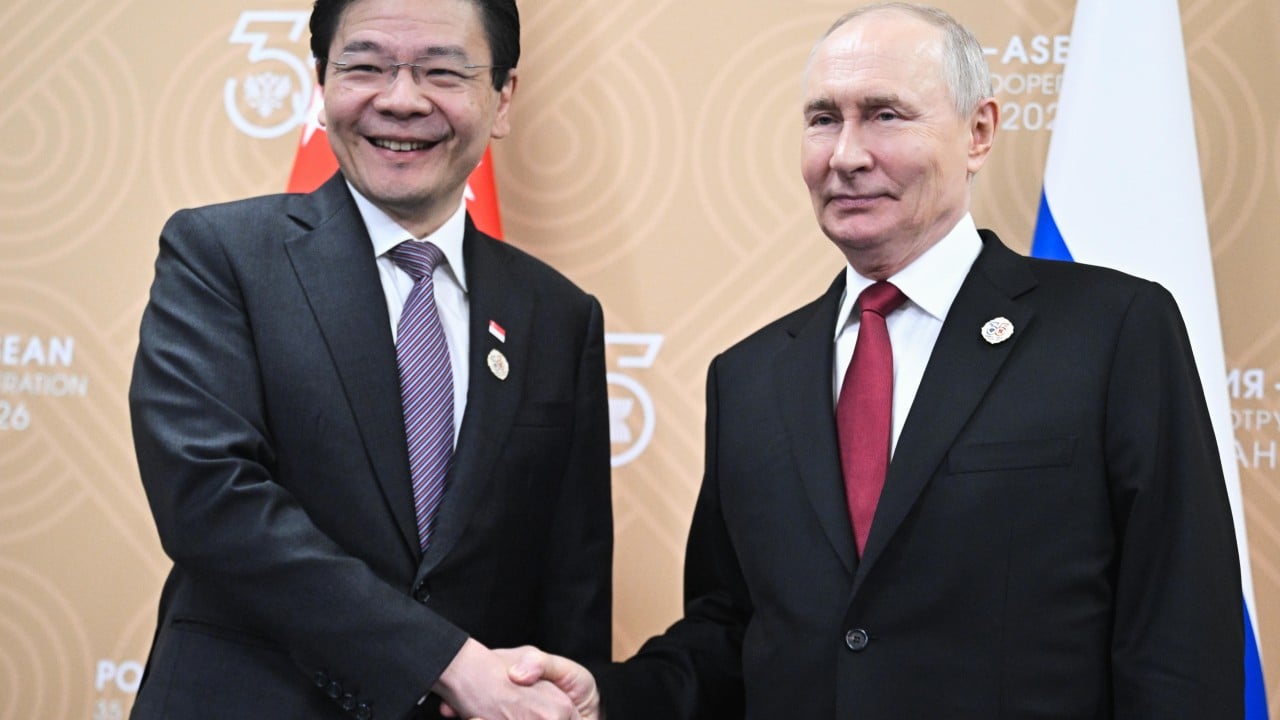
When Prime Minister Lawrence Wong sat down with Vladimir Putin, it triggered immediate, predictable anxiety across Western diplomatic circles. Critics wondered if Singapore, long considered Washington’s most reliable security partner in Southeast Asia, was quietly shifting its stance on the war in Ukraine. The short answer is no. Singapore is not softening its position on Russia, nor is it backing away from the historic sanctions it imposed in 2022. Instead, the meeting reflects a calculated, unyielding commitment to total strategic autonomy in a fracturing global order. For a tiny island nation dependent entirely on international law for its survival, keeping diplomatic channels open with a pariah superpower is not a sign of weakness. It is an exercise in cold, survivalist statecraft.
The Illusion of a Policy Shift
Laying eyes on a handshake between a Singaporean leader and the Russian president causes whiplash for a reason. In February 2022, Singapore did something completely unprecedented in its post-independence history. It bypassed the United Nations Security Council—which was hopelessly deadlocked by a Russian veto—and unilaterally imposed banking, financial, and export controls directly targeting Moscow.
To understand why that stance has not changed, you have to look at the foundational principles of Singaporean foreign policy. The country did not sanction Russia out of a desire to please the United States or align with NATO. It did so because Russia violated a sacred principle: the territorial integrity of a smaller sovereign state. If big countries can simply redraw borders by force, Singapore’s own existential security evaporates.
Therefore, diplomatic engagement is misread as policy capitulation. Maintaining lines of communication with Moscow is a practical necessity for a global trade hub, not an endorsement of Russian aggression. The economic sanctions remain firmly in place. The export bans on dual-use technology remain strictly enforced. A conversation in a summit room does not erase the legal frameworks Singapore erected to freeze Russian assets and block illicit financial flows.
What the Ground Reality Looks Like
Western analysts often look at international diplomacy through a binary lens. You are either with us, or you are against us. Southeast Asia does not operate this way, and Singapore has spent six decades mastering the gray spaces between competing superpowers.
To see how this works in practice, examine the trade data. While some neighboring countries have actively expanded their imports of discounted Russian crude oil, Singapore’s regulatory compliance has remained remarkably tight. The monetary authority keeps a suffocating grip on local banks, ensuring they do not become conduits for sanction evasion. This is a matter of self-preservation. The city-state's financial sector is tightly woven into the Western financial architecture; risking secondary sanctions from the US Treasury to score cheap Russian commodities would be economic suicide.
Yet, complete isolation is a luxury Singapore cannot afford. As a small state, its survival strategy has always been to make itself relevant to all global actors, ensuring that no single power can dictate its future. If Singapore cuts ties completely with every nation that violates international norms, its diplomatic network would shrink to a handful of states, neutralizing its influence as a neutral global forum.
The Regional Context and ASEAN Centrality
Singapore also operates within the context of the Association of Southeast Asian Nations. The region is highly fragmented on the issue of Russia. Some members depend heavily on Russian military hardware, while others view Moscow as a historical ally that checked Chinese expansion.
Had Singapore completely shut the door on Russia, it would have isolated itself within its own neighborhood. By maintaining a working relationship with Moscow while keeping sanctions active, Singapore preserves its position as the intellectual heavyweight of regional diplomacy. It proves it can hold a principled line without becoming a dogmatic proxy for Western interests.
The Real Risk of the Fragmented World Order
The true driver behind recent diplomatic maneuvers is an acute awareness that the global multilateral system is dying. The United Nations is functionally paralyzed. The World Trade Organization is ineffective. For decades, Singapore thrived because a single, rule-based global order protected free trade and state sovereignty. That world is gone.
We are now entering an era of aggressive minilateralism and competing trade blocs. In this fractured environment, a small state cannot afford to be trapped inside a single geopolitical silo. Wong’s willingness to engage with Putin demonstrates to the global south that Singapore refuses to be swallowed by a new Cold War dynamic. It signals that while Singapore will punish specific violations of international law, it will not participate in the permanent ideological isolation of a nuclear-armed state.
This approach carries immense friction. It requires a exhausting level of diplomatic precision. One misstep can anger Washington; another can alienate Beijing or Moscow. But for a nation with zero natural resources and no strategic depth, standing firmly in the crosswinds of global power is the only way to avoid being blown away. The meeting was not an apology for past actions, nor was it a promise of future alignment. It was a stark reminder that in the cold math of survival, talking to your adversaries is just as vital as standing by your principles.