The Irish Sea off the coast of west Wales does not coddle you. It is a bruised, churning expanse of gray and green, biting with salt and a wind that slashes right through Gore-Tex. On an ordinary Tuesday morning, it feels like the loneliest place on earth. You sit in a small, fiberglass boat, the outboard motor humming a low, vibrating note that rattles your teeth, watching a neon plastic bobber dance on the swell.
Fishing is often sold as a sport of patience, but that is a lie. It is a sport of isolation. You outwear your thoughts. You stare at the horizon until your eyes water, waiting for a mackerel or a bass to break the monotony of a quiet life. The stakes feel low—just a man, a rod, and a cold ham sandwich wrapped in foil.
Then the water explodes.
It started with a shift in the pressure, a subtle tightening of the sea's skin that only someone who spends hundreds of hours on the water would notice. The birds went quiet first. The gulls, usually screaming and diving for scraps, suddenly hovered high, circling like silent spectators.
Then came the breath.
It was a sharp, metallic hiss, like a pneumatic valve releasing under immense pressure. Pshhh. To an angler, that sound makes the heart drop into the throat. It is the sound of something massive breathing your air.
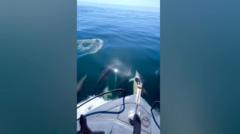
Just twenty yards from the starboard bow, a sleek, slate-gray back sliced through the surface. It was smooth, flawless, and glistening with a oily sheen that caught the weak Welsh sunlight. Then another. And another. Within sixty seconds, the empty, desolate stretch of Cardigan Bay transformed into a crowded highway of muscle, speed, and wild intelligence.
A pod of bottlenose dolphins had arrived.
We tend to look at nature through screens, neatly packaged into nature documentaries with soaring orchestral tracks. We think we understand it. But standing in a twelve-foot boat while a creature twice your weight launches its entire body into the air right next to you is a radically different reality. It is loud. The water slaps against the hull with violent force as they run underneath. The smell of the sea changes, suddenly filled with the sharp, fishy tang of apex predators on the hunt.
There were easily twenty of them, perhaps more, moving with a synchronized, terrifying grace. They were hunting, driving a school of herring or mackerel up from the deep sandy bottom of the bay toward the surface.
Consider the sheer mechanics of what was happening beneath the keel. The water in Cardigan Bay is murky, choked with sediment and plankton. To us, it is a wall of green fog. To the dolphins, it is a map drawn in sound. As they circled the boat, you could hear them through the fiberglass hull—a frantic, high-pitched chorus of clicks, squeaks, and pops. It sounded like a dozens of rusty hinges swinging wildly in a gale. This was echolocation in real-time, a biological sonar so precise it can detect an object the size of a golf ball from a football field away in pitch darkness.
They were talking. They were planning. The boat wasn't an obstacle to them; it was a prop.
One particularly large adult, scarred with white lines from old encounters with rocks or rival males, swam directly toward the stern. It rolled slightly onto its side, exposing a pale, pinkish underbelly.
And it looked up.
There is an uncomfortable vulnerability in looking a wild animal in the eye. We are used to being the observers, the masters of the landscape, looking down from our concrete perches. But when that dark, intelligent eye fixed on the boat, the hierarchy dissolved. There was no fear in that gaze. There was curiosity, a calculating assessment, and a strange, unmistakable flash of recognition. It was a mind looking back at a mind.
Cardigan Bay is actually home to the UK’s largest resident population of bottlenose dolphins, with around 250 individuals calling these waters home. Yet, knowing a statistic is entirely different from being surrounded by it. Locally, they are ghosts. You hear rumors of them from the life-boat crews or the ferry captains, but most days, the sea remains stubbornly empty. To stumble into the middle of a feeding frenzy feels less like a lucky break and more like an accidental intrusion into a sacred, hidden world.
The encounter lasted perhaps ten minutes, though time on the water stretches and warps until minutes feel like hours. They moved as a single entity, a rolling wheel of fins and fluke, pushing the baitfish further out toward the deep water of the channel. As quickly as the chaos began, the water began to heal itself. The ripples smoothed out. The frantic clicks beneath the hull faded into the steady, mundane thrum of the outboard engine.
The birds returned, screaming and bickering over the silver scales left floating on the surface.
You are left sitting in the damp cold, holding a fishing rod that suddenly feels absurdly small and irrelevant. The silence of the bay returns, but it is a different kind of silence now. It is no longer lonely; it is pregnant with the knowledge of what lies just beneath the gray curtain.
We build our lives around certainty, paving over the wild edges of the world to make ourselves feel secure. We track our steps, we schedule our days, and we look at our phones to tell us what the weather will be like in three hours. But every so Often, the sea reminds us that we are just visitors on a planet that doesn't belong to us. You crank the starter cord, turn the bow back toward the safety of the harbor, and realize you will spend the rest of your life looking at the water, waiting for the gray to flash into silver once again.