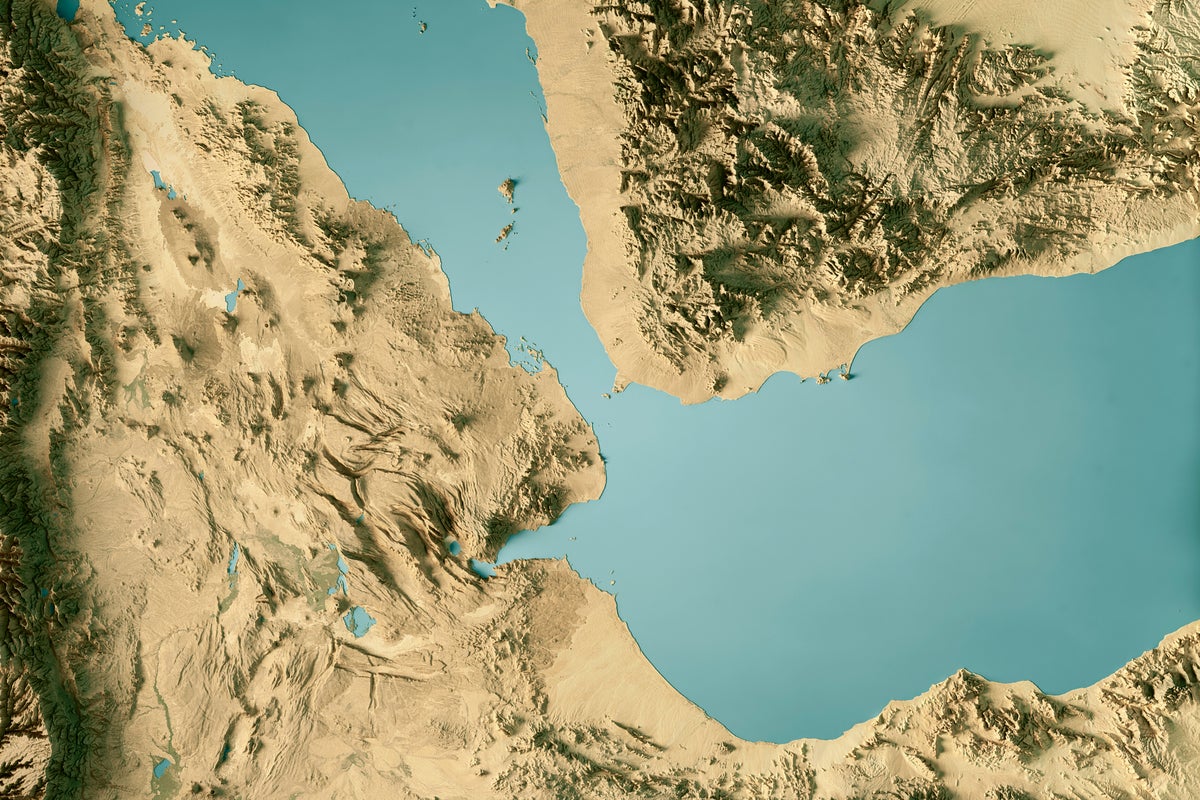
The Bab el-Mandeb Strait functions as the primary valve for 12% of global seaborne trade and 30% of worldwide container traffic. Disruptions within this narrow corridor do not merely delay shipments; they reconfigure the unit economics of global logistics. When Houthi militant activity forces a transition from the Suez Canal route to the Cape of Good Hope, the impact is a measurable increase in ton-miles, a contraction of effective global vessel capacity, and an immediate upward shift in the floor price of landed goods.
The Triple Constraint of Maritime Rerouting
The decision to divert a vessel around the southern tip of Africa involves three primary variables that dictate the severity of the economic fallout. These factors determine whether a disruption remains a localized supply chain annoyance or scales into a systemic inflationary shock. Read more on a connected issue: this related article.
1. The Capacity Contraction Variable
A standard journey from Shanghai to Rotterdam via the Suez Canal covers roughly 10,500 nautical miles. The detour around the Cape of Good Hope extends this to 13,500 nautical miles. This 30% increase in distance effectively reduces the global fleet's carrying capacity without a single ship being lost. If a vessel takes 10 extra days to complete a circuit, it can perform fewer voyages per year. To maintain the same weekly service frequency, carriers must inject more vessels into the loop. In a market where shipyard order books are fixed in the short term, this artificial scarcity drives spot freight rates upward.
2. The Bunker Fuel Cost Function
Operating costs for a Mega-Max container ship (20,000+ TEU) escalate sharply with distance. Fuel consumption is a non-linear function of speed. To mitigate the 10-to-14-day delay caused by the detour, many operators choose to increase vessel speed. This "speeding up" results in exponential increases in fuel burn. A 10% increase in speed can lead to a 30% increase in fuel consumption. This creates a feedback loop where the cost of the detour is compounded by the premium paid for time recovery. More journalism by Forbes highlights comparable perspectives on this issue.
3. The Insurance Risk Premium
The Red Sea has shifted from a standard risk zone to an active war-risk area. Insurance premiums for transiting the Bab el-Mandeb have surged from roughly 0.01% of hull value to 0.5% or higher. For a vessel valued at $100 million, a single transit now costs an additional $500,000 in insurance alone. This cost exists even for ships that are not targeted, as the entire risk pool is re-rated.
Mechanics of Supply Chain Desynchronization
The disruption extends beyond the physical location of the Red Sea. The global shipping network operates on a "hub and spoke" model that relies on precision timing.
Western Mediterranean ports like Algeciras or Gioia Tauro function as transshipment hubs. When ships arrive two weeks late from Asia, they miss their scheduled windows for feeder ships that distribute cargo to smaller regional ports. This creates port congestion. Containers pile up on docks because the inland logistics—trucks and trains—were scheduled for a different arrival date.
The "empty container" problem is the most significant secondary effect. Asia is the world's primary exporter. If ships are delayed returning to Asia from Europe, there is a shortage of empty containers in Chinese ports to be filled with the next wave of exports. This mismatch between equipment location and demand causes price spikes in regions far removed from the actual conflict zone.
The Resilience Fallacy and the Just-in-Time Crisis
Modern manufacturing, particularly in the automotive and electronics sectors, operates on a Just-in-Time (JIT) philosophy. This system minimizes inventory costs by assuming that the logistics layer is a constant, reliable utility.
The Red Sea instability exposes the fragility of low-inventory models. When a critical component—such as a wire harness or a semiconductor—is delayed by 14 days, an entire assembly line in Germany or the United States may stop. The cost of an idle factory far exceeds the cost of the shipping delay itself.
Companies are currently forced into a "Just-in-Case" transition. This involves holding higher safety stocks, which ties up working capital and increases warehousing costs. The transition from efficiency-optimized to resilience-optimized supply chains is inherently inflationary.
Energy Market Volatility and the LNG Link
While container ships carry consumer goods, the Bab el-Mandeb is equally critical for energy flows. Roughly 8 million barrels of oil per day pass through the region.
A prolonged threat to tankers necessitates a shift in global energy flows. Europe, which moved away from Russian pipeline gas, now relies heavily on Liquefied Natural Gas (LNG) from Qatar. These LNG carriers must pass through the Red Sea to reach European terminals. Rerouting an LNG carrier around Africa is not just a cost issue; it is a thermal efficiency issue. LNG evaporates (boil-off) during transit. Longer journeys mean more of the cargo is lost or used as fuel before it reaches its destination, tightening the supply-demand balance in the European winter.
Quantitative Analysis of Freight Rate Cascades
The impact on freight rates follows a predictable hierarchy.
- Primary Impact: Asia-to-Europe routes see the first and most dramatic surge.
- Secondary Impact: Asia-to-US East Coast routes rise as shippers seek to avoid the Red Sea/Suez path by using the Panama Canal (which has its own drought-related capacity limits) or the US West Coast.
- Tertiary Impact: Intra-regional routes and "backhaul" rates (Europe-to-Asia) increase as carriers apply emergency surcharges to cover the global equipment imbalance.
These increases are passed through to the consumer with a lag of 3 to 6 months, representing the time it takes for goods to move from a container to a retail shelf.
Strategic Positioning for Shippers and Investors
The volatility in the Red Sea is not a transient event but a signal of a new era of "Geopolitical Maritime Friction."
For businesses, the strategic play is no longer about finding the cheapest freight rate. It is about Multi-Node Diversification. This involves splitting manufacturing across different geographic regions to ensure that no single choke point can paralyze the entire operation.
For investors, the focus shifts to maritime logistics firms with flexible capacity and energy producers with access to diverse pipeline infrastructures. The "Security Premium" is becoming a permanent line item in global trade.
Current data suggests that as long as the kinetic threat remains high, the floor for global shipping rates has been permanently reset. The era of ultra-cheap, invisible logistics is over. Companies must now account for a "Geopolitical Tax" on every unit of cargo moved across an ocean. The next phase of this crisis will be the consolidation of shipping lines as smaller players, unable to absorb the increased operational risks and fuel costs, are forced out of the market, further concentrating pricing power among the top-tier carriers.
The objective reality is that the global economy has a single point of failure in the Bab el-Mandeb. Until a credible maritime security umbrella is restored or an alternative high-volume route is developed, the global supply chain remains in a state of precarious, high-cost equilibrium.