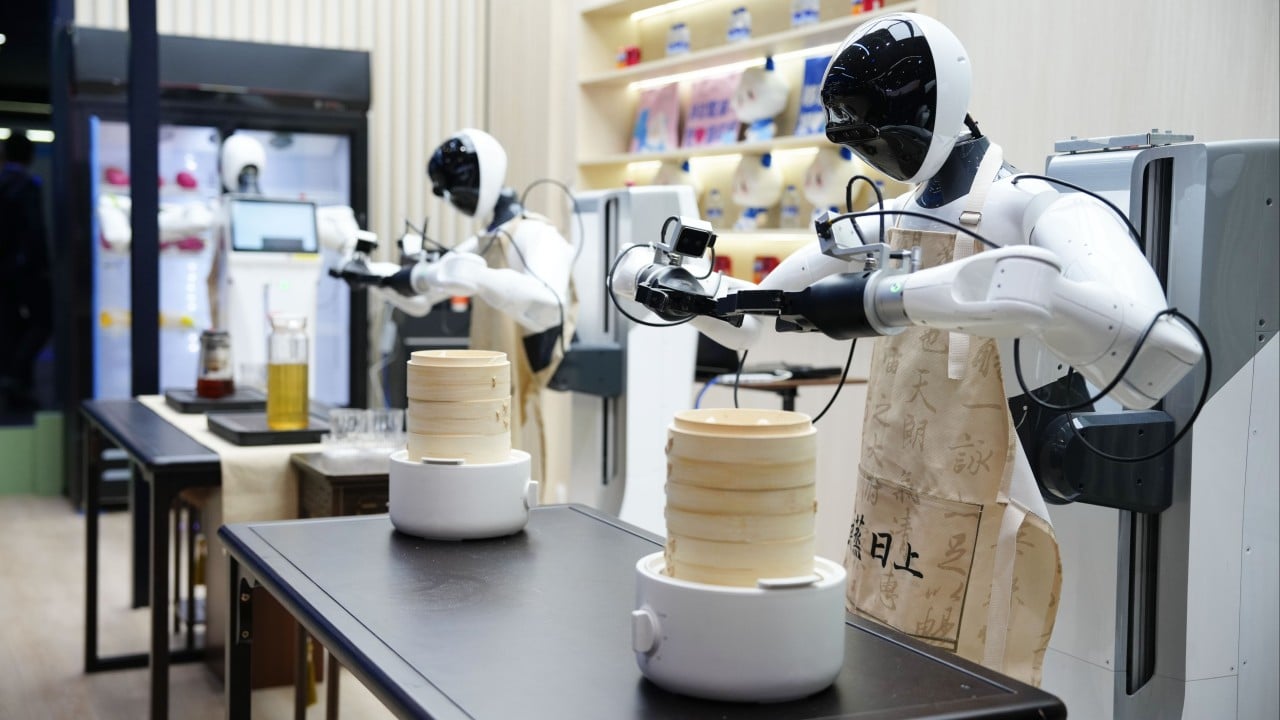
Midea isn't just a company that makes your air conditioner anymore. If you still think of them as a "white goods" manufacturer, you're missing the massive shift happening in Foshan. They just committed over 60 billion yuan—roughly 8.7 billion US dollars—to a three-year blitz centered on AI and robotics. This isn't a speculative play or a PR stunt. It's a survival strategy for a world where humans are getting more expensive and machines are getting much smarter.
I've watched companies try to "pivot" before, and usually, it's a disaster. But Midea's move is different because they're not just buying tech; they're rebuilding their entire corporate DNA. They call it the "Three Ones" strategy. It sounds corporate, sure, but the math behind it is brutal and fascinating.
The end of the appliance era
For decades, Midea won by being the world's factory. They mastered the art of making decent hardware at a price nobody could touch. But that model has a ceiling. Labor costs in China aren't what they used to be, and the market for "dumb" refrigerators is saturated.
By dumping 8.7 billion dollars into AI transformation, Midea is admitting that the future of home appliances isn't about the motor or the compressor. It's about the "Home Brain." They're launching a self-evolving AI agent called MevoX. The goal is a household that manages itself, but the real play is much bigger. They're taking what they learn in your kitchen and applying it to the factory floor.
Why robots are the real prize
You can't talk about Midea without talking about KUKA. When they bought the German robotics giant years ago, everyone in Europe panicked. Now we see why. Midea is integrating KUKA’s industrial arms with their own AI models to create "embodied intelligence."
Basically, they want robots that don't just follow a script but actually "see" and "think" about the task.
- In the factory: They’ve already built "Lighthouse Factories" that are fully AI-enabled. These aren't just automated; they're predictive. They know a part is going to fail before it does.
- In the home: They're testing humanoid robots like MELo and MELa. Honestly, we're still a bit far from a robot maid that does the laundry perfectly, but Midea is betting 8.7 billion dollars that they’ll get there first.
The numbers don't lie
Midea’s revenue in the first half of 2025 hit 252 billion yuan. That's a 15% jump during a time when global markets felt shaky. What's telling is where that growth came from. Their "ToB" (business-to-business) segments, which include industrial automation and smart building tech, are growing much faster than their consumer "ToC" side.
They aren't just selling to you; they're selling to other factories. This diversification is how they plan to dodge the "Large Enterprise Syndrome" that kills most old-school giants. They’re effectively cannibalizing their old identity to build something that looks more like a tech conglomerate and less like a hardware store.
What most people get wrong about this pivot
People see the big dollar sign and assume it's all about buying new toys. It's not. A huge chunk of that 8.7 billion is going into "human efficiency." They're using AI to streamline R&D, which historically is a massive money pit.
If you're a competitor, you shouldn't be worried about Midea making a better fridge. You should be worried about them making a fridge faster, cheaper, and with 30% fewer engineers because their AI handles the grunt work of design and testing. That’s the real threat.
Practical steps for the rest of us
If a giant like Midea is terrified enough of the future to drop nearly 9 billion dollars on a pivot, you probably shouldn't be sitting still either.
- Audit your automation: Don't just look at what can be automated; look at what can be "agentic." If your software isn't making decisions yet, it's already old.
- Watch the East: The AI narrative is dominated by Silicon Valley, but the physical implementation of AI is happening in places like Shenzhen and Foshan. If you aren't tracking Chinese industrial tech, you're flying blind.
- Focus on the "middle office": Midea’s success didn't come from a single cool robot. It came from building a digital infrastructure that allows their different divisions to share data.
The era of the simple appliance is dead. Midea knows it. Now the rest of the world has to catch up before the machines they’re building take over the market entirely.
Keep an eye on their upcoming patent filings in the robotics space; that's where the real "secret sauce" is being cooked.