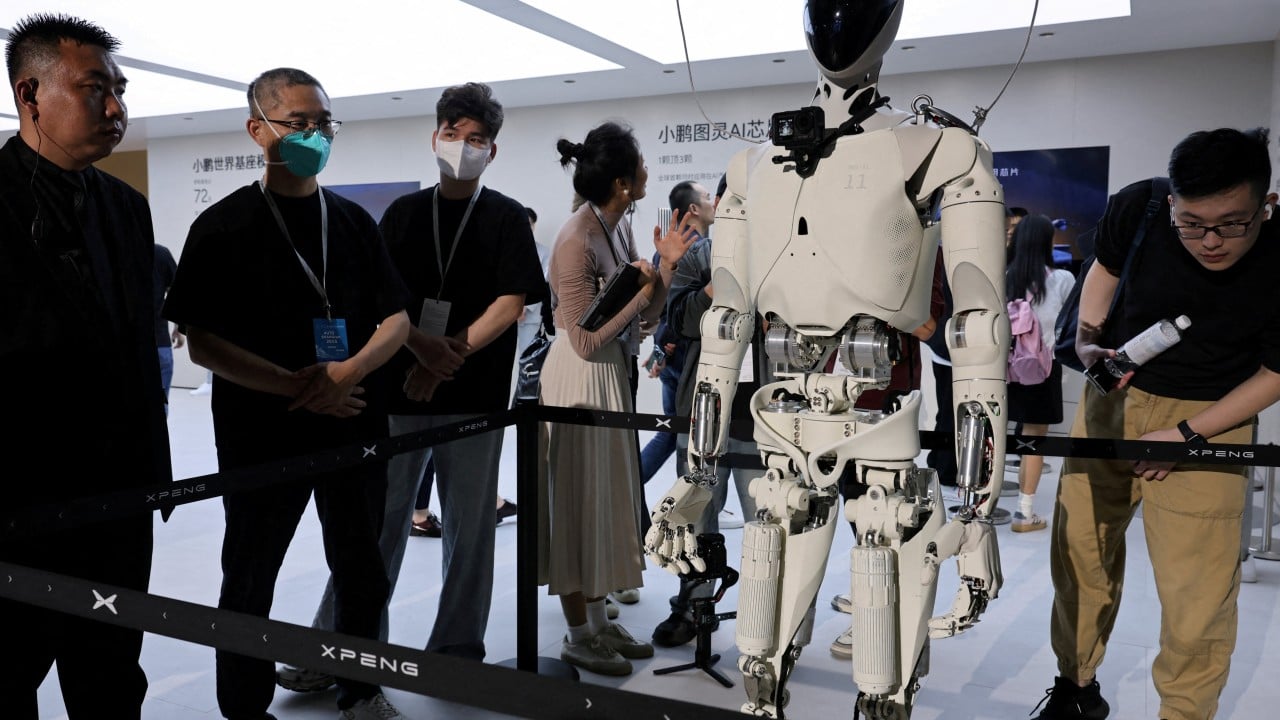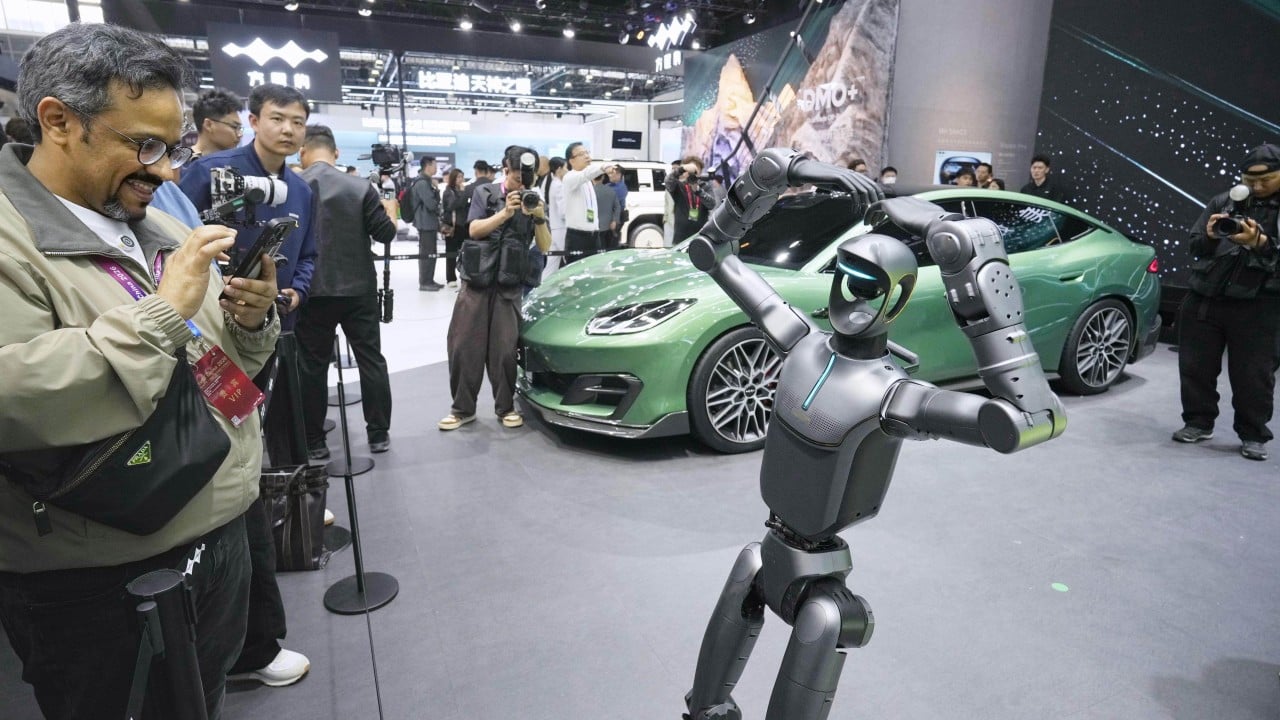
The tech press is currently salivating over the prospect of a humanoid robot war. Automotive media outlets are churning out breathless reports about Chinese electric vehicle giants like BYD, Dongfeng, and Nio rushing into the robotics space to clash with Tesla’s Optimus. They point to BYD’s "God’s Eye" advanced driving system and recent investments in humanoid startups as proof that the future of manufacturing is a bipedal machine walking a factory floor.
It is a beautiful, expensive fantasy.
The consensus view is lazy, driven by sci-fi tropes rather than the brutal realities of industrial engineering. Wall Street and venture capitalists love the narrative because it scales beautifully in slide decks. But anyone who has actually managed a high-throughput assembly line knows the truth. Building a humanoid robot to manufacture a car is the most inefficient way to solve an automation problem.
China’s EV makers aren't building humanoid robots because it makes operational sense. They are doing it because Tesla CEO Elon Musk turned robotics into a valuation multiple game, and Chinese OEMs cannot afford to look left behind in the capital markets.
The Kinematic Myth of the Human Form
Let's dismantle the foundational premise of the humanoid robot craze: the idea that because factories are built for humans, robots must be shaped like humans to operate in them.
This is fundamentally flawed engineering. The human body is an evolutionary compromise, not an optimized industrial machine. We have biological constraints. We bend, lift, and tire based on a skeletal structure designed for foraging, not continuous 24-hour torque application.
When you force a robot into a bipedal form factor, you inherit all of human biology’s structural liabilities without any of its cognitive fluidity.
- The Balance Tax: A humanoid robot wastes immense computational power and battery life simply not falling over. Maintaining dynamic equilibrium on two feet requires constant micro-adjustments from expensive actuators.
- Payload Inefficiency: A 150-pound humanoid robot struggles to lift 40 pounds safely over sustained periods. In contrast, a traditional, floor-mounted 6-axis robotic arm from Fanuc or Kuka can manipulate hundreds of pounds with sub-millimeter repeatability for decades without a break.
- The Point of Failure Multiplier: Every human joint duplicated in a robot—shoulders, elbows, wrists, hips, knees, ankles, fingers—introduces a new point of mechanical failure. In a production environment where one minute of downtime costs thousands of dollars, multiplying your points of failure for cosmetic reasons is corporate malpractice.
I have watched automotive executives dump millions into experimental robotics labs just to showcase a prototype that can barely walk across a polished stage or pick up a single component without dropping it. Meanwhile, the unsexy, stationary gantry robots next door are quietly driving 95% of the plant’s actual productivity.
BYD’s Real Weapon Isn't Walking
While the media focuses on the humanoid shiny objects, they miss what actually matters. Look at BYD’s launch of its "God’s Eye" (DiPilot) system. The mainstream analysis frames this as a stepping stone toward a generalized AI that will power autonomous walking humanoids.
This completely misreads the architecture.
Advanced Driver Assistance Systems (ADAS) and factory automation require entirely different algorithmic frameworks. Optimizing a vehicle to navigate a chaotic, rainy highway at 70 miles per hour using neural networks is a specialized problem. Mapping that same software stack onto a machine that needs to install a seat harness inside a stationary vehicle chassis is a square-peg, round-hole scenario.
BYD's true advantage lies in its vertical integration of battery supply chains and specialized, fixed-location automation. Its mastery of lithium iron phosphate (LFP) chemistry and high-volume cell-to-body manufacturing is what allows it to undercut global rivals on price.
The moment a car company diverts elite engineering talent away from cell degradation physics and power electronics to figure out why a robotic ankle is seizing up, they lose their edge.
The Economics of the Factory Floor
Advocates argue that humanoid robots are the ultimate solution to China’s aging demographic and rising labor costs. They ask: "What happens when there aren't enough workers to man the lines?"
The answer isn't a humanoid robot. The answer is a redesigned factory.
If a task is too complex for a standard robotic arm, the solution is to re-engineer the product or the assembly process, not to build a $30,000 mechanical human to mimic the manual labor. This is the core tenet of Design for Manufacturing (DFM). If a car requires a human-like hand to snake through an impossible angle to plug in a wire, you don't build a multi-million dollar cybernetic hand. You move the plug.
Consider the data on industrial robot density. According to the International Federation of Robotics, China has deployed hundreds of thousands of industrial robots over the past decade, becoming the fastest-growing market in the world.
| Robot Type | Primary Use Case | Efficiency Rating | Capital Expenditure Return |
|---|---|---|---|
| Articulated Arm (6-Axis) | Welding, Painting, Assembly | Maximum (99.9% Uptime) | High (12-18 Month ROI) |
| SCARA / Delta | High-Speed Pick and Place | Maximum (Sub-millisecond) | High (Under 12 Months) |
| Humanoid Bipedal | PR Stunts, Material Tending | Minimal (High Failure Rate) | Non-Existent |
The chart tells the story. The capital expenditure return on traditional automation is proven. The return on humanoid forms is a black hole of ongoing maintenance and software debugging.
The Tesla Valuation Contagion
To understand why Chinese carmakers are playing this game, you have to look at the valuation mechanics of the auto industry.
Traditional car companies trade at depressing price-to-earnings (P/E) multiples, often between 5x and 10x. Tech companies and AI houses trade at multiples of 30x, 50x, or higher. Musk successfully convinced the public market that Tesla is not a car company, but an AI and robotics enterprise that happens to manufacture cars. The Optimus robot is a crucial anchor for that narrative, propping up a premium valuation that defies standard automotive metrics.
Chinese EV firms like Nio, Xpeng, and BYD operate in a brutally competitive domestic market where price wars have gutted margins. To survive, they need continuous access to cheap capital. To get cheap capital, they must pitch themselves as tech conglomerates.
Therefore, the humanoid robot initiatives are marketing expenses disguised as R&D. They are designed to signal to regional governments, institutional investors, and sovereign wealth funds that these companies are participating in the "Fourth Industrial Revolution."
It is a high-stakes game of keeping up with the Joneses, played with billions of dollars that should be spent on solid-state battery research, thermal management software, and charging infrastructure.
The True Cost of the Hype
The downside of this distraction is real. Engineering talent is a finite resource. The brilliant software engineers spending their nights training reinforcement learning models so a robot can walk up a flight of stairs are engineers who are not perfecting the corner-case object detection of an autonomous vehicle's braking system.
We are entering a phase of global automotive consolidation. In the next five years, dozens of EV brands will go bankrupt or be acquired. The survivors won't be the ones with the coolest sci-fi prototypes in their lobby. The survivors will be the ones who figured out how to wring another 2% efficiency out of their electric drivetrains and cut another $500 out of their manufacturing costs.
Stop asking which Chinese carmaker will build the best humanoid robot to beat Tesla. Start asking which carmaker will have the financial discipline to ignore the hype entirely, double down on fixed automation, and price their competitors out of existence.
The robot race is a circus. The real war is being fought in the pennies of the bill of materials.