China has officially pushed its Qianfan, or Thousand Sails, low-Earth orbit satellite constellation past the 200-satellite milestone in orbit. To the casual observer, the recent high-frequency launches from Taiyuan and Wenchang signal a hyper-accelerated space program ready to break SpaceX’s near-monopoly on global orbital internet. But this initial surge masks a brutal systemic bottleneck that threatens the entire initiative. Beijing is trying to build a 15,000-satellite megaconstellation using an industrial pipeline that lacks the foundational element required for global scale: a massive, cheap, and combat-tested fleet of reusable rockets.
The Real Numbers Behind the Race for Orbital Real Estate
Space operates on a first-come, first-served basis under International Telecommunication Union rules. SpaceX’s Starlink already controls over 60% of active global satellite slots and has locked up nearly 70% of the prime real estate between 500 and 600 kilometers. The prime real estate is disappearing fast.
To prevent total American dominance of space-based broadband, Shanghai Spacecom Satellite Technology backed the Qianfan project with a long-term goal of 15,000 satellites by 2030. While hitting 200 satellites this month looks impressive on paper, a deeper dive into the numbers reveals an astronomical math problem.
- The Stated Goal: 648 satellites in orbit to build an initial regional network, scaling to thousands for global coverage.
- The Reality Check: At the current deployment cadence, China is accumulating satellites in pairs or small batches of 18.
- The SpaceX Gap: Starlink routinely lofts 20 to 23 satellites per single Falcon 9 launch, multiple times a week.
China’s space industry has successfully industrialized the manufacturing side. The Innovation Academy for Microsatellites has adopted modern assembly-line principles, slashing production costs. Building a satellite is no longer the problem. The core issue is that a mass-produced satellite is nothing more than expensive warehouse clutter if it cannot find a ride to orbit.
The Maiden Flight Gamble and the Reusability Bottleneck
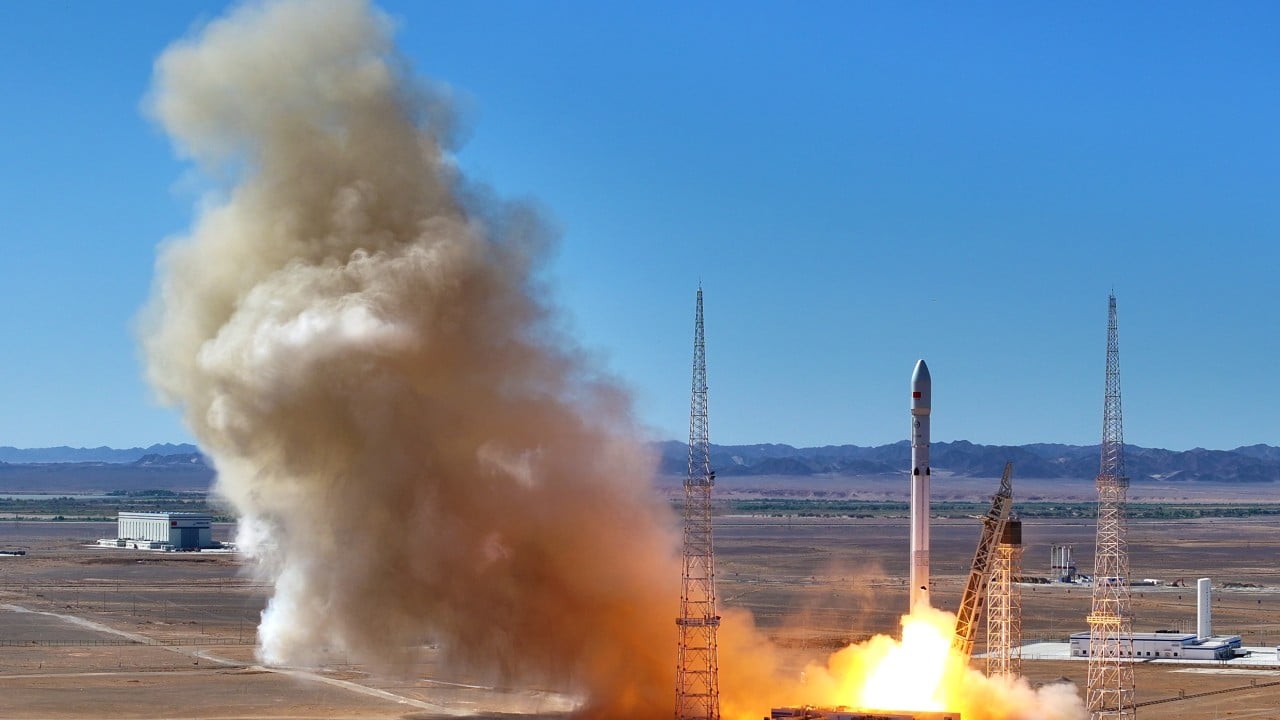
The desperation to bridge this cadence gap was put on full display when China rolled its brand-new Long March 12B onto a pad in the Gobi Desert. In an unprecedented move for a conservative state space program, the rocket flew its maiden mission without advance public airspace notices and carried functional, paying payloads: two Qianfan satellites.
The launch was a technical success, but it exposed the deep vulnerabilities of the program.
The Expendable Execution
The Long March 12B is designed for first-stage recovery, featuring kerosene and liquid oxygen engines that mirror the engineering path of the Falcon 9. Yet, during this critical debut, the booster flew in entirely expendable mode. No recovery was even attempted.
The Trail of Failures
This wasn't an isolated cautious step. Landspace’s Zhuque-3 and the Long March 12A both reached orbit during their initial trials over the past year, but both structural systems saw their first-stage recovery tests fail during descent.
The Debris Liability
The pressure to launch has bypassed critical safety design maturity. The Long March 6A upper stage used to deploy earlier Qianfan batches broke apart in orbit, scattering hundreds of pieces of trackable debris across high-value polar orbits. Speed is consistently overriding sustainability.
A space program that throws away its primary booster with every single launch cannot compete with an architecture that lands, refurbishes, and reflies the same hardware within days. China is treating the satellite race as a sprint of production, but it is ultimately an endurance log of logistics.
Geopolitics vs. Economics in the Developing World
Qianfan is not designed to win over retail consumers in North America or Western Europe. Instead, Beijing is positioning the constellation as global public infrastructure, actively courting governments in South America, Southeast Asia, and Africa.
The strategy focuses on offering data security and digital sovereignty to nations wary of relying entirely on a network controlled by a single American billionaire. For an ocean-going commercial fleet or a remote municipality in a developing economy, a non-U.S. provider looks like an attractive hedge.
+------------------+-----------------------------+-----------------------------+
| Feature          | SpaceX Starlink             | Spacesail Qianfan           |
+------------------+-----------------------------+-----------------------------+
| Active Fleet     | 6,000+ Satellites           | ~200 Satellites             |
| Launch Vehicle   | Fully Reusable Falcon 9/G1  | Primarily Expendable LM-6A  |
| Primary Band     | Ku, Ka, Direct-to-Cell      | Ku, Q, V-Band               |
| Core Market      | Global Consumer/Enterprise  | Global Public/Global South  |
+------------------+-----------------------------+-----------------------------+
But this ideological alternative comes with a steep price tag. Because SpaceX has perfected booster reusability, its marginal cost per launch is a fraction of the market rate. China’s commercial space sector is heavily subsidized by regional and municipal governments, like the massive capital injections from the city of Shanghai. These subsidies can hide the true cost of using expendable rockets for a while, but economic gravity always wins.
Maintaining a 15,000-satellite constellation requires replacing roughly 2,000 to 3,000 degrading satellites every single year due to natural orbital decay in low-Earth orbit. Doing that with disposable hardware will drain even the deepest state coffers.
Why the Pad Building Boom Won't Solve the Crisis
To counter the launch vehicle deficit, China is executing its classic industrial playbook: building infrastructure at a massive scale. Coastal launch facilities are expanding rapidly, with new commercial launchpads designed to support missions every single week.
This infrastructure boom misses the fundamental problem. The bottleneck isn't the concrete pads; it is the maturity of the supply chain feeding them.
Industrializing reliable rocket engines requires thousands of successful component cycles, refined metallurgy, and automated precision testing. China’s commercial aerospace startups are still trapped in the prototype era. They can build a factory, but they cannot yet mass-produce a reusable, throttling engine that can withstand the extreme thermal shock of re-entry dozens of times.
The 200-satellite milestone is an impressive engineering achievement for a program that started scaling its launches less than two years ago. It proves that China can match the West in satellite architecture, payload design, and high-frequency factory assembly lines. But until those commercial pads are populated by rockets that can land vertically, refurbish instantly, and fly again the following week, the Thousand Sails constellation will remain an ambitious regional network trapped under the shadow of a far more efficient orbital machine.
To truly challenge the status quo, the Chinese space sector must stop measuring success by how many satellites it can build, and start mastering the brutal science of bringing its rockets back home.