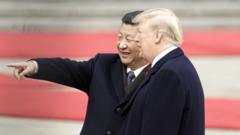
The media is currently obsessed with a narrative of "Chinese Ascendance 2.0." The consensus is simple, lazy, and wrong: they claim that because a decade has passed, Donald Trump is returning to find a China that is more "assertive," "unified," and "economically resilient."
This is a hallucination.
If you look past the shiny high-speed rail lines and the aggressive naval maneuvers in the South China Sea, you don't see a superpower in its prime. You see a nation that has hit a structural wall. The China of 2024 isn't a more formidable opponent than it was in 2016; it is a more desperate one. The "assertiveness" that pundits mistake for strength is actually the frantic signaling of a regime that has run out of easy wins.
The Debt-Fueled Mirage of Growth
Western analysts love to point at China’s GDP figures as proof of an unstoppable trajectory. I’ve sat in boardrooms where executives treat these numbers as gospel. They shouldn't.
China’s growth for the last decade has been a massive exercise in capital misallocation. We aren't talking about productive investments that yield long-term value. We are talking about the "Ghost City" phenomenon scaled to a national level. Total social financing—a broad measure of credit and liquidity—has skyrocketed, but the efficiency of that debt is cratering.
In the early 2000s, one dollar of debt generated roughly $0.80 of GDP growth. Today, that same dollar generates less than $0.20.
The Real Estate Cardiac Arrest
The collapse of giants like Evergrande and Country Garden wasn't a "glitch" or a "necessary correction." It was the death of the Chinese middle-class dream.
- Over 70% of Chinese household wealth is tied up in property.
- In the US, that figure is closer to 25%.
- When the property market freezes, the Chinese consumer stops spending.
The competitor's narrative suggests Trump faces a more "integrated" Chinese economy. The reality? He faces an economy where the internal engine is stalled, and the only way out is to dump subsidized excess capacity onto global markets, sparking trade wars with not just the US, but the EU, Brazil, and Turkey.
The Demographic Time Bomb Is No Longer Theoretical
Everyone talks about the "aging population" as if it’s a problem for 2050. It’s a problem for right now.
China’s working-age population peaked in 2014. Since then, it has been shrinking by millions every year. This isn't just a "labor shortage" issue. It is a fundamental shift in the national psyche. The "996" culture (working 9 am to 9 pm, 6 days a week) has been replaced by "lying flat" (tang ping) and "let it rot" (bai lan).
Young Chinese people are opting out of the rat race because they see the ceiling. Youth unemployment reached such embarrassing levels last year that the government literally stopped publishing the data for months until they could "refine" the methodology.
Trump isn't dealing with a rising tiger. He is dealing with a country that is getting old before it gets rich—the ultimate developmental trap.
The "Unified" Party Is Actually a Bottleneck
There is a common misconception that Xi Jinping’s consolidation of power makes China more efficient. The "dictator advantage," as some call it.
It's actually a massive strategic liability.
In 2016, there were still competing factions within the CCP—the "technocrats," the "princelings," the "tuanpai" (Youth League faction). These groups provided a feedback loop. Mistakes could be called out. Today, that loop is broken. Xi has surrounded himself with loyalists whose primary job is to say "yes."
The Cost of Total Control
Consider the "Zero-COVID" policy. It was a masterclass in bureaucratic inertia. Even when the costs became catastrophic and the rest of the world moved on, China stayed locked down because nobody had the political cover to tell the Emperor he was wrong.
The same thing is happening in the tech sector. By crushing giants like Alibaba and Tencent to ensure state control, the CCP effectively decapitated its own innovation engine. You don't get the next Nvidia when your most successful entrepreneurs are being "re-educated" or forced into early retirement.
The Manufacturing Trap
The competitor article claims China’s grip on supply chains is tighter than ever.
It’s actually more brittle.
The "China Plus One" strategy isn't a corporate buzzword; it’s a survival tactic. Capital is fleeing. Foreign Direct Investment (FDI) into China turned negative for the first time in decades recently. Companies aren't leaving because they hate China; they’re leaving because the risk-to-reward ratio has flipped. Between the anti-espionage laws that can land a consultant in jail for looking at public data and the looming threat of a Taiwan flashpoint, the "China Price" now includes a massive "Geopolitical Risk Premium."
The American Advantage Nobody Admits
While we hand-wring about our own political divisions, we ignore the fact that the US has demographic tailwinds and energy independence that China would kill for.
- Energy: China is the world's largest importer of oil and gas. Their economy lives at the end of a very long, very vulnerable maritime straw.
- Food: They are increasingly dependent on imported calories.
- Geography: The US has friendly neighbors and two vast oceans. China is surrounded by historical rivals—Japan, India, South Korea, Vietnam—all of whom are currently hiking their defense budgets to counter Beijing.
The Contrarian Playbook for the Next Four Years
If you are a CEO or a policymaker, you need to stop preparing for a "strong China." You need to prepare for a "brittle China."
A brittle power is more dangerous than a strong one. It lashes out. It uses "wolf warrior" diplomacy because it has no soft power left. It uses economic coercion because it can no longer compete on pure innovation.
How to Navigate the Real China
- Aggressive Diversification: If your supply chain still runs 80% through Shenzhen, you aren't "optimized"—you're a hostage. Move to Mexico, Vietnam, or India. Not because it’s cheaper (it often isn't), but because it’s the only way to insure against a sudden decoupling.
- Ignore the GDP Headlines: Watch the electricity consumption and the container freight rates. Those are the only metrics that don't lie in a command economy.
- Prepare for the "Internal Pivot": As the Chinese economy slows, the CCP will lean harder into nationalism to maintain legitimacy. This means more boycotts of Western brands and more "security" crackdowns.
The Bottom Line
Trump is not returning to face a more assertive China. He is returning to face a China that is realizing its window of opportunity is closing. The bravado we see on the world stage is a mask for deep, systemic anxiety.
The decade has not been kind to Beijing. It has stripped away the illusions of their "model." They are over-leveraged, under-populated, and strategically isolated.
Stop reading the headlines that describe China as a 20-foot tall giant. They are standing on stilts, and the wood is starting to splinter.
The real risk isn't that China will take over the world. It’s that they will collapse under their own weight and take the global trade system down with them. Plan accordingly.