Dust does not settle easily in the Arabian Peninsula. It hangs in the hot air, fine and relentless, coating the windshields of armored patrols and blurring the horizon where the desert meets an unforgiving sky. For years, the security architecture of the Gulf was written in a single ink: a heavy, transatlantic script signed in Washington and backed by decades of mutual guarantees. But ink fades in the sun.
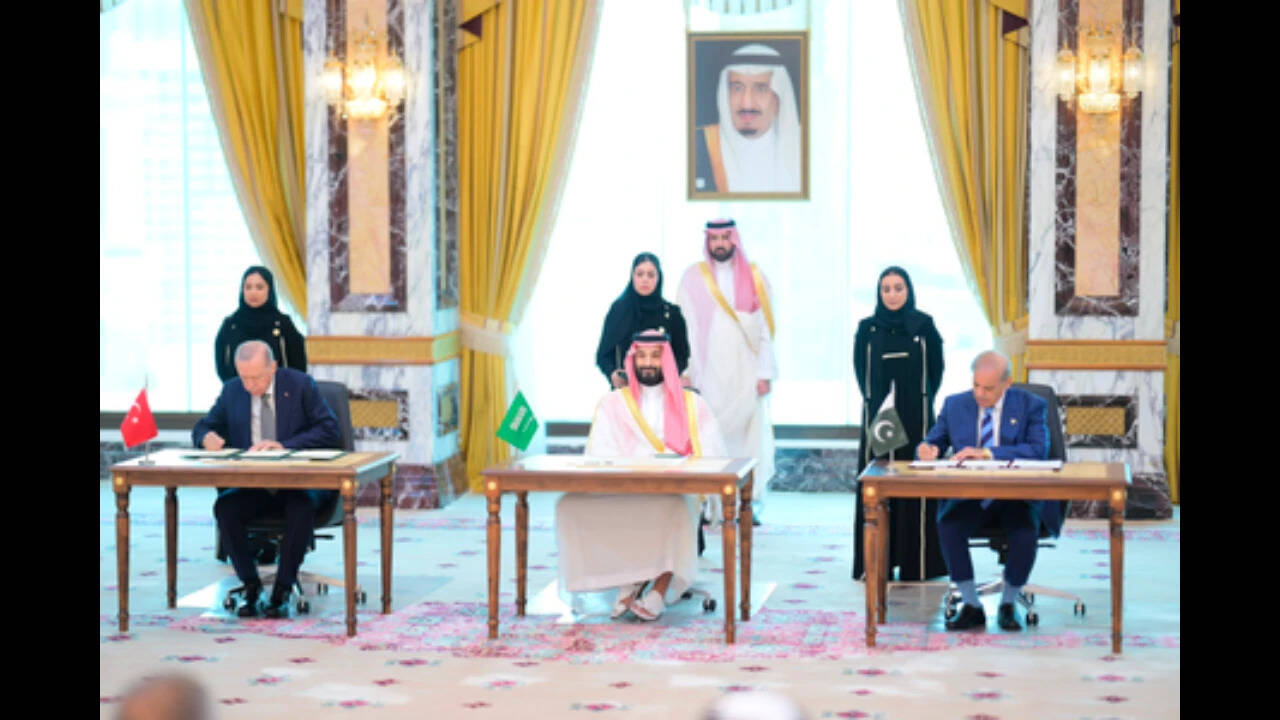
Look closely at the shifting perimeter of Riyadh’s defense lines, and you will see a different silhouette taking shape. Turkish boots on gravel. Pakistani tactical units moving in synchronization with local commands. It is a quiet realignment, born not from grand ideological brotherhood, but from the raw, unromantic calculus of survival as the fires in Yemen continue to cast long, erratic shadows across the border.
Consider what happens when an anchor starts to slip.
For generations, regional powers looked westward for absolute security. If the oil flowed and the deterrence held, the arrangement worked. Yet, as the war in Yemen dragged on—transforming from a localized rebellion into a multi-layered proxy conflict featuring ballistic trajectories and drone incursions—the limits of distant protection became glaringly apparent. Missiles do not care about distant defense treaties when they are descending toward an oil refinery. Sovereignty requires immediacy.
This is where Ankara and Islamabad enter the frame, carrying a different kind of utility.
Turkey brings the lethal precision of modern drone warfare and electronic intelligence, lessons forged in its own jagged borderlands and tested across the skies of multiple continents. Pakistan brings something equally invaluable: an army hardened by decades of counter-insurgency, profoundly familiar with regional terrain, and possessing deep, historic institutional ties to the security apparatus of the Gulf kingdoms.
When these forces begin to deploy, coordinate, or advise under the broad umbrella of joint defense cooperation, it is not merely a troop rotation. It is the tectonic plates of Middle Eastern geopolitics grinding against one another, shifting weight from traditional Western capitals to indigenous, regional axes of power.
To understand the weight of this moment, you have to step away from the maps and think about the human cost at the periphery.
Imagine a young Saudi lieutenant standing on an observation post near the southern border at dawn. The air is cool for a brief window before the furnace of the day ignites. Below him, the terrain folds into treacherous wadis—dry riverbeds that can just as easily conceal a smuggling ring or a launch site for loitering munitions. He has radar screens, yes. He has satellite feeds. But the technology can only tell him what is happening; it cannot tell him what his allies will do when the sirens start wailing.
When Turkish defense contractors deliver advanced unmanned aerial systems, and when Pakistani trainers help sharpen the tactical response of local infantry, that lieutenant is no longer relying solely on a distant superpower’s calculus of interest. He is relying on neighbors who bleed in the same time zone. That changes the psychology of deterrence entirely.
Critics call this proliferation of actors messy. They worry about tangled chains of command, competing regional ambitions, and the risk of accidental escalation. Those fears are not unfounded. When too many hands are on the steering wheel, the vehicle tends to swerve. Ankara has its own distinct regional calculus, balancing relations with Western partners against a fierce drive for strategic autonomy. Pakistan walks a perpetual tightrope, managing domestic economic pressures while maintaining its indispensable role as a pillar of Islamic military cooperation.
Yet, to dismiss this as mere opportunism is to misread the depth of the crisis.
The war in Yemen exposed a terrifying vacuum. When non-state actors acquire the capability to strike critical infrastructure with cheap, mass-produced technology, traditional air defense architectures begin to look like medieval castles facing artillery. No single nation can guard every mile of desert alone. Burden-sharing is no longer a diplomatic buzzword whispered in conference rooms; it is the price of admission for regional stability.
Look at the way military doctrines are quietly rewriting themselves in real time.
Turkish defense engineering has evolved from importing foreign hardware to exporting combat-proven systems that redefine modern maneuver warfare. In Saudi hands, or operating in coordination with allied contingents, these systems act as a digital shield. Meanwhile, Pakistan’s military advisory presence provides a human anchor—thousands of personnel who have lived through the crucible of asymmetric warfare and know how to train others to survive it.
This is not a formal NATO of the Middle East. It is something much more fluid, pragmatic, and fragile. It is a network of bilateral trust and transactional necessity, stitched together by the urgent need to keep regional fires from consuming the house.
The desert wind picks up again, erasing footprints almost as fast as they are made. In the command centers of Riyadh, Islamabad, and Ankara, maps are being redrawn with grease pencils and digital overlays, charting a future where security is no longer imported from across the ocean, but forged in the harsh, unforgiving crucible of local reality.