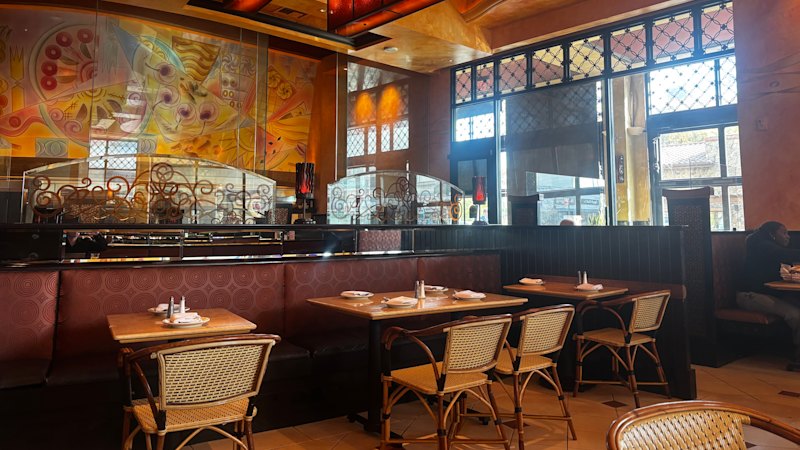
Political pundits love a simple fairy tale. They walk into a suburban mall, smell the warm brown bread, watch a family split a 1,500-calorie slice of Oreo Dream Extreme Cheesecake, and declare victory over the American culture war.
They see a neutral oasis. They call it "blissful ignorance."
That is lazy journalism. Worse, it is terrible business analysis.
The Cheesecake Factory is not ignoring the culture war because its executives are oblivious or uniquely virtuous. They are avoiding political landmines because their entire corporate survival depends on maximum throughput, broad-spectrum customer acquisition, and razor-thin hospitality margins. What commentators mistake for naive escapism is actually cold, calculated risk management.
If you run a business and think you can copy The Cheesecake Factory’s silence simply by refusing to post on social media, you will fail. You have to understand the operational machinery underneath the silence.
The Myth of the "Apolitical" Corporation
When media outlets cover brands that stay out of political brawls, they frame neutrality as a passive act. They treat it like a restaurant deciding not to hang a cable news channel over the bar.
In modern corporate strategy, neutrality is never passive. It is an active, expensive, and continuous defensive posture.
I have sat in boardrooms where executives burned millions of dollars on crisis communications consultants just to figure out how to say nothing at all. Staying quiet when activists, employees, and politicians demand a statement requires rigid discipline. Every menu item, every real estate lease, every corporate philanthropy dollar, and every HR policy has to be scrubbed for ideological friction.
The Cheesecake Factory operates over 200 full-service restaurants across vastly different ideological geographies. A location in Irvine, California, and a location in Frisco, Texas, use the exact same spiral-bound, 21-page menu. They rely on the exact same supply chain. They execute the exact same training manuals.
If the brand alienates 30% of the demographic in either market, the unit economics collapse. Casual dining does not have the luxury of niche tribalism. You cannot survive on ideological loyalty when your business model requires turning high-square-footage dining rooms multiple times a day, seven days a week.
The High Cost of Chasing Niche Validation
Compare this to brands that voluntarily step into the political arena. Often, when a company takes a loud ideological stance, it is not doing so out of moral courage. It is doing so because its core product is commoditized and losing market share.
When you cannot win on product, price, or operations, you try to win on identity. You turn your brand into a political badge so customers buy from you to signal their values to their neighbors.
The Cheesecake Factory does not need to sell you a political identity because it sells you operational abundance. Its competitive moat is built on kitchen execution—producing over 250 dishes from scratch in high-volume environments without catastrophic ticket times.
Why Marketers Ask the Wrong Question About Brand Neutrality
If you look at search trends or corporate strategy forums, executives constantly ask the same flawed question: "Should our brand take a stand on social and political issues?"
That question is completely backward. It assumes brand positioning is a moral philosophy exercise rather than a math problem.
The real question is: What is your customer acquisition cost, and how much addressable market can you afford to amputate?
Let’s break down the mechanics of brand polarization using basic economic principles:
- High-Margin, Niche Brands: If you sell $120 yoga pants or boutique craft beer, you can afford to alienate half the country. You only need a small, hyper-loyal tribe to sustain high margins on low volume. Your political stance acts as a filter that strengthens tribal bonds.
- High-Volume, Mass-Market Operators: If you run a casual dining chain, a big-box retailer, or a regional airline, alienation is fatal. Your fixed overhead—rent, equipment, baseline labor—is massive. Every empty booth is pure margin erosion. You need the red-hat wearing retiree, the progressive college student, the suburban soccer mom, and the traveling salesperson sitting within ten feet of each other, spending $35 per head.
When pundits praise The Cheesecake Factory for "ignoring" politics, they miss the financial reality. The company isn't ignoring politics; it is protecting its Total Addressable Market (TAM).
Dismantling the "Silence Is Complicity" Trap
A common objection from modern brand consultants is that staying silent is no longer an option—that younger consumers demand corporate activism and will boycott neutral brands.
Look at the actual foot traffic data, not Twitter polls.
Consumers do not boycott restaurants that serve great food at predictable prices just because the CEO didn't issue a press release about a Supreme Court ruling. Boycotts happen when a brand breaks an implicit promise to its customer. When a restaurant promises escapism and comfort, injecting political anxiety into the dining room violates the core product experience.
People do not go to The Cheesecake Factory to be educated, validated, or challenged. They go there to dissociate from reality for ninety minutes over a plate of Cajun Jambalaya Pasta.
The Operational Reality Behind the 21-Page Menu
To understand why this brand thrives while competitors flounder, you have to stop looking at its PR strategy and start looking at its kitchen operations.
In the restaurant industry, conventional wisdom says a massive menu is a death sentence. Gordon Ramsay built an entire television career screaming at restaurant owners to cut their menus down to ten items to control food waste and prep times.
The Cheesecake Factory broke every rule of culinary efficiency and turned a 250-item menu into a cash machine. How? Through ruthless, industrial-grade standardization and ingredient cross-utilization.
- Ingredient Overlap: That chicken breast isn't just for one dish. It is diced for salads, pounded for schnitzel, sliced for pasta, and shredded for tacos. A massive menu feels like infinite choice to the diner, while functioning as a tightly controlled inventory matrix in the back of the house.
- Prep Line Choreography: Line cooks aren't improvising. Every station is engineered down to the second. The kitchen operates like an automotive assembly line disguised as a scratch kitchen.
- Portion Psychology: Massive portions justify higher check averages while creating a perception of immense value. Even when inflation drives up menu prices, the sheer physical weight of the plate keeps the customer from feeling cheated.
This operational mastery is why the brand is immune to the culture war. When your product is structurally engineered to deliver maximum dopamine and perceived value to every demographic, you don't need cheap PR stunts to drive traffic.
The Hidden Downsides of Radical Neutrality
Before you sprint back to your company and strip every values statement from your website, let’s be honest about the risks. Radical neutrality is not a free lunch. It comes with severe vulnerabilities that can blindside an unprepared leadership team.
1. You Have Zero Tribal Shield
When a polarizing brand gets attacked by the media or regulators, its core tribe rallies to defend it. Customers buy gift cards in bulk just to spite the critics. When a strictly neutral brand hits a genuine operational crisis—a foodborne illness outbreak, a wage-theft lawsuit, a supply chain failure—nobody comes to the rescue. You have customers, not zealots. If the product falters, they walk away without a second thought.
2. Internal Talent Friction
Maintaining external neutrality requires strict internal boundaries. Modern corporate workforces—especially at the corporate headquarters level—frequently demand that leadership validate their personal worldviews. Enforcing a "leave politics at the door" policy means you will lose talented marketers, designers, and managers who view their career as an extension of their activism. You have to accept higher corporate turnover or recruit specifically for mercenaries who care about execution over ideology.
3. The "Gotcha" Ambush
Because you don't stake out clear ideological territory, partisan activists on both sides will inevitably try to force your hand. A single rogue franchisee, an unvetted vendor, or a poorly worded local job posting can trigger a viral outrage cycle. Without a pre-existing ideological base, neutral brands often panic during these ambushes, issuing clunky apologies that manage to anger both sides simultaneously.
How to Build an Ideology-Proof Business
If you want to replicate the resilience of a mass-market powerhouse without falling into the traps of lazy neutrality, stop focusing on what you say and start fixing how you operate.
Audit Your Friction Points
Look at every touchpoint your customer experiences. Where are you accidentally injecting political or cultural friction? Often, it isn't coming from the CEO. It’s coming from mid-level marketing hires chasing industry awards, HR departments importing trendy corporate jargon, or customer service scripts that sound preachy. Strip out anything that doesn't directly serve the core utility of your product.
Over-Index on Tangible Value
Cultural tribalism thrives in a vacuum of tangible value. When a product is mediocre, people judge it by its politics. When a product is undeniably superior, people forgive almost anything. Pour the budget you would have spent on "purpose-driven" ad campaigns directly into product quality, speed of delivery, and customer service. Make your offering so objectively good that even your ideological opposites feel stupid boycotting it.
Establish a Strict Communication Threshold
Create an explicit, written rule for when the company speaks publicly. Tie it strictly to material business impact.
- Does this legislation directly alter our supply chain, tax rate, or labor laws? Speak up through industry trade groups.
- Is this a broader cultural debate unrelated to our core operations? Say nothing.
Train your leadership team to withstand the 48-hour outrage cycle. Most internet boycotts have the half-life of a fruit fly. Executives only turn a temporary social media flare-up into a permanent brand scar when they panic and release a statement.
Design for Broad-Spectrum Escapism
Understand the psychological job your customer is hiring you to do. In an era where every news feed, workplace, and family dinner is saturated with ideological tension, offering a friction-free zone is a massive competitive advantage. Whether you sell software, coffee, or financial advice, make the user experience feel like a relief from the outside world, not an extension of it.
Stop Confusing Silence with Strategy
The commentators marveling at The Cheesecake Factory’s ability to float above the political fray are looking at the symptom, not the cause.
They see a restaurant chain quietly printing money while louder, "purpose-driven" competitors struggle with declining same-store sales and consumer fatigue. They assume the secret is simply keeping your mouth shut.
It isn't.
Keeping your mouth shut only works when your operations are bulletproof, your value proposition is undeniable, and your business model is built to serve everyone rather than flatter a few. Silence isn't a strategy. Execution is the strategy. The silence is just what happens when you're too busy running a real business to argue on the internet.