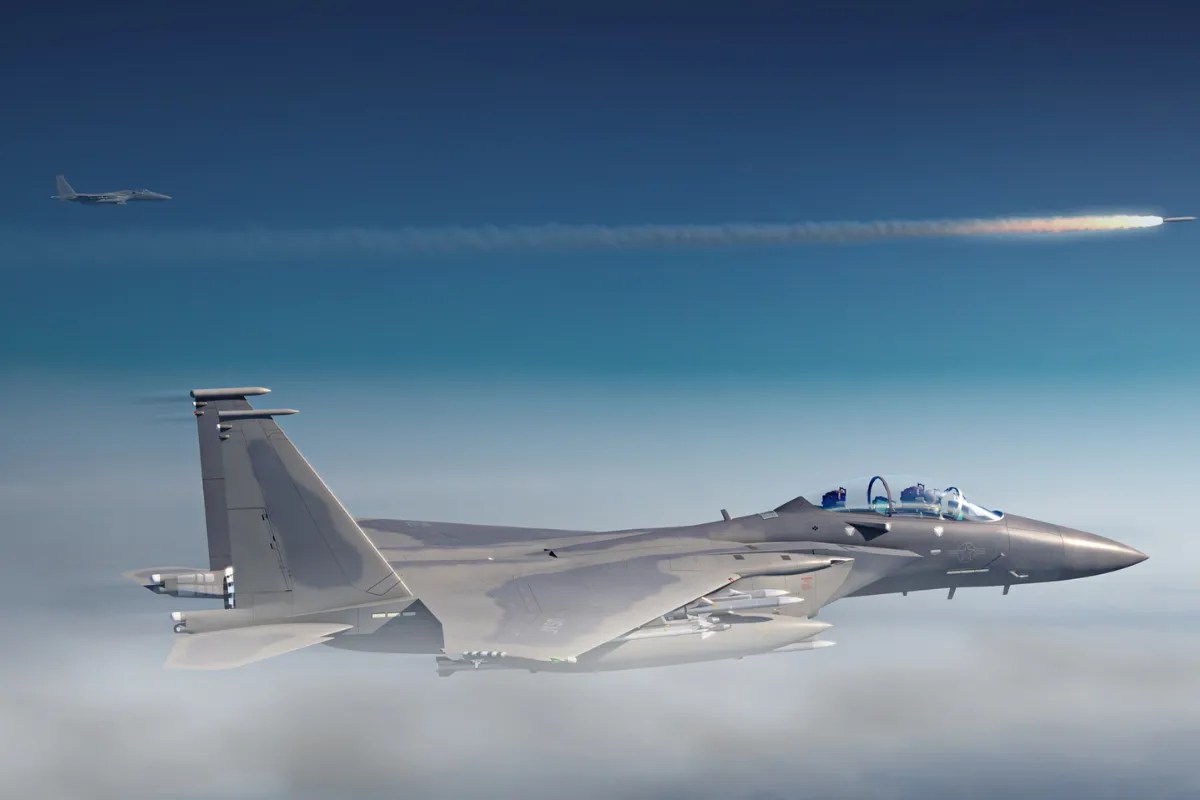
The night sky over the Middle East became a chaotic shooting gallery that pushed American aviation to its absolute limits. When Iran launched hundreds of ballistic missiles, cruise missiles, and one-way attack drones toward Israel, US Air Force F-15E Strike Eagle crews found themselves flying directly into a dense swarm of low-altitude threats. Pilots later described the experience as a grueling, claustrophobic ordeal, running out of missiles, relying on internal guns, and scrambling in pitch darkness against an enemy that relies on sheer volume. It was the most intense air-to-air engagement the Pentagon had seen in decades, but beneath the celebratory press releases lies a stark, uncomfortable reality.
Western air superiority is facing a structural crisis. Iran has not merely acquired drone-making technology; Tehran has perfected a doctrine of industrial-scale, low-cost aerial attrition that weaponizes the cost-imbalance of modern warfare. When a five-million-dollar interceptor missile is used to destroy a twenty-thousand-dollar drone made of fiberglass and lawnmower engines, the math favors the insurgent, not the superpower.
The encounter proved that the traditional American way of war is ill-equipped for this shift. For thirty years, the United States assumed it would always dictate the terms of the sky, operating from secure bases and deploying exquisite, expensive platforms against adversaries with no air power. That era is officially over.
The Night the Calculus Changed
During the massive Iranian salvo, F-15E crews from the 494th Fighter Squadron and the 335th Fighter Squadron were forced into a chaotic scramble. The sheer density of the incoming Shahed-136 drones overwhelmed standard radar screening protocols. These loitering munitions fly low, hug the terrain, and possess a minimal radar cross-section, making them exceptionally difficult to track with systems designed to intercept fast-moving Soviet-era fighter jets.
Air crews described a scenario where targeting sensors were flooded with signals. Pilots had to get dangerously close to the slow-moving drones to visually verify them using night-vision goggles, navigating the constant hazard of flying at high speeds near the ground in total darkness. The risk of mid-air collision with a drone, or even with another friendly aircraft chasing the same target, was a constant threat.
The tactical strain quickly became a logistical nightmare. An F-15E carries a limited payload of air-to-air missiles. Within the opening hours of the engagement, several aircraft completely depleted their air-to-air missile inventories. Pilots were forced to resort to their 20mm internal Gatling guns, a desperate, high-risk tactic that required closing the distance to within hundreds of feet of an explosive-laden drone.
At that proximity, the debris field from a destroyed drone can easily destroy a fighter jet's engine. One pilot later recounted that they ran completely out of ammunition, leaving them helpless to do anything but watch as more targets drifted past. While the military apparatus spun the event as a resounding success because most targets were destroyed, tactical insiders viewed it as a flashing red warning light.
The Anatomy of the Iranian Drone Program
Tehran did not achieve this capability overnight. It spent three decades bypassing international sanctions through a sophisticated, decentralized procurement network that treats consumer electronics as military-grade components. The Western intelligence community long dismissed these efforts as crude, labeling them "toy airplanes" unworthy of serious strategic concern. That dismissive attitude was a critical intelligence failure.
The Shahed series relies on a philosophy of aggressive simplicity.
- Propulsion: They use MD-550 two-stroke piston engines, which can be purchased on open commercial markets or easily reverse-engineered from German designs.
- Guidance: Instead of military-grade inertial navigation units, they utilize commercial GPS modules coupled with cheap, off-the-shelf microcontrollers that run basic flight paths.
- Airframe: Molded from cheap fiberglass and carbon composite materials, making them incredibly light and difficult for traditional air-defense radars to isolate from ground clutter.
By avoiding proprietary military tech, Iran insulated its supply chain from targeted sanctions. If a specific chip becomes unavailable, technicians alter the motherboard to use an alternative commercial chip available on any consumer electronics website. This fluid design philosophy means production lines in places like Isfahan never stop moving.
The real innovation is not the engineering of the drone itself, but the industrial capacity to produce them by the thousands. Iran converted old automotive factories and tractor plants into distributed manufacturing nodes. Components are shifted constantly between facilities using civilian transport networks, making the infrastructure nearly impossible to neutralize through conventional airstrikes alone.
The Cost Asymmetry That Is Breaking the Pentagon
The financial reality of modern air defense is unsustainable. To understand why the Pentagon is alarmed, one must look at the balance sheets of a typical engagement.
Consider a standard interception scenario in the skies above the Red Sea or the Levant. An Iranian-designed drone costs between $20,000 and $40,000 to manufacture and deploy. To bring it down safely, a Western warship or fighter jet typically fires an AIM-9X Sidewinder or an AIM-120 AMRAAM.
| Weapon System | Estimated Unit Cost | Target Cost | Financial Deficit Per Shot |
|---|---|---|---|
| AIM-9X Sidewinder | $500,000 | $20,000 | -$480,000 |
| AIM-120 AMRAAM | $1,000,000 | $20,000 | -$980,000 |
| SM-2 Standard Missile | $2,100,000 | $20,000 | -$2,080,000 |
This disparity means an adversary can spend roughly $2 million on a swarm of one hundred drones and force the defending nation to expend up to $100 million in rare, non-renewable missile stockpiles. The defense industrial base of the United States and its allies cannot build interceptor missiles fast enough to replace what is being used up in these skirmishes.
It takes defense contractors years to fulfill orders for complex guided missiles due to specialized component shortages and rigid manufacturing pipelines. Iran, meanwhile, can scale up its drone assembly lines by hiring low-skilled labor and sourcing more commercial electronics. The Pentagon is effectively trading scarce, high-end chess pieces to eliminate an infinite supply of checkers.
Proliferation and the Russian Connection
The threat is no longer confined to the geopolitical boundaries of the Middle East. The conflict in Ukraine served as a massive, live-fire testing ground for Iranian technology, accelerating the evolution of these systems at an alarming rate.
When Russia began purchasing Shahed drones, it did not just buy hardware; it bought the manufacturing blueprints. The construction of a massive drone production facility in the Alabuga Special Economic Zone in Tatarstan marks a dangerous evolution. Russian engineers, working alongside Iranian technical advisors, have modified the original designs to include automated production techniques, better electronic warfare resistance, and domestic Russian navigation systems like GLONASS.
This collaboration has created a feedback loop. Lessons learned on the battlefields of Ukraine—such as how to bypass Western-supplied air defense systems like Patriot and NASAMS—are immediately shared back with Tehran. The drones flying today are smarter, more resilient against electronic jamming, and capable of coordinating their flight paths to hit a single target simultaneously from multiple directions.
Furthermore, this technology has trickled down to non-state actors across Yemen, Iraq, and Lebanon. The Houthis have used these exact blueprints to disrupt global shipping lanes in the Bab al-Mandab strait, proving that a localized militia can hold global economic infrastructure hostage using tech provided by a regional sponsor.
The Technological Failure of Electronic Warfare
For years, the Pentagon insisted that electronic warfare would be the silver bullet against cheap drones. The narrative was simple: jam the commercial GPS signal, disrupt the command link, and the drone will crash harmlessly into the desert or the sea. This approach worked against early commercial quadcopters, but it has largely failed against the current generation of military-grade loitering munitions.
Modern Shahed variants do not rely on a continuous remote-control link with an operator. Once launched, they follow a pre-programmed set of coordinates using a rudimentary backup inertial navigation system. Even if the GPS signal is entirely jammed, the drone can maintain its trajectory using its internal sensors well enough to hit a large-scale target like a military base, an oil refinery, or a city center.
The Challenge of Optical Sensors
Newer models have been spotted with cheap optical cameras and basic machine-learning chips. These allow the drone to recognize the terrain below it or identify specific structures even when its electronic systems are completely blind. This level of autonomy completely neutralizes standard electronic jamming rifles and vehicle-mounted spoofers.
Frequency Hopping and Resiliency
The communication channels used for initial targeting have become highly adaptive. They utilize rapid frequency-hopping techniques that require immense computing power to isolate and disrupt in real time. By the time an electronic warfare system identifies the correct frequency to jam, the drone has already transitioned to another band or has reached the point in its flight path where it no longer requires external inputs.
The Deep Flaw in Western Defense Procurement
The root of this crisis is structural, buried deep within the bureaucratic machinery of Western defense ministries. The procurement system is built to design multi-billion-dollar platforms over decades. It excels at creating stealth fighters, nuclear submarines, and complex aircraft carriers, but it is utterly incapable of rapidly developing and fielding cheap, disposable countermeasures.
Defense giants have little financial incentive to build a cheap, $5,000 anti-drone system when they can lock governments into decades-long contracts for million-dollar missiles. The regulatory hurdles, testing requirements, and bureaucratic red tape mean that by the time a new defense system is approved for production, the drone technology it was designed to counter has already evolved through three generations.
Smaller, agile tech startups that try to offer cheap solutions are often choked out by the complex defense acquisition process. They cannot survive the years-long gap between demonstrating a working prototype and receiving an actual production contract. The result is a military force that remains hyper-optimized for a high-intensity war that may never happen, while losing an ongoing war of attrition right now.
To survive this shift, military planners must abandon the obsession with exquisite tech and embrace industrial scale. True security will not come from building a better fighter jet, but from inventing a cheaper way to knock a lawnmower engine out of the sky.


