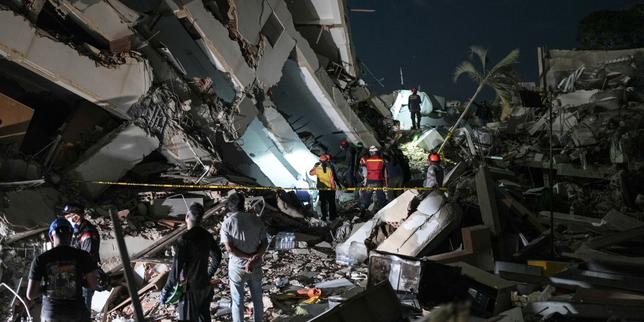
The occurrence of a magnitude 4.6 aftershock on June 29, 2026, centered near the Caracas-La Guaira corridor, exposes the systemic fragility of northern Venezuela’s structural engineering and disaster-response protocols. This tremor follows the catastrophic June 24, 2026, doublet earthquake event—a Mw 7.2 foreshock followed 39 seconds later by a Mw 7.5 mainshock along the San Sebastián fault system. While the immediate reporting focuses on civilian panic, an objective assessment requires a mechanical analysis of progressive structural fatigue, logistical bottlenecking, and macro-economic degradation. The disaster has generated an estimated $4.7 billion to $8.7 billion in direct asset losses, representing 4% to 8% of the nation's gross domestic product (GDP), while leaving over 46,000 individuals listed as unaccounted for.
The Mechanics of Doublet Rupture and Progressive Fatigue
The primary driver of the ongoing structural failures in Caracas and the coastal state of La Guaira is not the standalone force of the latest 4.6 aftershock, but rather the cumulative material degradation caused by the initial doublet sequence.
Seismological Timeline and Energy Propagation
On June 24, the rupture initiated near Morón along an east-west trending right-lateral strike-slip fault. The spatial and temporal mechanics of the sequence operated via specific kinetic phases:
- Phase 1 (The Foreshock): A Mw 7.2 rupture at a depth of 21.9 kilometers, producing up to 2.5 meters of slip. This initial energy release primed the fault plane and altered the local stress fields.
- Phase 2 (The Mainshock): Occurring 39 seconds later, a Mw 7.5 rupture manifested at a shallower depth of 10 kilometers. The rupture propagated eastward toward Caracas at a velocity of 3.0 to 3.5 kilometers per second, concentrating maximum slip (peaking at 4.49 meters) approximately 70 kilometers from the epicenter.
- Phase 3 (The Secondary Stresses): Over 300 subsequent aftershocks, culminating in the June 29 event, which redistributed high-frequency kinetic energy into already compromised foundations.
Structural Degradation Framework
To quantify why buildings that survived the June 24 events are now failing under minor aftershocks, engineering models utilize the concept of progressive structural fatigue.
[Initial Seismic Shock (Mw 7.2/7.5)]
                  │
                  ▼
[Micro-fracturing of Reinforced Concrete Core]
                  │
                  ▼
[Yielding of Internal Steel Rebar (Loss of Elasticity)]
                  │
                  ▼
[Minor Aftershock (M 4.6) Exploits Structural Creep]
                  │
                  ▼
[Catastrophic Shear Failure / Total Collapse]
When a reinforced concrete structure is subjected to the sustained, high-intensity lateral forces of a Mw 7.5 strike-slip event, the material passes its elastic deformation limit and enters the plastic deformation zone. Internal steel rebar yields, micro-fracturing occurs throughout the concrete matrix, and the bonding between the concrete and reinforcement degrades.
The June 29 aftershock acted as a mechanical trigger on these critically unstable systems. Structures exhibiting high structural creep—such as the 15-story residential high-rises and commercial hotels in La Guaira and the Altamira neighborhood of Caracas—are failing because their remaining load-bearing capacity has dropped below the threshold required to withstand even low-amplitude horizontal accelerations.
Logistical Bottlenecks in the Reconstruction and Rescue Phase
The survival window for individuals trapped beneath structural debris typically drops exponentially after 72 hours. Five days post-disaster, rescue operations face a compounding logistical bottleneck defined by geographic, political, and infrastructure constraints.
The Transit Interruption Index
The state of La Guaira is geographically isolated from the capital by the Cordillera de la Costa mountain range, relying on a highly concentrated transit network. The earthquake compromised these arteries via two primary failure points:
- The Caracas-La Guaira Highway Fracture: Landslides and lateral fault displacements tore the primary highway artery in multiple sections, reducing vehicular throughput capacity by an estimated 85%.
- Maiquetía International Airport Runway Compromise: The primary aviation hub suffered runway cracking and control tower subsystem failures, forcing a complete closure before its partial reopening for restricted humanitarian flights.
Because heavy earth-moving machinery cannot navigate the compromised mountain passes, initial search and rescue operations were forced to rely on manual labor. This decoupling of human capital from mechanical capability slowed the clearing rate of multi-layered reinforced concrete collapses to less than 5% of the standard operational target for urban search and rescue (USAR) teams.
Operational Fragmentation
The deployment of 14,000 military and police personnel, combined with the arrival of approximately 2,600 international personnel from nations including Switzerland, France, and the United States, created an administrative coordination deficit. The government's decision to restrict access to La Guaira via a strict permit system created a secondary bottleneck. This administrative barrier delayed the deployment of arriving international assets to the frontlines of the debris field by an average of 24 to 36 hours post-arrival.
Macroeconomic Impact and Financial Realities
The economic destruction of this seismic sequence shifts the country's financial trajectory from stagnation to acute structural deficit. Initial United Nations and independent economic assessments place the baseline direct damage between $4.7 billion and $8.7 billion.
| Asset Class | Estimated Capital Loss (USD) | Share of Total Damage |
|---|---|---|
| Residential High-Density Real Estate | $2.1 Billion - $3.8 Billion | 44% |
| Critical Infrastructure (Port, Air, Road) | $1.4 Billion - $2.4 Billion | 28% |
| Commercial & Tourism Assets (La Guaira) | $0.8 Billion - $1.6 Billion | 19% |
| Industrial & Utility Networks (Power, Gas) | $0.4 Billion - $0.9 Billion | 9% |
The true economic cost is highly likely to be 1.5 to 3 times greater than the direct asset asset valuation when accounting for secondary economic friction.
The Capital Loss Mechanism
The immediate suspension of economic activity in the port city of La Guaira halts a critical customs and import gateway for northern Venezuela. The physical destruction of two five-star hotels and multiple beachside commercial sectors removes the region's primary service-driven revenue engine.
The state's financial strategy relies heavily on the temporary suspension of certain international sanctions by Washington to facilitate aid delivery. This regulatory relief alters the capital flow dynamics, allowing the inbound transfer of foreign currency and emergency equipment. The long-term challenge resides in the capital reallocation framework. Directing domestic capital toward rebuilding non-productive residential infrastructure will necessarily starve the industrial, agricultural, and manufacturing sectors of investment capital for the next 36 to 48 months.
The Strategic Deployment Strategy for Structural Stabilization
To mitigate further loss of life from subsequent aftershocks and stabilize the northern macro-region, a clear sequence of engineering and logistical protocols must be executed.
Phase 1: Dynamic Structural Triage
Civil engineering assets must immediately move from qualitative visual inspections to quantitative structural health monitoring. Resources should be allocated using a three-tiered classification matrix:
- Category Red (Immediate Demolition): Buildings exhibiting a lateral tilt exceeding a 2-degree variance from the vertical axis or showing severe shear cracks in foundational columns. These structures must be cordoned off with a 1.5x height radius to prevent secondary damage to surrounding assets during further aftershocks.
- Category Yellow (Shoring and Stabilization): Buildings with localized structural damage but intact core shear walls. These require immediate mechanical shoring using structural steel jackets and timber cribbing to arrest progressive deformation.
- Category Green (Operational Safeguard): Structural frames showing no major structural fracturing, restricted to superficial facade damage. These can be utilized immediately as local supply depots or temporary medical triage units.
Phase 2: Decentralized Supply Chain Architecture
To counter the failure of the Caracas-La Guaira highway, logistics operators must shift from a centralized hubs-and-spoke delivery model to a decentralized maritime and aviation grid. Utilizing the partially repaired port infrastructure at La Guaira, supply chains should bypass land routes entirely, establishing a direct maritime corridor from regional offshore hubs to deposit survival assets directly onto the coastline.
The execution of these stabilization steps determines the floor of the ultimate casualty rate and establishes the baseline from which any future infrastructure reconstruction can begin. Focus must remain squarely on structural triage and logistical efficiency rather than long-term policy formulation.