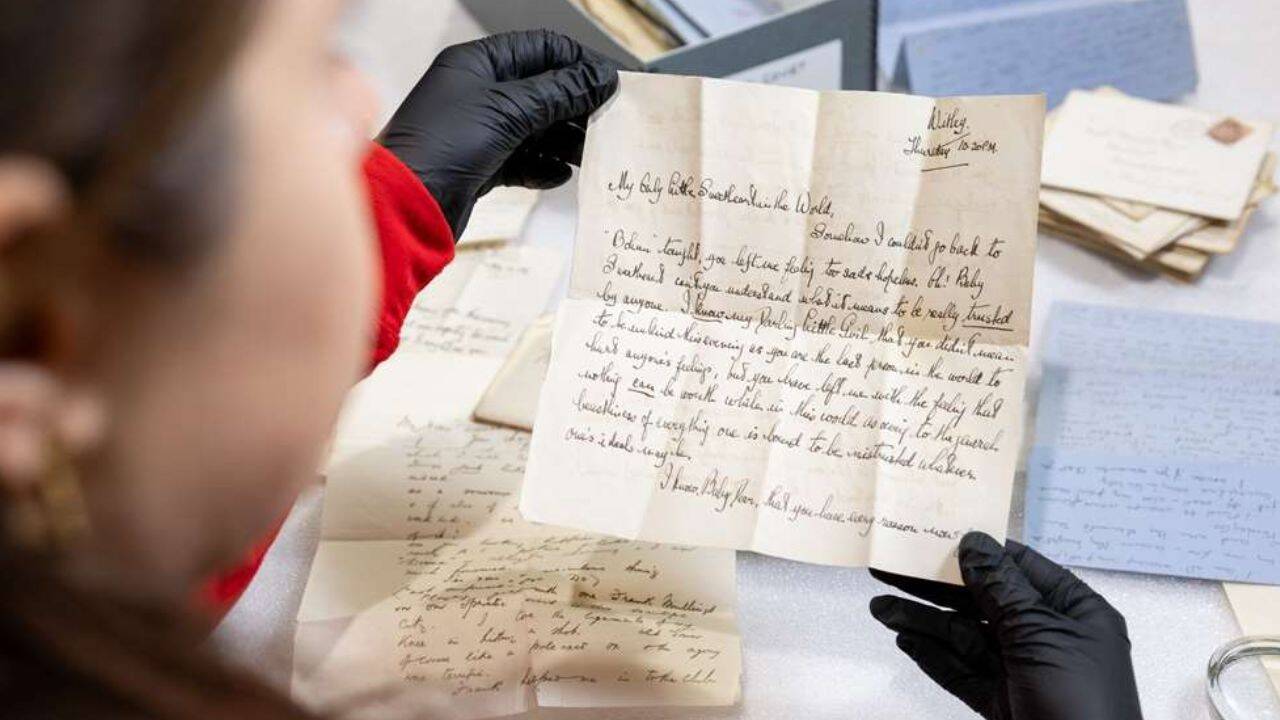
Cardboard has a very specific smell when it has been sitting in an attic for seventy years. It smells like dry dust, old glue, and the slow, quiet surrender of paper turning back into wood pulp.
Most of the time, when you pull down a battered shoebox from the top shelf of an estate sale or a dusty closet, you find nothing worth keeping. Tangled extension cords. Dried-out tubes of oil paint. Buttons snipped from coats that disintegrated during the Eisenhower administration. You toss the box into a dumpster and move on with your afternoon.
Except sometimes, the lid comes off, and a century of carefully curated history catches fire.
That is what happened with a cache of forgotten correspondence tied to Witley Court, the monumental Worcestershire ruin that once hosted royalty and symbolized the peak of Victorian excess. Inside an ordinary shoebox lay a collection of love letters—intimate, urgent, and entirely unauthorized by the rigid social architecture of the British aristocracy. They belonged to a Witley Court heiress, a woman raised inside a gilded cage where every handshake was weighed for political value and every marriage was a merger of land and bloodlines.
History books love bricks. They love architects, dates of construction, and the exact tonnage of Bath stone hauled across the English countryside to build fountains shaped like Perseus and Andromeda. What history books routinely erase are the people who had to breathe inside those monuments. They erase the suffocating weight of expectation. They erase the secret lives lived in the margins of respectable society.
The Architecture of a Cage
To understand why a bundle of paper in a shoebox matters, you first have to stand in the ruins of Witley Court and look up.
Even today, gutted by the catastrophic fire of 1937, the sheer scale of the place is aggressive. In the nineteenth century, the Earls of Dudley poured millions—the modern equivalent of hundreds of millions of pounds—into transforming an already massive country house into an Italianate palace. There were sweeping parterres, hundreds of servants moving through hidden corridors so the family never had to look at the labor keeping them warm, and dinner parties where the Prince of Wales sat at the head of the table.
Imagine growing up as a daughter in that house. Let us picture a young woman—call her Clara, though the ink on the real pages carries the weight of a specific, documented life—walking down a corridor so long the footsteps echo twice.
For a woman of that station, life was not a blank canvas. It was a contract signed before she could walk. Her body, her fortune, and her name were assets held in trust for the preservation of the family dynasty. Love was a charming concept for poets and milkmaids, certainly, and perhaps something you hoped might bloom politely after the wedding breakfast, once the lawyers had finished transferring the deeds. Passion, however, was dangerous. Unapproved passion was treason.
I have spent years sifting through estate archives and family papers, and there is a distinct physical sensation that hits you when you hold a letter that was never meant to survive. The paper is usually thinner than official stationery—easier to fold small, easier to tuck into a pocket or a writing desk with a false bottom. The handwriting starts neat at the top of the page, disciplined by years of governesses raping knuckles with rulers, and then, by the third paragraph, the slant changes. The ink pools slightly where the nib hesitated. The loops widen. You can literally see the writer’s pulse accelerating across the rag paper.
What the Ink Actually Says
When the Witley Court shoebox surfaced, historians and curators were not looking at state secrets. They were looking at something far more subversive: proof of an inner life that refused to kneel.
In the Victorian and Edwardian eras, aristocratic women were masters of the coded glance and the polite deflection. Publicly, an heiress of Witley Court was expected to glide through London seasons, accept the correct invitations, and eventually take her place beside a peer of the realm. Privately, the letters reveal a woman conducting a clandestine romance that bypassed every gatekeeper her family had paid to keep the world out.
Consider the logistics of secrecy before smartphones, encrypted messaging, or private cars.
You could not simply send a text at midnight. Every envelope entering or leaving a great house passed through the hands of a butler, a footman, or a postal runner. Envelopes were scrutinized. Handwriting was recognized. A recurring postmark from the wrong county—or worse, from a man without a title or an estate—was enough to trigger an immediate, quiet intervention. A sudden trip to the Continent. A stern conversation in the library. A locked door.
To maintain a secret relationship under those conditions required the tradecraft of a spy and the nerve of a gambler.
- Dead drops in plain sight: Letters slipped into books returned to a lending library, or passed through a trusted lady's maid whose loyalty had been bought with genuine affection rather than wages.
- Borrowed stationery: Writing on plain, uncrested paper rather than the heavy, embossed sheets bearing the family coat of arms, stripping away the very identity that gave her power in the outside world so she could be an equal in private.
- The tyranny of the hearth: Burning letters immediately after reading them was standard protocol for illicit lovers. The fact that this shoebox survived means someone broke the most basic rule of survival.
Why keep them?
That is the question that keeps archivists awake at night. Keeping incriminating letters was an act of staggering recklessness. If found during her lifetime, they would have meant social ruin—not just embarrassment, but total exile from the only world she knew how to navigate. If found by executors after her death, standard Victorian practice was to toss personal correspondence straight into the grate to protect the family reputation.
Someone chose not to burn them. Someone packed them into a box, tucked them away, and decided that the truth of who she loved was worth more than the lie everyone else agreed to tell.
The Lie of the Gilded Age
We have a terrible habit of looking at the past through the lens of costume dramas. We see the silk gowns, the gleaming silver, and the sprawling lawns of Worcestershire, and we mistake wealth for freedom. We assume that because these people had everything, they could do anything.
The truth is precisely the opposite.
The higher you climbed on the British social ladder in the late nineteenth century, the narrower the ledge became. A factory worker in nearby Birmingham had a brutal, exhausting life, short on calories and shorter on comfort, yet he could marry the woman he loved without consulting a solicitor or risking the collapse of a county's economy. At Witley Court, the air was perfumed with hothouse gardenias, and every breath was monitored.
Think of the psychological toll of living a double life inside a house with over a hundred rooms, yet not a single square foot that truly belonged to you.
When you read these recovered letters, the glamour of the aristocracy evaporates instantly. What replaces it is something raw, claustrophobic, and deeply familiar. It is the universal human panic of wanting something you are forbidden to have, combined with the quiet terror of being found out. The writers of these letters were not characters in a period piece. They were two people trying to build a tiny, warm room out of paper and ink while a blizzard of duty raged outside the window.
Why We Are Obsessed With Found Secrets
Every few years, a story like this breaks—a hidden compartment in a desk, a bundle of letters behind a skirting board, a shoebox in a cupboard—and the public leans in. We click. We read. We share.
Why do we care about a dead heiress and a romance that ended before our grandparents were born?
Because deep down, we suspect our own lives are just as heavily curated.
We live in an era of total exposure, where people broadcast their breakfasts, their breakups, and their political rage to strangers across the globe. Yet, paradoxically, we have never been more guarded. Our public selves are polished avatars designed to satisfy employers, algorithms, and social circles. We understand, intuitively, what it feels like to perform a role all day while keeping our real desires locked in a mental shoebox.
When a cache of secret letters survives the fire, it feels like a jailbreak. It proves that even the most formidable systems of control—whether a Victorian dynasty or a modern social expectation—have cracks. People still slip through. They still choose the wrong person. They still write things down that could destroy them, simply because the alternative—pretending they never felt anything at all—is a slower, quieter death.
The Fire and the Paper
There is a grim poetic justice in the fate of Witley Court itself.
In September 1937, while the owner was away, a fire broke out in the basement bakery. Because the house was so vast, and because the water pressure in the estate's grand fountains failed at the critical moment, the blaze tore through the central block unchecked. It burned for days. The roof collapsed. The gilded ceilings turned to ash. The limestone cracked from the heat, leaving behind the hollowed-out skeleton that English Heritage maintains today.
All that stone, all that iron, all that immense, intimidating wealth—reduced to charred timber and open sky in a single weekend.
Meanwhile, a fragile stack of paper, sitting quietly inside a cardboard shoebox miles away from the flames, survived intact.
Stone is heavy, so we think it is permanent. Paper is light, so we think it is weak. We get that entirely backward. Stone is rigid; when the heat comes, it fractures. Paper bends. It gets tucked into coat pockets, slipped under floorboards, forgotten in attics, and carried across decades until the people who would have burned it are all dust.
The heiress of Witley Court is gone. The men who tried to arrange her life are gone. The ballroom where she was expected to smile on cue is now a patch of grass open to the English rain.
All that remains is the voice in the box, still warm, still stubborn, still refusing to apologize for who she loved.