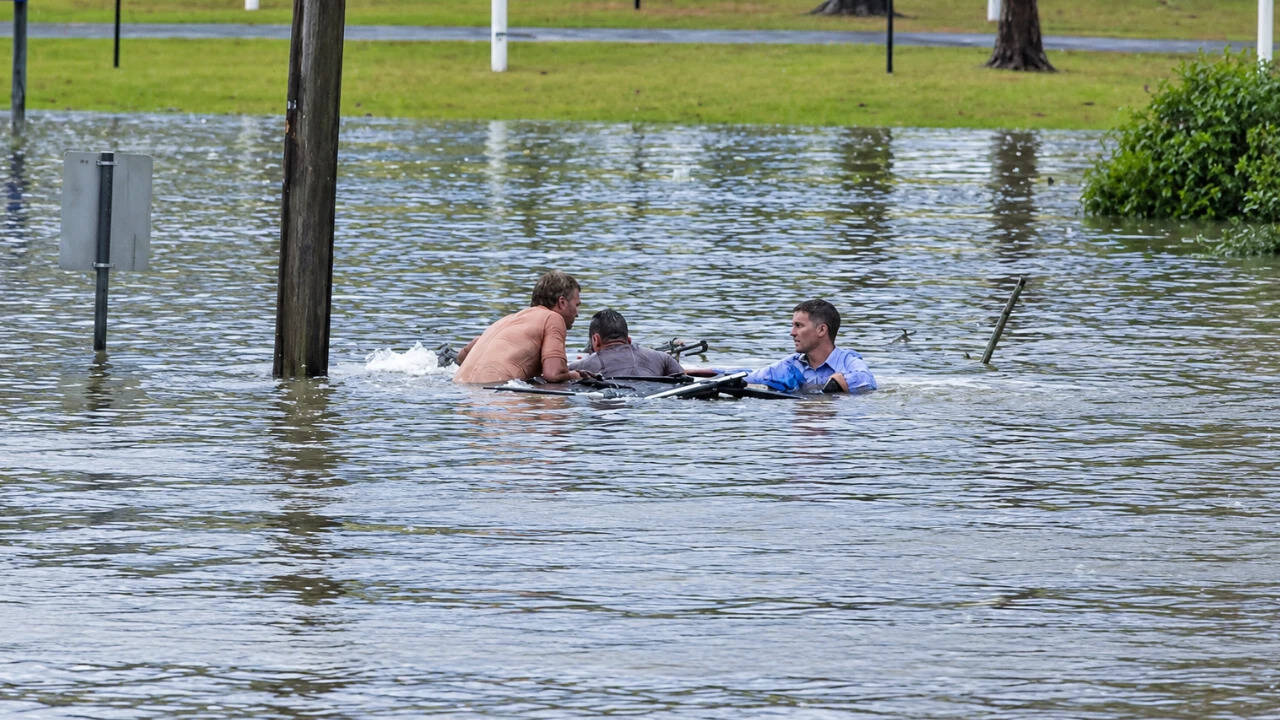
When an Australian television reporter and a passing bystander waded into rising floodwaters to pull a trapped motorist from a submerged vehicle, the footage became an instant viral sensation. Networks replayed the clip on a continuous loop, praising the split-second heroism of a journalist who dropped the microphone to save a life. Yet beneath the surface of that dramatic broadcast lies a deeply troubling reality about modern emergency reporting, public risk perception, and the structural failures of disaster infrastructure across flood-prone regions of Australia.
The incident itself followed a familiar, terrifying script. Heavy rainfall had overwhelmed local drainage systems, turning an ordinary stretch of road into a fast-moving torrent. A driver misjudged the depth and current, stalled out, and found the vehicle rapidly taking on water. Because a news crew was already positioned nearby to capture the severity of the weather event, the reporter and an alert member of the public were able to intervene before emergency services could arrive, physically extracting the motorist from the sinking cabin.
The Viral Heroism Trap
Media executives love a rescue story. It validates the presence of expensive outside broadcast vans in the middle of a storm and transforms a routine weather cross into a defining career moment for on-air talent.
However, decades of watching newsrooms operate during extreme weather events reveal a dangerous feedback loop. To get the most visceral, ratings-driving footage, producers routinely dispatch crews to the exact choke points where drivers are most likely to get into trouble. Flooded causeways, low-lying underpasses, and overflowing creek beds become makeshift television sets.
By standing next to a raging torrent in high-visibility rain gear, a reporter inadvertently sends a mixed message to the public. The spoken script usually warns viewers to stay off the roads and never drive through floodwaters. Meanwhile, the visual evidence shows a camera crew, a reporter, and often dozens of onlookers standing comfortably near the water's edge, normalizing proximity to a lethal hazard.
The Psychology of the Flooded Crossing
Why do drivers continue to enter floodwaters despite relentless public safety campaigns? The answer is rarely sheer recklessness. Most motorists who end up stranded are victims of sensory deception and routine bias.
Water obscures the road surface entirely. What looks like a shallow puddle across familiar asphalt can actually be a washed-out culvert or a dip several feet deep. Furthermore, human eyes struggle to gauge the velocity of murky water from inside a vehicle cabin.
A hypothetical example illustrates how quickly the physics turn lethal. Imagine a standard mid-size sedan weighing roughly 1,500 kilograms entering water that is just 30 centimeters deep. At that depth, the water reaches the underside of the chassis, creating buoyancy that dramatically reduces the downward pressure of the tires on the road. If that water is moving at just a walking pace, the lateral force exerted against the side of the vehicle is enough to break traction, sweeping the car sideways into deeper channels where the engine floods, electrical systems short-circuit, and doors become pinned shut by external water pressure.
When Journalists Become First Responders
The moment a journalist steps into floodwater to perform a rescue, the fundamental rules of both journalism and emergency management collide. Reporters are trained to observe, verify, and document. They are not trained swift-water rescue technicians.
Swift-water rescue is one of the most technically demanding disciplines in emergency services. Professional responders undergo rigorous training in hydrology, rope systems, tethered swimming, and defensive positioning to avoid foot entrapment—a leading cause of death where a rescuer's boot gets wedged between submerged rocks, allowing the current to push them underwater.
When a reporter and a bystander enter moving water without personal flotation devices, throw bags, or tether lines, a successful outcome relies heavily on luck. Had the current surged a fraction faster, or had the roadbed collapsed beneath their feet, emergency crews would have arrived to find three victims instead of one.
The Legal and Ethical Minefield
News networks operate under strict workplace health and safety legislation, particularly in Australia, where corporate liability for placing employees in foreseeable danger carries heavy penalties. Every major broadcaster maintains detailed risk assessment protocols for severe weather coverage.
Those protocols almost universally forbid staff from entering floodwaters. Yet when a camera is rolling and a human life is visibly in danger just meters away, corporate policy evaporates. No human being with a conscience stands on dry ground filming a person drown while waiting for a rescue boat that might be twenty minutes away.
This creates an impossible ethical bind for field journalists. They are sent into hazardous zones to capture dramatic visuals, explicitly told not to take physical risks, and then thrust into scenarios where the only moral choice is to violate those safety directives. Once the rescue succeeds, the same network managers who drafted the safety rules will proudly broadcast the footage as a testament to their team's bravery.
The Bystander Factor in Australian Disasters
The presence of a bystander alongside the reporter in this rescue highlights a defining characteristic of Australian emergency response. Across regional towns and outer suburbs, local residents are almost always the true first responders.
Australia's geography ensures that emergency services—whether state emergency volunteers, fire brigades, or police—face immense response distances during widespread weather events. When a major east coast low or tropical rain system stalls over a catchment, triple-zero call centers are inundated within minutes. Volunteer crews are stretched thin across hundreds of square kilometers of damaged infrastructure.
In that gap between the onset of an emergency and the arrival of trained professionals, ordinary citizens step in. Bystanders bring local knowledge of the terrain, utility vehicles, tractors, and sheer physical grit.
Yet relying on bystander intervention is a symptom of systemic vulnerability, not a viable disaster management strategy. For every viral success story where a passerby pulls a driver to safety, there are quiet tragedies where would-be rescuers are swept away alongside the person they tried to save.
Infrastructure Failures Hidden by Dramatic Footage
Focusing exclusively on the heroism of the rescue lets local councils, state planners, and road authorities off the hook. A motorist stalling in floodwaters is rarely an isolated incident; it is usually the predictable result of known infrastructure bottlenecks.
Many Australian road networks were engineered decades ago based on historical rainfall data that no longer reflects modern weather extremes. Culverts are undersized. Drainage channels are choked with debris and sediment. Low-lying bridges lack automated boom gates or flashing electronic warning signs that activate when water levels rise.
Instead of physical barriers that prevent vehicles from entering dangerous crossings, authorities rely heavily on passive metal signs that read "Road Subject to Flooding" or "If It's Flooded, Forget It." Passive signage fails precisely when it is needed most—at night, during blinding rain, when visibility is near zero and drivers are stressed, fatigued, or unfamiliar with the area.
The Cost of Reactive Engineering
Upgrading flood-prone crossings costs millions of dollars per site. Raising bridge decks, installing automated flood gates, and widening drainage corridors require sustained capital investment that rarely wins political points until a disaster strikes.
Consequently, municipalities default to cheaper behavioral messaging campaigns. They place the entire burden of safety on the individual driver's judgment while leaving the physical hazard open and accessible. When a driver inevitably makes a fatal error in judgment, the narrative frames it solely as individual foolishness rather than a failure to engineer out a known lethal trap.
The Economics of Extreme Weather Journalism
To understand why news crews keep ending up in the middle of these rescues, you have to look at the changing economics of broadcast television. Traditional linear TV is locked in a brutal fight for survival against streaming platforms and social media algorithms.
Live, unscripted drama is one of the few remaining assets that traditional newsrooms can monetize effectively across both broadcast and digital channels. A dramatic rescue clip generates millions of views on social media platforms, drives traffic to news websites, and boosts nightly bulletin ratings.
This commercial reality subtly shapes editorial decision-making during storms. Producers are under immense pressure to deliver "active" shots rather than static updates from a dry studio. That pressure pushes crews closer to the water line, closer to burning bushfire fronts, and deeper into unstable disaster zones.
The Illusion of Control
Modern broadcast technology amplifies this risk. Lightweight cellular bonding backpacks allow a two-person crew—a reporter and a camera operator—to go live from virtually anywhere without the logistical footprint of a traditional satellite truck.
While this mobility allows journalists to reach isolated communities quickly, it also strips away the natural friction that used to keep crews out of extreme danger. Two people working alone in driving rain do not have a safety officer watching their flanks. They are focused on framing the shot, checking audio levels, and listening to a producer talking in their earpiece while the water rises around their ankles.
Reforming Storm Coverage and Road Safety
Breaking this cycle requires honest reckoning from both media organizations and infrastructure authorities. Neither side can afford to keep treating near-miss rescues as feel-good news stories.
For newsrooms, genuine duty of care means establishing hard operational boundaries before a storm hits. Crews should never be stationed at unbarriered flood crossings where drivers are actively attempting to pass, unless emergency services are already on scene controlling traffic. Broadcasters must also examine how they frame these incidents on air—celebrating the human instinct to help while explicitly detailing the lethal dangers the rescuers faced, rather than presenting the event like an action movie sequence.
For transport and emergency agencies, the priority must shift from slogans to physical intervention. High-risk flood crossings need automated physical barriers, active depth gauges with high-intensity strobes, and real-time integration with consumer navigation apps so drivers are routed away from flooded roads long before they see water on the asphalt.
A rescue caught on live television is a triumph of human decency in a moment of crisis, yet every time a journalist has to drop a microphone to pull a stranger from a sinking car, it marks a collective failure of road engineering, emergency planning, and broadcast restraint.