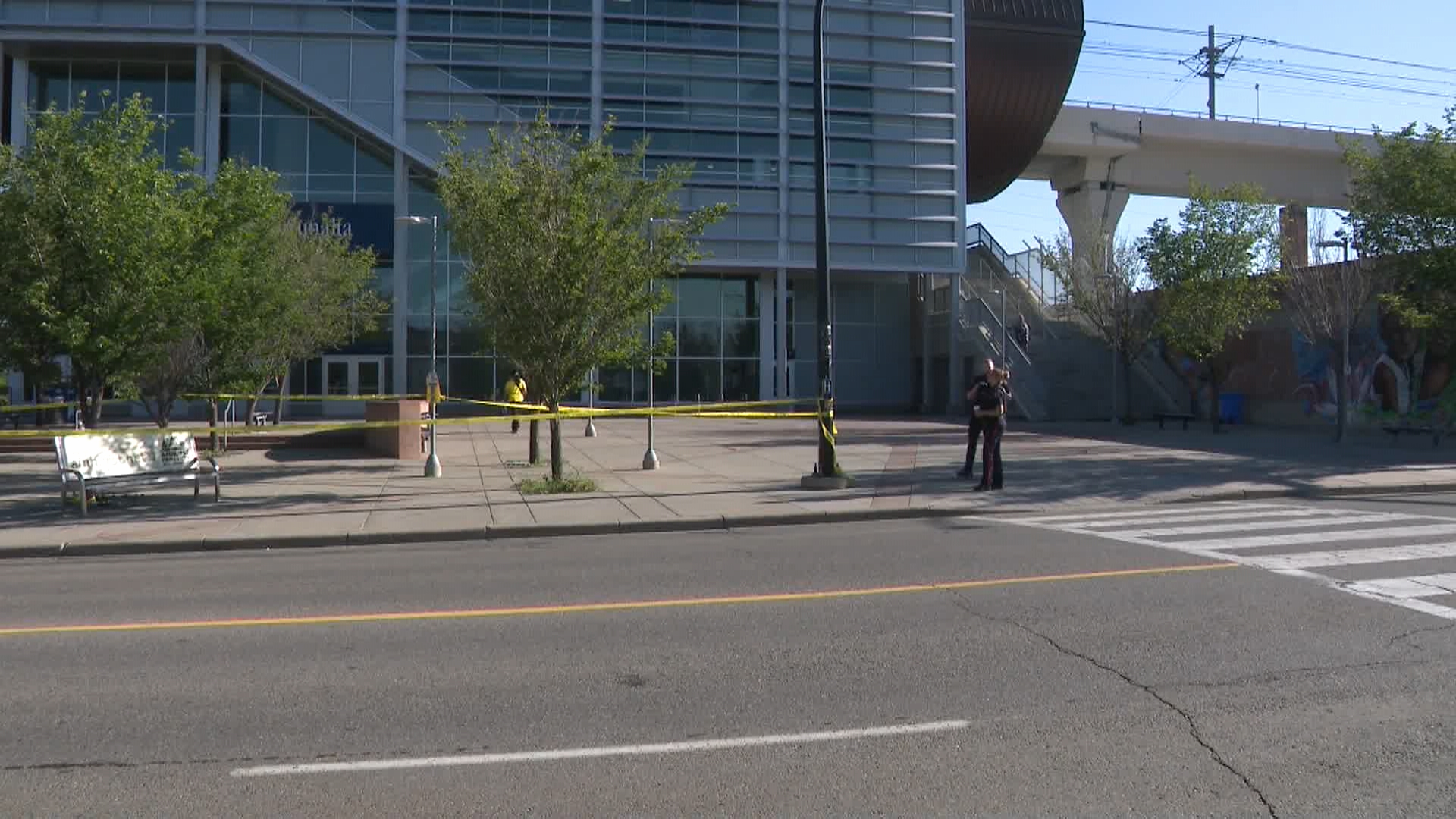
A man gets charged in downtown Calgary after a brutal stabbing leaves a victim fighting for their life. The local news cycle springs into action with its predictable, rubber-stamp choreography. You get the yellow police tape footage, the standard line about the suspect being remanded in custody, and the inevitable wave of neighborhood anxiety.
Then come the predictable demands from the public: more boots on the ground, harsher sentencing, and tighter security corridors.
It is a comforting script. It is also entirely useless.
Mainstream crime reporting suffers from a systemic fixation on isolated, reactive events while completely ignoring the structural decay of urban bail systems, mental health triage failures, and the statistical reality of random violence. When we treat a critical incident like a sudden, unpredictable lightning strike, we fail to recognize that the storm was engineered by policy years ago.
Stop looking at individual crime scenes to understand urban safety. You are asking the wrong questions, looking at the wrong data, and demanding solutions that actually accelerate the chaos.
The Illusion of the Random Attack
The immediate reaction to any severe public stabbing is a spike in localized panic. People look at transit hubs and public squares and see a dangerous lottery.
But true randomness in violent crime is a statistical anomaly. When you audit the history of violent offenders in mid-sized North American cities, a stark pattern emerges. The vast majority of these incidents are committed by individuals who are already intimately familiar with the justice system. They are not ghosts; they are individuals with extensive paper trails of revolving-door arrests, breached probation conditions, and failed court appearances.
By framing these events as sudden, unpredictable explosions of violence, media outlets shield the administrative state from accountability. The issue is rarely a lack of police presence at the exact intersection where a blade is drawn. The issue is a broken risk-assessment apparatus that releases high-risk, chronic offenders back into dense public spaces under the naive assumption that a set of paper conditions will deter a broken mind.
Why More Police Officers Won't Fix the Root Failure
The knee-jerk policy response to high-profile stabbings is always the same: deploy more uniform presence to the area.
I have spent years analyzing municipal budgets and public safety deployments. Flooding a transit platform or a downtown block with police officers creates a temporary displacement effect, not a reduction in violence. The crime simply migrates three blocks over, outside the immediate view of the patrol unit.
More importantly, a police officer cannot act as a permanent, individualized mental health shadow or a round-the-clock bail supervisor.
Standard Policy Cycle:
Public Outcry -> Increased Patrols -> Crime Displaces -> Budget Exhausted -> Patrols Recede -> Incident Recurs
The real breakdown happens long before the police are dispatched to a stabbing in progress. It happens in provincial courtrooms and remand centers where the legal threshold for holding potentially dangerous individuals has been systematically eroded. When the justice system prioritizes the rapid processing and release of chronic offenders over public preservation, the street becomes the de facto containment zone. Police officers are forced to act as high-stakes janitors, cleaning up the mess of a judiciary that refuses to do its job.
The Hard Truth About Bail Reform and Accountability
Let us dismantle the core defense of the current legislative environment. Proponents of relaxed bail conditions argue that pretrial detention must be minimized to protect individual liberties and prevent the overcrowding of correctional facilities.
That sounds noble in a law school seminar. On the pavement of a major city, it plays out as a preventable tragedy.
When we look at the data surrounding chronic violent offenders, we find that a tiny fraction of the population is responsible for an overwhelming percentage of violent disorder.
- The 5% Rule: In most urban centers, less than five percent of the offending population drives over half of the violent emergency calls.
- The Breached Order Paradox: A significant portion of individuals arrested for weapons offenses are already under active court orders explicitly prohibiting them from carrying weapons.
To suggest that further restrictions or standard monitoring will change the behavior of someone who has already demonstrated total contempt for the court is a delusion. The downside to a highly restrictive bail system is administrative cost and potential legal challenges; the downside to our current permissive system is a human being bleeding out on a downtown sidewalk. We have chosen to accept the latter to avoid dealing with the former.
Dismantling the "People Also Ask" Contradictions
Whenever a major city experiences a spike in public weapons offenses, the search engines light up with predictable queries. The answers provided by public officials are almost always calculated to soothe rather than inform.
Is downtown Calgary safe to walk in at night?
This is a fundamentally flawed question. "Safety" is not a uniform geographic state. A downtown core can be perfectly safe for 95% of its users while remaining a high-risk environment for vulnerable populations trapped in proximity to illicit drug economies and housing deficits. Asking if a city is safe ignores the micro-climates of crime. Safety depends entirely on whether your local justice system has allowed a specific block to turn into an open-air asylum.
What are the main causes of rising knife crime?
The conventional wisdom points to poverty, systemic inequality, and lack of social programming. While those are long-term societal challenges, they do not explain the acute, immediate spikes in violent weapon use. The proximal cause of rising public knife crime is the systemic failure to incapacitate individuals who have a documented history of weapon possession. When carrying an illegal blade carries zero meaningful custodial consequences upon arrest, carrying a blade becomes a rational choice for actors in the street economy.
The Playbook for Real Urban Safety
If we want to stop reacting to stabbings after the fact, we have to entirely upend our approach to public disorder. This requires moving past the political posturing from both the left and the right.
- Targeted Incapacitation, Not Mass Incarceration: We do not need to lock up every low-level offender. We need to identify the core group of chronic, violent, non-compliant individuals and remove them from public spaces permanently until they are stabilized.
- End the Pretrial Release Loophole: If an individual is arrested for a violent crime while on bail or probation for a previous violent crime, their right to automatic release must be entirely revoked. No exceptions.
- Mandatory Institutional Stabilization: If an individual cannot function in a public space without posing a mortal threat to strangers due to severe mental degradation or substance-induced psychosis, they must be placed in secure, long-term involuntary care. Releasing them to a shelter with a court date is an act of institutional cruelty disguised as progressive policy.
The current system is built on a foundation of profound cowardice. It asks everyday citizens, commuters, and shop owners to absorb the risk of violent crime so that bureaucrats can maintain the fiction that our current corrections and healthcare systems are functioning.
Every time a press release drops announcing charges against a man who should have been behind bars months ago, the system isn't failing. It is working exactly how it was designed to work. It protects the administrative state, manages the optics, and leaves the public to dodge the blades. Stop asking for more police. Demand a justice system that values the life of the victim more than the convenience of the court docket.