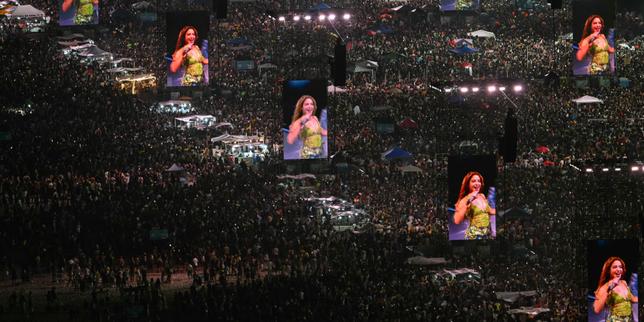
The global explosion of Spanish-language music has spent years relying on a predictable formula of polished reggaeton rhythms and clean pop hooks designed for maximum streaming efficiency. This assembly-line approach is hitting a wall of creative exhaustion. Amid this stagnation, Puerto Rican singer-songwriter RaiNao is leading a quiet rebellion against the genre's rigid commercial boundaries. By fusing classic underground club beats with experimental electronic textures and highly personal, unpolished lyricism, she has captured the attention of a demographic weary of corporate pop. Her rise is not an accident of the algorithm, but a deliberate execution of avant-pop defiance that challenges how Latin urban music is produced, packaged, and consumed.
The broader music market is experiencing a quiet crisis of uniformity. Major labels have long prioritized predictable streaming metrics over artistic risk, resulting in a landscape where many charting singles sound like variations of the exact same track. RaiNao, born Naomi Ramírez, rejects this flattening of sound. Her work acts as a blueprint for survival in an industry that often demands compromise from independent artists.
The Architecture of Sonic Disruption
To understand why RaiNao matters, one must look at the mechanics of her sound production. Standard commercial urban tracks rely heavily on quantized drum patterns that fit perfectly into digital audio workstations, creating a sterile, predictable bounce. RaiNao complicates this. She injects sudden tempo shifts, distorted basslines, and jazz-influenced vocal phrasing that deliberately disrupt the listener's expectations.
Her breakthrough projects do not abandon the roots of Puerto Rican music; instead, they deconstruct them. She strips the traditional reggaeton dembow riddim down to its bare essentials, then overlays it with dark synthesizer chords reminiscent of 1980s synth-wave and experimental Euro-club music. This tension between the familiar and the alien keeps the listener off-balance. It forces active engagement rather than the passive listening that background streaming playlists usually encourage.
This sonic friction serves a specific purpose. By refusing to smooth out the rough edges of her production, she carves out a distinct identity that cannot be easily replicated by artificial trend-chasing.
The Economics of the Anti-Algorithm
The current music economy rewards high-volume output. Artists are pressured to release singles every few weeks to stay relevant on digital platforms, a cycle that often drains creative depth. RaiNao has taken the opposite approach, focusing on cohesive, long-form bodies of work that demand to be heard from start to finish.
This strategy carries significant financial risk. Independent distribution lacks the massive marketing budgets of major conglomerates, meaning an artist relying on complex, album-length narratives must build a hyper-loyal fanbase from the ground up.
- Direct Audience Engagement: Prioritizing intimate live performances over viral social media stunts builds long-term touring viability.
- Creative Autonomy: Retaining ownership of master recordings allows for uncompromising aesthetic choices.
- Niche Monopolization: Dominating a specific sub-genre creates a more stable economic foundation than competing for broad, fickle pop audiences.
The data suggests this slow-burn approach pays off. While viral novelty tracks spike and disappear within a month, artists who cultivate a distinct subculture maintain steady, growing streaming numbers and, more importantly, consistent ticket sales. Live touring revenue remains the truest measure of an artist's cultural staying power, and that cannot be faked with bought playlist placements.
Breaking the Lyric Template
Beyond the instrumentation, the lyrical content of mainstream Latin pop has largely been sanitized for global corporate sponsorship. Songs are frequently engineered to be universally applicable, stripped of hyper-local slang or complex emotional ambiguity. RaiNao rejects this sanitization entirely.
Her pen is sharp, specific, and unapologetically queer. She documents the nightlife of San Juan not as a glamorous VIP caricature, but with the gritty, humid realism of someone who lived it. Her narratives dive into the messy realities of modern relationships, fluid identity, and the psychological toll of urban isolation. She uses localized Puerto Rican vernacular that doesn't bend to satisfy an international audience unfamiliar with the dialect.
This insistence on hyper-locality creates a paradox. By being intensely specific to her environment and her personal identity, her music achieves a raw authenticity that resonates deeply with listeners worldwide who are tired of watered-down, universal pop platitudes. Audiences can spot corporate-mandated inclusivity from a mile away; they gravitate toward RaiNao because her perspective is inherent to her art, not a marketing checklist.
The Overlooked Producer Factor
Conversations around solo artists frequently ignore the crucial collaborative ecosystems that make their breakthroughs possible. RaiNao’s sonic identity is heavily shaped by her work with underground producers who share her disregard for conventional radio formats.
In a typical studio setup, a producer hands a pre-made beat to an artist, who then records vocals over the top. This separation of duties often results in a disjointed track. RaiNao works symmetrically with her production teams, treating the human voice as an instrument that can be chopped, distorted, and rearranged just like a drum sample.
Consider a hypothetical scenario where an artist wants to convey anxiety. A conventional pop track might use a sad chord progression. RaiNao and her team would instead introduce a subtle, asynchronous clock-like click in the background or artificially degrade the vocal quality to mimic a panic attack. This level of detail requires deep studio chemistry and a shared willingness to discard standard mixing handbooks.
Reclaiming the Underground Identity
The lifecycle of any underground movement involves a constant battle against commercial co-optation. As major labels notice the growing cultural capital of alternative Latin artists, they inevitably attempt to sign them and soften their style for mass consumption.
The true test for RaiNao and her peers in the new wave of Latin avant-pop will be their ability to scale their operations without losing the radical independence that made them vital in the first place. History is littered with underground innovators who signed major deals only to see their subsequent albums buried or watered down by committee thinking.
Remaining independent requires a rigorous understanding of the music business. It means investing in independent distribution networks, mastering the complexities of publishing rights, and understanding that sustainable growth is always superior to a fleeting moment of hyper-visibility. RaiNao is proving that an artist can command the stage, influence fashion, and dictate the cultural conversation without surrendering her masters or her message to a boardroom.
The future of Latin music does not belong to those reproducing the safe sounds of five years ago. It belongs to the innovators willing to alienate the casual listener to build something built to last.